


The Public Display of Queer History
BY John D'Emilio ON November 26, 2014
Last month I made a trip to Cleveland to lecture at Case Western Reserve University. While there, I paid a visit to the Western Reserve Historical Society which currently has an exhibit on the LGBT history of northeast Ohio. The exhibit relies on materials in the collections of the Historical Society and moves from the 1930s forward to the present.
For the earlier period, it centers on life stories of some prominent members of Cleveland society who, while not “out” in the way we use that phrase today, were known to be gay – individuals like Winsor French, a Cleveland Press reporter; Leonard Hanna, Jr, a philanthropist; and Jerome Zerbe, a celebrity photographer. As the exhibit moves into the 1970s, the content becomes more overtly political and activist in its emphasis. Cleveland’s What She Wants, a feminist monthly magazine, which began publishing in 1973 is well-represented, as well as materials from the All-Ohio Gay and Lesbian Conferences that were a fixture of the 1980s.
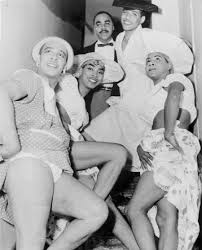
Performers in Chicago’s Queer Bronzeville
The exhibit, which is well-placed on the ground floor not far from an entrance, is hard to miss if you are visiting the Historical Society. It was a reminder to me of how important such public displays of LGBT history are and how almost unimaginable they would have been a generation ago. Three years ago, the Chicago History Museum mounted a major exhibit, “Out in Chicago,” that was curated by Jill Austin and Jennifer Brier. It was extraordinary. Organized thematically rather than chronologically, it filled something like five galleries in the museum, with photos, art, objects, music, film, newspapers, clothing, organizational materials, and video. Its time frame stretched from the mid-19th-century to the present. It was so rich that I found it impossible to take it all in on a single visit, and I’m someone who already knows a lot of queer history. Squadrons of students from the greater Chicago area visited the exhibit, and I could only imagine what an eye-opener it would have been for them, given how non-existent LGBT history is in high school classrooms.
The same year as the Chicago exhibit, 2011, the GLBT History Museum opened in San Francisco in the Castro district. Though it only occupies one large room in a storefront on 18th Street, the Museum’s exhibits are so rich and carefully organized that, on my visit, I felt as if I had worked my way through several halls of a museum. It is the first such museum in the world, and its opening attracted world-wide attention, with media coverage in dozens of nations and languages.
While the web represents a relatively new medium of communication that, through sites like OutHistory and others, is becoming a vehicle for the dissemination of LGBT history, museums and historical societies are public spaces that have been with us a much longer time but are now starting to display these histories. In presenting queer history outside the academic world, they help to make it part of public life. Cleveland, Chicago, and San Francisco are just three examples. I know there are more spaces that have already displayed this history. It would be a great project for local people to press more institutions to make LGBT history visible in their communities. What an achievement that would be!
Comments