

Looking back and Listening: Memories of Stonewall
BY Chris Gioia ON June 27, 2017
“Sheridan Square this weekend looked like something from a William Burroughs novel as the sudden specter of ‘gay power’ erected its brazen head and spat out a fairy tale the likes of which the area has never seen.” [1] This is how Lucian Truscott IV rather disparagingly characterized the Stonewall rebellion of 1969 in his eyewitness account published in the Village Voice on July 2nd of that year. The event was indeed something never before seen in New York City’s West Village, but was not the first time LGBT people stood up to police harassment. The Black Cat Tavern raid in Los Angeles and the Compton’s Cafeteria riots in San Francisco a few years prior also saw members of the community fight back against unfair treatment, police brutality and discriminatory laws that targeted the most unambiguous members of the community.
Its hard to imagine that in New York City in 1969, laws prohibited members of the same sex dancing together, restricted the sale of alcohol to homosexuals and penalized those who wore articles of clothing of the opposite sex, but it would take years of activism and action to have these officially taken off the books in the following decades. So, how did the Stonewall Inn become the birthplace of LGBT civil rights? Many details are hard to nail down and many debates have focused on the myths and mysteries of the Stonewall incident, but specific memories and stories help to paint a picture of the place and of the times. Bars like the Stonewall Inn represented a kind of reluctant haven for New York City’s downtown gay scene. Most patrons had a love hate relationship with the bar and its mafia controlled operators. The drinks were weak and over priced, the ambiance was dive bar but the vibe was by most accounts intoxicating if not fully liberating.
Bruce Monroe, who was a college student visiting from Indiana in 1969, describes his memory of Stonewall to me:
I remember … two dance floors and a big long wall down the middle. But I remember it being a very young lively crowd that I could relate to. It was like really exciting to see all these other young men that were around my age. I guess it was one of the most popular places for dancing in NY at that- there weren’t very many places around like that. And I remember having a great time there and I remember having to leave by myself because my friends had found elsewhere to spend the evening.
Historian John D’Emilio’s experience of the West Village as a college student in the late 1960’s is of a “whole gay world.” On two occasions he visited the Stonewall Inn with a friend and remembers the following:
. . . so anyway we go to Stonewall and of course the thing that was immediately apparent to me I mean besides the fact that it was, unlike Julius’ where there were a lot of people but it was conversation, and it was kind of quiet, Stonewall was wildly noisy and what do they have, but go go boys who were dancing you know, up on a platform wearing you know, kinda nothing, like a g-string, or just underpants, and it seemed very exciting to see and experience something like that!
Author Felice Picano has written about Stonewall and been involved in gay literature/publishing since the 1970’s. He wasn’t a fan of Stonewall in 1969, but recalls that it could be useful:
. . . if you found somebody interesting and you sorta wanted to feel them up and feel them out before you took them home you’d take them around the corner to the Stonewall and slow dance in the dark and figure out what you wanted . . . it became by the time the incident happened, a place for trannies and for people who were not quite street people but almost, and sometimes the hustler boys who would hang out in front of it in the park in Sheridan Square would go in too. So it had this very, very mixed vibe and, and I was always hearing that it was closing down, that it was going bankrupt.
Trans activist Miss Majors introduces her story to Felice Picano in a rare correspondence:
Miss Majors: I’d had a tough day, and I heard that that singer Judy Garland had died. I wasn’t a fan of hers, but I didn’t feel like being alone, so I went down to the Stonewall. That was our club, where the other “T’s” and I could hang out and relax and be ourselves. [2]
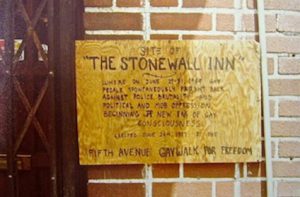
Stonewall Plaque placed in 1977 by the 5th Ave. Gay Walk of Freedom. LGBT Community Center Archives, Grillo Collection.
Pioneering gay journalist Mark Segal provides a first hand account of being inside the bar that night:
I remember the lights flashing. I remember asking somebody …“what does that mean?” And someone said, “Oh we’re just going to be raided!” And everybody who was a regular there took that very nonchalant. They were just used to it cause that was part of what life was like for gay people at that point. Me on the other hand had never been through a raid. I tried to look nonchalant but I gotta tell you its not –[laughs] I was very nervous. … As people were coming out they started forming a semi circle around the door and that eventually – and as the police let out more and more people at one point the only people left in the bar or most of the people left in the bar were the people that worked there and the police. At which point people just started throwing things at the door. Um, [sigh] that’s basically when people started breaking things, running up and down the street. [3]
Activist Martha Shelly recalls in my interview with her last year, how the liberation movement was energized by Stonewall:
Monday I read about the riots in the newspaper and I thought that was what it was about! I read about the Stonewall Riot in some small article in the New York Times or the New York Post I don’t remember which and I immediately called . . . Jean Powers and she was the person who was getting out the newsletter and organizing meetings. I called her and said we have to have a protest march. She told me to call the head of the Mattachine Society and she said if they’re interested we could jointly sponsor it. …So I called Dick Leitsch who was the head of the Mattachine Society. He said they were having a meeting at Town Hall to discuss all of these things and what it meant for the gay community and come to the meeting and put my proposal out and that’s what I did.
Craig Rodwell, owner of the Oscar Wilde Memorial bookshop on Mercer St. at the time of the riot, sums up the significance of Stonewall:
Immediately I saw that this was something that was going to have an impact in the future for the movement because I’d been saying for years that something would happen- there would be a spark. I recognized instantly that this was it.[4]
Today the Stonewall Inn is an iconic symbol of the birth of LGBT rights and has secured its place in history by being designated a National Monument. To learn more about the liberation movement and hear more of the interviews I conducted visit www.stonewallhistory.us and for additional first hand testimony about Stonewall listen to a wonderful radio segment from 1989 here: Remembering Stonewall
At a performance upstairs at the Stonewall Inn not too long ago, I was shoulder to shoulder with a truly diverse mix of patrons: trans women and men, lesbians, drag queens, regulars who call the bar a hangout, more than a few allies, and of course tourists checking another landmark off their list. I like to think that the pioneers of the liberation movement who have passed, would be proud of what the reincarnated Stonewall represents, but I’m sure if asked a contentious debate would ensue. After all, if its not worth arguing about, was it worth fighting for?
Gay Power!
[1] Lucian Truscott IV, “Gay Power Comes to Sheridan Square,” Village Voice, July 2, 1969, accessed December 10, 2016, http://www.villagevoice.com/news/stonewall-gay-power-comes-to-sheridan-square-6670443.
[2] Felice Picano, “The Remains of the Night: Six Observers: Felice Picano Talks with Eyewitnesses to the Stonewall Riots,” The Gay & Lesbian Review Worldwide, 2015 (4): 29.
[3] Mark Segal, interview by Christopher L. Gioia, February 7, 2017, interview.
[4] Tina Crosby, “The Stonewall Riot Remembered, Excerpt 2,” Stonewall: Riot, Rebellion, Activism and Identity, accessed April 14, 2017, https://stonewallhistory.omeka.net/items/show/25.
In the Archives | Dignity
BY John D'Emilio ON June 23, 2017

James Bussen, 1988. Photo by Lisa Howe-Ebright
I have been thoroughly enjoying my explorations of collections at the Gerber/Hart Library and Archives. Depending on the person or the organization, I come away with a deeper or a broader knowledge than I already had of topics in the history of LGBT life and activism since the 1960s. I love encountering the particular personal stories or the forgotten dramatic moments that emerge from individual documents in a collection and that are the stuff that makes history come alive. But, I also have to admit that, with my own history of activism and research, I haven’t found myself dramatically revising what I thought I knew.
Until now, that is. The collection I’ve explored most recently are the papers of James Bussen, a Chicago activist who, in the early 1970s, was a founder of the local Dignity chapter. He remained continuously active in the organization and later served as its national president in the second half of the 1980s. For those who don’t know, Dignity was for decades the primary organization giving voice to LGBT Catholics.
Before the 1960s, the Roman Catholic Church was like every other Christian community of faith. Homosexuality was a sin. Some denominations may have incorporated medical frameworks into their language, but there was little evidence of a significant move toward acceptance and approval. That began to change in the 1960s as some church activists and reformers began to speak out in support of gays and lesbians. This tendency accelerated significantly in the 1970s and 1980s. A number of religious denominations began to revisit official teachings on homosexuality and open themselves up to acceptance of LGBT members.
The Roman Catholic Church, however, stood out as moving distinctly against the grain. In October 1986, with the approval of Pope John Paul II, Cardinal Ratzinger issued a “Letter to the Bishops of the Catholic Church on the Pastoral Care of Homosexuals.” It took a strong and uncompromising stand against any expression of homosexuality. The document described homosexual behavior as “an intrinsic moral evil” and a homosexual orientation as “an objective disorder.” In posing the question as to whether being a sexually active gay man was “a morally acceptable option,” it offered a categorically unambiguous answer: “It is not.” This 1986 document came to define Roman Catholicism as unremittingly and inflexibly homophobic. There seemed to be no possibility of change. And when Cardinal Ratzinger became Pope Benedict in 2005, it only confirmed this perspective.
After just a bit of reading through the material in the Bussen papers, however, it became abundantly – and surprisingly – clear to me that one of the effects of the 1986 Letter was to erase from my historical memory, and I suspect the memory of many others as well, a rich history of LGBT activism within the Catholic Church in the U.S. in the 1970s and early 1980s. At the simplest level, Dignity grew as an organization with impressive speed. Founded right at the beginning of the 1970s in the wake of the energy released by Stonewall and gay liberation, it expanded from seven chapters in 1973 to 70 by 1977 when it held its 3rd biennial convention in Chicago. 430 people registered for the national gathering of an organization that had grown to 4000 members. There were very few LGBT organizations of that size in the 1970s.
But it wasn’t only about size. Dignity projected a strong message of confidence and militancy. In its May 1973 newsletter, the editor wrote: “A force is growing within the Church. It will not be stopped.” At the end of the decade, the newsletter directed these words to its members: “it will not be theologians sitting in their offices who will one day decide that homosexuality makes sense . . . theologians will come around to thinking that only after a good number of gay people have already made sense of their own lives.” In other words, come out. Show your pride in how you live and what you do.
The Church, too, was responding in encouraging ways. In 1976, the Young Adult Ministry of the U.S. Catholic Conference issued a very positive statement about gay men and lesbians. At the local level, Dignity found itself in dialogue with a number of the more liberal Catholic bishops. Also in 1976, Dignity received an invitation to attend the “Call to Action” Conference of the Catholic Church in the U.S. The Conference passed the following resolution: “That the Church actively seek to serve the pastoral needs of those persons with a homosexual orientation; to root out those structures and attitudes which discriminate against homosexuals as persons; and to join the struggle by homosexual men and women for their basic constitutional rights to employment, housing, and immigration.”
The statement took me by surprise. It was far more positive than anything I might have imagined coming from the Catholic Church. It also provides context for the 1986 Letter of Cardinal Ratzinger. Rather than a simple articulation of the standard teachings of Catholicism, it represented an aggressive assault upon serious grassroots efforts that were stirring things up and provoking progressive change.
I came away from Jim Bussen’s papers with a very strong sense that there’s much to be learned by researching the history of Catholic LGBT activism and the Church’s response in the 1970s and 1980s. Bussen’s papers, other relevant collections at Gerber/Hart, and many that I’m certain exist in archives around the country will provide the materials. Without doubt, there’s a book waiting to be written. I hope someone seizes the opportunity – unless I beat you to it!
In the Archives | Black and White Men Together
BY John D'Emilio ON May 8, 2017

Illustration courtesy of the Ken Allen Papers, Gerber/Hart Library and Archives, Chicago.
When historians do their research, many of us often operate with a set of categories that help to sort and divide the past into neatly organized separate boxes. There are histories of politics and movement activism; of social life and community; of culture and artistic production. But, alas, life is not always so neatly segmented. Political activism can be a force for building community. Socializing in bars sometimes became the setting for mobilizing people, most famously at the Stonewall Inn in 1969. And cultural creativity can help articulate political grievances and rouse people to action.
The haziness of history’s boundaries came home to me as I worked my way through two small, but related, collections at Gerber/Hart: the papers of Ken Allen and Wendell Reid. Their materials stretch across the 1980s and 1990s. Each of them was active in the Chicago chapter of Black and White Men Together (BWMT) which, in some cities, morphed over time into Men of All Colors Together.
Black and White Men Together formed in San Francisco in the spring of 1980. By the time it held its first conference in San Francisco during Pride Month in 1981, there already were ten chapters, stretching from cities in California to Arizona, Missouri, Florida, North Carolina, Pennsylvania, and Michigan. Three hundred men attended that first national convention. By 1987, based on the holdings in these collections, at least 17 chapters were regularly producing newsletters, some of which were quite substantial. In 1991, on the 10th anniversary of its first convention, there were at least 25 chapters, including in cities not generally thought of as hubs of gay male life – among them, Hartford, Connecticut; Youngstown, Ohio; and Louisville, Kentucky.
From the outside, BWMT was often perceived as what today one might describe as a “meet-up” group for gay men whose sexual attractions crossed a color line. And, undoubtedly, it did serve that purpose, filling a need that was all the more pressing because evidence abounds that in the 1970s many gay bars implemented policies of excluding African American men by demanding extra pieces of identification. BWMT provided safe spaces for interracial socializing. That socializing in turn helped build broad social networks that facilitated organization building.
Even a quick look through the papers of Allen and Reid shows how strong the activist motivations were in BWMT. For instance, the programs of the 1991 and 1992 national conventions, held in Detroit and Dallas respectively, provide ample evidence of political consciousness and intentions. Keynote speakers included Perry Watkins, an African-American soldier who was challenging the military’s LGBT exclusion policy; Keith St. John, a member of the Albany, New York city council and the first openly gay black man elected to public office; Mandy Carter one of the most politically progressive grassroots community organizers in the U.S; and Marjorie Hill, the director of New York City’s Office for Lesbian and Gay Community Concerns. Many of the workshops at these conferences were unmistakably activist in their focus: “You Can’t Fight AIDS from the Closet”: “Lesbians and Gays of Color as a Political Force in the ’92 Elections”; “A History of Gay Rights”; and “Establishing Your Own HIV/AIDS Agency.”
This orientation toward movement activism also shows up at the local level. Box Six of Ken Allen’s papers is filled with newsletters from local chapters. Those from 1987 are overtly recruiting and encouraging readers to come to the 1987 March on Washington. Many newsletters were important sources of information on the growing AIDS epidemic, at a time when mainstream media coverage was still inadequate. The Los Angeles chapter successfully applied for a grant to engage in community-based AIDS education.

Illustration courtesy of the Ken Allen Papers, Gerber/Hart Library and Archives, Chicago.
Of all the materials I found in these collections, the piece that most caught my attention and that serves as powerful evidence of the activist intentions of BWMT’s leadership was a 150-page publication, Resisting Racism: An Action Guide. It included outlines and resource materials for twenty different workshops intended to equip participants with tools and knowledge to counter racism. There was material from lesbian writers like Audre Lorde and Cherrie Moraga. There were articles on “Racism in the Movement” and “What Black History Month Should Mean to White Gays.”
Taken together, these collections provide a glimpse into the kind of organizing that was being done by gay men in the 1980s and 1990s to challenge racism both within and beyond the gay community in many cities across the U.S.
Stonewall: Riot, Rebellion, Activism and Identity
BY Chris Gioia ON April 24, 2017
My objective in creating stonewallhistory.us has been to collect a range of documents, images, texts and testimony about the controversial and crucial Stonewall rebellion. Presenting these items in an online digital database provides an entry point into the complex, tangled, web of stories and memories that construct the Stonewall narrative. Through this engagement with the past, the audience can determine for themselves if answers to the many questions that remain are possible – or even desirable. The accepted Stonewall narrative is that the riots are the spark that ignited the LGBT rights movement. For the most part, the community has embraced this view. Although the collective understanding that Stonewall is significant is not debated, on most other aspects agreement is hard to find: Which segment of the community led the way organizing protest? Did gay male social networks have a profound effect on organizing in the gay rights movement? Was the early homophile movement influential, or even considered by the more radical movement that emerged post-Stonewall? Were trans individuals influential in gay liberation? Were people of color invited to participate in activism? Who was really there that night in June of 1969? Who started the rebellion?
The facts and details of the rebellion are open for interpretation and in my opinion should remain so, for as this project hopes to demonstrate, Stonewall and the resulting birth of the “gay revolution” were very much spontaneous and creative. Barbie Zelizer writes in Remembering to Forget (a study of the impact of images of the Holocaust on collective memory) “…we allow collective memories to fabricate, rearrange, elaborate and omit details about the past, pushing aside accuracy and authenticity so as to accommodate broader issues of identity formation, power and authority, and political affiliation.”[1] Zelizer’s thesis, which could also be considered a warning, helped me to recognize that even the stories that emanate from those with the least power, who exist on the margins of society, are impacted by political and social influences. In the case of the Stonewall narrative the broader social movements of the time, the militant protest culture, the youth-oriented counterculture and consciousness raising all converged to help leaders of the nascent gay rights movement form a concept of identity, affiliation, and authority for the community. In this case, the authority that was exerted was the concept of oppression. Prior to Stonewall, many gays and lesbians existed quietly in the closet but enjoyed a moderate level of comfort and stability within their social lives and to a degree in society at large as long as they were reserved and respectable. The new authority, exercised by the liberation movement, was one that asked for more than tolerance and required acceptance.

Come Out! newspaper of Gay Liberation Front, 1970
I decided early on that recording oral histories would be a crucial part of this public history project. Alessandro Portelli’s examination of the history of the labor movement in Italy through oral histories was an inspiration for this decision. I found some similarities in the blurring of facts and chronology between the story of Stonewall and the narrative he chronicles in The Death of Luigi Trastulli and Other Stories. Nan Alamilla-Boyd notes that when writing his book, Gay New York George Chauncey states, “early in my research it became clear that oral histories would be the single most important source of evidence concerning the internal workings of the gay world.”[2] In my interviews I too became keenly aware of the hierarchies present within gay social circles. The power of listening to the recorded voices of my informants, elder members of the community, provides a uniquely accessible point of entry for those who may not be familiar with the events described. The crucial next step now that the site is built, the data collected and content written, is to disseminate it. Hearing the voices of older members of the community is something that can draw a listener into the rich history of the liberation movement. Alamilla-Boyd talks about the voices heard in oral histories as texts “…open to interpretation and their disclosures should be understood as part of a larger process of reiteration.” She questions whether factual details matter or whether a more romantic story is told through oral history.[3] Certainly the Stonewall story is romanticized as any other “battle” or “revolution” has been throughout history. But for some, it was perceived as a tool in a broader series of actions and reactions. The activist community in New York was clearly media savvy and therefore capitalized on the attention the unrest attracted, even the most disparaging. If it were not for the media coverage and the ensuing controversies, the commemorative potential of Stonewall may not have been realized.
The individual interpretations of participants, witnesses, activists, and authors also provide the means to shape the factors that contributed to Stonewall’s “success” as a catalyst and create a narrative that resonates beyond simple facts and a linear sequence of events. The development of this schematic narrative is echoed in the testimony of those I interviewed and also in the earliest written accounts such as the Rat Subterranean News coverage of the incident: “Soon pandemonium broke loose. Cans, bottles, rocks, trash cans, finally a parking meter crashed the windows and door,” the Rat reporter, known only as “Tom” writes. He concludes, “What was and should have always been theirs, what should have been the free control of the people was dramatized, shown up for what it really was: an instrument of power and exploitation. It was theater, totally spontaneous. There was no bullshit.”[4]

Come Out! newspaper of Gay Liberation Front, 1970
The development of this story into the schematic narrative of Stonewall is set in motion by the grassroots organizing that develops almost immediately after the first night of the rebellion. The narrative that develops represents elements that are derived from the protest movement culture of the late sixties and is tied to notions of identity that envelop the specific narrative (individual components that are arranged and interpreted schematically). [5] Craig Rodwell, Jim Fouratt, Martha Shelley as well as Sylvia Rivera can be seen as shaping this narrative of Stonewall Rebellion, while Dick Leitsch, Vito Russo and others authorize its re-telling. Despite the fact that this was by no means the first violent protest against police harassment, the event is instilled with the significance of the activist’s interpretation within the context of broader social movements of the time.
I hope to continue building the collection of stories, images, and documents contained on Stonewallhistory.us with the goal of bringing in as many voices and interpretations of the past as possible. Contributions of digitized archival material or written testimony and comments are welcome and can be submitted through the “contribute an item” tab on the home page.
__________________________________________________________________
[1] Barbie Zelizer, Remebering to Forget, University of Chicago Press; 1998
[2] Nan Alamilla-Boyd. 2008. “Who is the Subject? Queer Theory Meets Oral History.” Journal of the History of Sexuality (2): 177
[3] Ibid.
[4] Unknown, “The Rat, July 9-23, 1969, pg 6.,” Stonewall: Riot, Rebellion, Activism and Identity, accessed April 7, 2017, https://stonewallhistory.omeka.net/items/show/56.
[5] Knut Lundby. 2008. Digital Storytelling, Mediatized Stories: Self-Representations in New Media Peter Lang.
In the Archives | Gay Liberation
BY John D'Emilio ON February 7, 2017
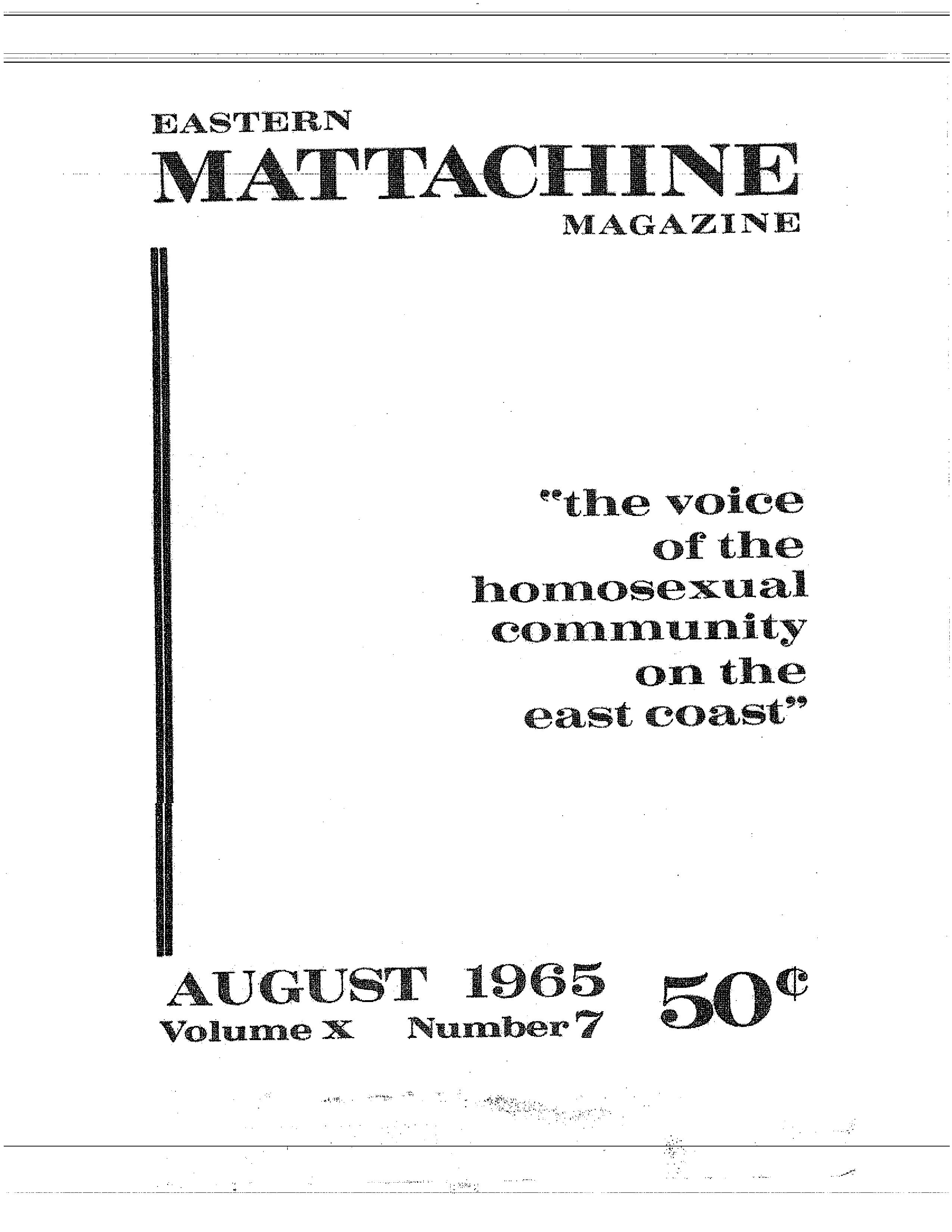
August 1965 Cover of Mattachine Magazine, from OutHistory.org
Besides the papers of individuals and organizations, an archive like the Gerber/Hart Library in Chicago also contains LGBT periodicals. This can be especially important when the periodicals are the newsletters of local organizations. Most of these did not have massive circulation or long runs. Yet they do often provide thorough and detailed reports on local events and the work of the organization. They also frequently contain opinion pieces and commentary written by local activists that give a vivid sense of the times.
Two such periodical collections are the newsletters of Chicago Gay Liberation and the Chicago Gay Alliance. These were two of the very earliest post-Stonewall organizations to form in Chicago, and the newsletters at Gerber/Hart stretch from 1970 to 1972. They report on the broad range of activities that the groups engaged in, the demonstrations they organized, and the tensions and challenges they each confronted.
At first glance, the story that unfolds in Chicago seems to parallel the narrative that historians have constructed of early post-Stonewall activism in New York. In the wake of Stonewall, a group calling itself the Gay Liberation Front quickly formed in New York. Self-declared militant revolutionaries, they conducted sassy public actions, urged people to come out, declared solidarity with other radical movements of the day, and displayed that solidarity by participating as openly queer contingents in marches against the Vietnam War and at rallies in support of the Black Panther Party. Within months, a group of white gay men split from the GLF and formed the Gay Activists Alliance. It, too, was committed to militant public action, but it broke with the multi-issue coalition politics of the Gay Liberation Front and declared itself solely focused on gay issues.
Reading the Chicago Gay Liberation Newsletter, one immediately encounters its multi-issue orientation. Besides organizing a Pride March and Rally in June 1970, and conducting demonstrations at restaurants that refused to serve gay customers, it also sent a contingent to participate in the march commemorating those who died in the atomic bombing of Hiroshima, and it organized support for the Venceremos Brigade, a group of young radicals who were supporting the Cuban revolution and defying the U.S. boycott of the island nation. One of its issues contained a report on the Revolutionary People’s Party Convention, held in Philadelphia in September 1970 and organized by the Black Panther Party. Chicago Gay Liberation included both a women’s caucus and a black caucus, which worked to keep issues of sexism and racism in the vision of the organization while also remaining active in the organization as a whole.
The October 1970 issue of the newsletter reports that Chicago Gay Liberation is experiencing a “schism.” A large group of white gay men decided to secede from the organization because it was “too political, too radical” and was “allying itself too closely to Movement groups.” They formed a new group, Chicago Gay Activists. The first issue of its newsletter, published in November 1970, announced that “our politics are that of homosexuality.” Another article declared that “the most important part of liberation is personal.” CGA definitely remained a militant organization. It planned and conducted public demonstrations that could be rowdy and disruptive. But it continued to proclaim that CGA “is devoted solely [emphasis in original] to the politics of homosexuality.”
Although this seems to mirror what had happened a few months earlier in New York, a closer reading of the newsletters leads to a more complicated and nuanced analysis. Chicago Gay Liberation, for instance, might declare itself a revolutionary organization, but a surprisingly large number of its demonstrations were focused on obtaining the right to dance. The famous retort by Emma Goldman notwithstanding (“If I can’t dance, it’s not my revolution”), one could reasonably argue that the right to dance was not the cutting edge of revolutionary change for LGBT people. Meanwhile, though CGA stated that its only focus was on homosexuality, its newsletter reported on gay contingents at antiwar marches, provided its readers with information about the Hiroshima Day rally, and joined in a broad coalition action to protest President Richard Nixon’s appearance in Chicago. At least in Chicago, the divide between revolutionary and reformist, between multi-issue and single-issue politics, was a good deal hazier than it might seem upon first analysis.
What I found most exciting about reading these newsletters was encountering the intensity and extent of activism in this three-year period. Especially when one considers that both organizations were run entirely on volunteer labor and had almost no budget to consider, the amount of work they did in the three years covered by these newsletters was huge. Between them, they organized protests against police harassment and violence. They demonstrated against gay bars that discriminated to keep women and people of color out, and against other commercial establishments that discriminated against LGBT people. They appeared on radio and TV shows, at a time when a visible queer presence was still extremely rare. They maintained a speakers bureau and sent speakers to high schools in the greater Chicago area. They polled candidates for Chicago’s city council, and they testified at city council hearings about the need to enact laws banning discrimination. They helped organize student groups on campuses around the state. CGA opened Chicago’s first community center for LGBT people, located in a house at 171 Elm Street. CGA maintained a mailing list of 1300, at a time when doing a hard-copy mailing was the main way to communicate to people en masse, and that involved a lot of work. CGA likewise produced 3,000 copies of its newsletter, and distributed it in many venues in the city.
Today, when so many LGBT organizations have paid staff, when many elected officials seek out LGBT endorsements, and when there is so much cultural visibility and attention by news media, it can be hard to appreciate just how cutting edge the work of these two early post-Stonewall organizations in Chicago was. It made a difference. It created a beginning foundation upon which later organizations and activists built. And the work of Chicago Gay Liberation and Chicago Gay Alliance comes down to us today in part because an archive like the Gerber/Hart Library contains precious copies of many of the newsletters of these organizations.
In the Archives | The 1987 March on Washington Committee: The Chicago Chapter
BY John D'Emilio ON December 21, 2016
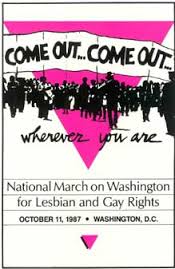 While the archival collections at Gerber/Hart are grounded in the history of Chicago, inevitably some of the papers reach beyond the city to illuminate national events. They reveal connections between the local and the national and the impact of each on the other. The papers of the Chicago chapter of the 1987 March on Washington Committee are a case in point.
The importance of the 1987 March on Washington cannot be overstated. It put the organized LGBT community on the national stage as never before. There had been a first lesbian and gay national march in 1979, but it drew fewer than 100,000 people to Washington. By the standards of the time, that marked it as decidedly unimpressive. By 1987, just eight years later, much had changed. The AIDS epidemic was raging across America, killing men who had sex with men in staggering numbers. The Reagan administration was disgracefully ignoring it. In 1986, in Bowers v. Hardwick, the Supreme Court added to the fury by upholding the constitutionality of state sodomy laws, with language that was gratuitously contemptuous of same-sex love and relationships. Put all this together, and the result was a march of 500,000 people in October 1987, perhaps the largest protest march to ever assemble in the nation’s capital.
But there was more. There was also mass civil disobedience and arrests in front of the Supreme Court, a mass wedding of same-sex couples to protest the absence of family recognition, and the powerful display, for the first time, of the Names Project Memorial Quilt on the Washington Mall. Key speakers at the rally were the Reverend Jesse Jackson, long-time African-American civil rights leader and a candidate in 1984 for the Democratic presidential nomination; Cesar Chavez, head of the United Farmworkers Union and perhaps the most visible Chicano leader in the U.S.; and Eleanor Smeal, president of the National Organization for Women, the largest feminist organization in the United States. Their participation was a dramatic sign that the LGBT movement had come of age and was recognized as a component of the broad struggle for social and economic justice in the United States.
Materials in the papers of the Chicago’s MOW Chapter provide a glimpse into just how wide and deep the organizing for the March was. The national steering committee had representatives from 18 states, and there were local committees in 43 states. For instance, three cities in Alabama, six in Georgia, and three in Maine had an organizing structure to get people to Washington. The Chicago chapter papers contain a list of endorsers of the March that filled several pages. It included labor unions, religious groups, and women’s organizations, as well as national, state, and local elected officials. It is worth remembering that every one of those endorsements came because an LGBT activist reached out to key figures in those groups, talked about the March and the issues, and persuaded them to lobby within their organization for an endorsement.
The papers also contain extensive materials about civil disobedience and the kind of training that was provided to individuals. A condition of joining in the civil disobedience outside the Supreme Court was that participants belong to a local affinity group. This meant that, in the summer and early fall of 1987, deep and trusting relationships were forming among groups of activists in cities across the country. As I looked through this material I could not help but wonder how much this contributed to the explosion of local direct action protests by ACT UP and other AIDS-activist groups in the months after the March on Washington, both in Chicago and around the country.
 Besides the window that this collection opens into the scope and reach of national preparation, it also naturally gives a close sense of what the organizing looked like and accomplished in Chicago. Julie Valloni and Victor Salvo were the co-chairs of the Committee. In the course of organizing Chicagoans to go to Washington, they and other committee members sought local endorsements, a process that undoubtedly built support for a city non-discrimination ordinance which still hadn’t passed in 1986-87. They also worked closely with media in Chicago; one result was front-page coverage of the March by the Chicago Sun-Times. Perhaps the most visible local achievement was the endorsement letter the Committee received from Mayor Harold Washington. “It is with enthusiasm that I endorse the National March on Washington for Lesbian and Gay Rights,” he wrote in his letter of September 17. “The breadth of the issues highlighted by the March – against racism and apartheid, as well as for civil rights – is consistent with the historic thrust of struggles for civil rights in this country.” Working hard to get a civil rights ordinance passed in Chicago, Mayor Washington also wrote: “The March will in turn support passage of a comprehensive Human Rights Ordinance here in Chicago.” Such a law was finally enacted a year after the March on Washington.
The last thing I’ll mention about this collection is a laugh that it elicited. In October 1986, the Vatican issued a major document on homosexuality that provoked a great deal of criticism and outrage, since it supported a theology that defined homosexual behavior as criminal. But one result was that, in Chicago, it led to the formation of a new group called “P.O.P.E.” The letters stood for “Pissed-Off Pansies Energized.” You’ve got to love our sense of humor!
In the Archives | GLAAD Chicago
BY John D'Emilio ON November 16, 2016

Journalist Mike Royko, lounging at his desk
On more than a few occasions in the last three or four years, as I’ve read the New York Times or the Chicago Tribune in the morning, I have had the sensation that I was reading an LGBT community newspaper. The range and number of stories have sometimes been staggering. There have been stories on the fight for marriage equality, of course, but I was also encountering news about changes in federal policies, tech industry initiatives, sports figures coming out, arts and culture profiles, young people organizing in their schools, op-ed pieces, and much, much more. In addition to the quantity of material, the positive perspective embedded in the reporting has also been noteworthy. The underlying point of view in the coverage and reporting has been one that affirms and validates LGBT communities and our fight for acceptance and justice.
Needless to say, it was not always so. In the pre-Stonewall years, before the rise of a militant movement, more typical coverage about our community was the alternation between a deep silence – no mention or recognition at all – and lurid stories that emphasized crime, danger, and moral corruption. This didn’t all magically change after Stonewall and the rise of a gay liberation movement. Part of what contributed to the rapid spread of AIDS in the 1980s was the tendency of the media either to ignore the story, thus perpetuating ignorance and an inability to act effectively against its spread, or to sensationalize the epidemic and thus perpetuate the deep cultural and institutional bias against men who have sex with men.
I received a powerful reminder of how slow the media was to change when I explored the GLAAD-Chicago collection at the Gerber/Hart Library and Archives. The seven boxes of material, which span the first half of the 1990s, were donated by Randy Snyder, who served as the chapter’s executive director. GLAAD, which stands for Gay and Lesbian Alliance Against Defamation, was a media watchdog organization formed in New York City in 1985 by Vito Russo and Darrell Yates Rist, both writers, as well as others. They acted in response to some of the horrifying coverage of AIDS coming from papers like the New York Post, owned by Rupert Murdoch. By the early 1990s, GLAAD had spawned perhaps a dozen local chapters, of which Chicago was one.
One of the major emphases in the work of GLAAD was its monitoring of the newly powerful “Religious Right.” For those interested in learning about and exploring the Religious Right more deeply in these years, the collection is a rich source of material. GLAAD kept track of and collected publications produced by organizations like the Traditional Values Coalition, the Family Research Institute, Focus on the Family and, locally, the Illinois Family Institute that, even today in 2016, is out there rousing opposition to initiatives to protect the safety and well being of transgender youth. The work of Paul Cameron especially drew GLAAD’s attention. A psychologist who was expelled from the American Psychological Association in 1983, Cameron produced reports with titles like “Criminality, Social Disruption, and Homosexuality”; “Child Molestation and Homosexuality”; and “Murder, Violence, and Homosexuality.” The GLAAD-Chicago papers also provide insight into the organizing being done to contain and discredit the Religious Right. Materials produced in the 1990s by organizations like the National Gay and Lesbian Task Force and People for the American Way can be found here.
Interestingly, the work of a media watchdog group like GLAAD in these years was not confined to exposing extremists. Mainstream media outlets, including those that might be defined as liberal, needed to be targeted as well. A case in point was the Chicago Sun-Times, the city’s liberal daily paper. In the space of two months in 1994, the paper published two editorials that, shockingly, sounded as if the editorial board had lifted passages out of a Religious Right report. In response to the suburb of Oak Park extending medical benefits to the same-sex partners of town employees, the Sun-Times editorialized about “the importance of more traditional families” and “the central role in society traditional families must still assume.” Then, in an editorial coinciding with the 25th anniversary celebrations of the Stonewall Rebellion of 1969, the Sun-Times declared: “we oppose extending favored status to gays . . . the heterosexual majority is justifiably concerned that its values not be marginalized . . . and that a new set of rights not be extended to a privileged class.” GLAAD’s response was uncensored: “you have bought into the Religious Right’s lies and myths,” it wrote to the editorial page editor. Your claims, it said, were “vague and fallacious.”
As with so many collections, there are also the jaw-dropping surprises. The GLAAD-Chicago papers include a “Mike Royko” folder. The Pulitzer Prize winning columnist was a fixture of Chicago journalism for decades. He had a take-no-prisoners style of writing that called out politicians and other public figures. His biography of Mayor Daley, Boss, was a best seller. In the folder is an unsigned typed memo, dated May 22, 1995, and with it a copy of a police report, dated December 17, 1994, documenting Royko’s arrest on DUI and resisting arrest charges in conjunction with a car crash. The memo called attention to comments of Royko’s documented in the report. Among other things, he screamed at the responding officer “you cocksucker” and “get your hands off me, you fucking fag.” Later he yelled, “Get away from me. What are you, fags?” and “Jag off, queer,” and finally, “What’s your ethnicity, you fag?” Because of Royko’s stature, the memo and report, which was sent to several LGBT organizations, created a media moment in Chicago
All this and more are to be found in the collection. GLAAD’s work helps explain why the tone and content of media coverage of LGBT issues is different today than it was even two decades ago. It didn’t happen by magic, by some mysterious process of evolution that brings progress. It took activist commitment and energy, and some of that commitment and energy are documented in the Gerber/Hart Library and Archives.
In the Archives | The Melissa Ann Merry Papers
BY John D'Emilio ON October 31, 2016
 One of the pleasant surprises that comes from snooping through the collections at the Gerber/Hart Library and Archives is seeing how rich with information even small collections can be. The papers of Melissa Ann Merry are a perfect illustration of that.
Merry was a Chicago-based bisexual activist and performer. Born in Canton, Ohio, in 1963, she went to college at Eastern Michigan University and then moved to Chicago soon after graduating in 1986. It was in Chicago that she came out as bisexual, and she soon plunged into a world of bisexual activism that was coming together in the late 1980s and early 1990s. Locally, she got involved in the Bisexual Political Action Coalition (BIPAC) and was also a Midwest representative to the national organization BiNet (Bisexual Network of the USA), which grew out of the first national bisexual conference, held in San Francisco in June 1990. The papers she donated to Gerber/Hart consist of three boxes of material, almost all from between 1990 and 1995.
The first thing that emerged very clearly from surveying Merry’s papers is how important both the 1993 March on Washington and the 1994 Stonewall ’25 commemoration in NYC proved to be for bisexual activism and mobilization. Merry has several folders of material on each of them. First there was the organizing that needed to happen in order to have “Bi” be included in the official name of the 1993 March. Once that was achieved, planning for the March provided a great spur to local organizing across the U.S. to make sure that bisexuals participated in and were targeted by the efforts to guarantee a vast turnout in Washington in April 1993. Thus, the March proved to be not a single event, but a tool that had consequences afterward in the heightened level of local organization that it produced. The same can be said of the buildup for and aftermath of Stonewall ’25, which brought massive numbers of people to New York and achieved extraordinary media visibility. Not only did more local organizing emerge from both of them, but they also led to higher levels of national networking.
 The increasing breadth and depth of bisexual organizing also emerges from another feature of Melissa Ann Merry’s papers. The collection contains a substantial number of bisexual publications from the early to mid-1990s. Among them are Anything That Moves, from the San Francisco Bay Area; Bi-Lines, from Madison, Wisconsin; Bi-Monthly from Champaign-Urbana, Illinois; the Boston Bisexual Women’s Network Newsletter; North Bi Northwest, out of Seattle; Bi-Atlanta; Bi-Centrist, from Washington, DC; Bi-Lines, from Chicago; and Bi-Focus from Philadelphia.
These newsletters and community magazines suggest that bisexuals were organizing on a far more extensive scale than is commonly recognized. In rare instances, an individual might prove capable of writing, producing, and distributing such a publication. But, typically, it requires a group to do the work of gathering the information, writing it up, and building an audience to read the material and sustain the newsletter or magazine. The existence of publications like these also suggests that there were sufficient groups and issues and campaigns to write about, thereby confirming that this was a period of intense and productive bisexual activism.
 Finally, working my way through these three boxes of Merry’s papers also brought many smiles to my face. Besides documents, her collection also includes physical objects – tee-shirts, buttons, and political stickers. Many of them display a sense of humor that will easily produce chortles of laughter for the knowing but may also perhaps produce a moment of shock that successfully grabs the attention of those who may never have thought of bisexuality before. To mention just a few: there is a tee-shirt that read “Caution: Ice-pick wielding bisexual fag-dyke. Do not agitate!” Another portrays a line of women, some back-to-back and others face-to-face, with looks of ecstasy on their faces and the words “Primal Clit: Lesbians and Bi-Womyn in Radical Action.” There were stickers, meant to be placed on poles and walls and cars, one of which read “Bisexuals Don’t Sit on Fences. We Build Bridges!!!” And, finally, many buttons, among them the following: “I’m Bisexual – You’re Confused”; “Bi-Sexuals Are Equal Opportunity Lovers”; and “Two Roads Diverged in a Yellow Wood . . . and I Took Both.”
As I said at the beginning of this post, the Melissa Ann Merry Papers might be seen as a relatively small collection of three boxes, but they are packed with material that, cumulatively, provides rich insight into key years of bisexual activism in the United States.
Don’t Get Cozy, Queer Millennials
BY Eric Gonzaba ON November 20, 2015
 I’m one of those few people who still reads Time magazine. I know . . . I’m ancient. What’s worse? I still read the paper version of the weekly newsmagazine, and I receive it from a member of the United States Postal Service. Look, I’m working on joining the rest of my digitally savvy generation. I’m proud to announce, for instance, that I recently became a member of the cool kids club and used my iPhone as a boarding pass for a cross-country flight. When my face lit up after the scanner successfully read the phone code, the TSA agent just glared at me all confused. Baby steps. . .
As you probably know, cover stories for the American Time usually prove to be nothing more than attention grabbing nonsense. I had little hope for a recent cover story entitled “Help! My Parents Are Millennials,” accompanied by an image of a baby riding in a fancy stroller and accosted by numerous smartphones pointed at his adorable face. I reckoned I was in for another essay of millennial bashing, a now popular activity among hip baby boomer intellectuals. I get the thrust of the concern for my generation; we’re sometimes entitled, self centered, lazy activists, ready to add a filter to our Facebook profile pictures to support marriage equality or show solidarity with the victims of the Paris atrocities, but not that into getting off our couches to do much more than that. It’s certainly easy to broad stroke an entire generation but I’m starting to find it a little lackluster. Why does everything have to result in some kind of generational fight?
Much to my surprise, Katy Steinmetz’s article proved more informative than condescending. Yes, she laid out the quirkiness of the smartphone society, our odd name selections for children, for example, and our exploding “vast archives of selfies.” Still, perhaps it’s the cultural historian in me, but I appreciated the fact that she let millennial parents actually speak for themselves, and the results proved illuminating. Some 50% of millennial parents consciously purchased gender-neutral toys for their children, compared to only 34% of Generation X or baby boomer parents. Millennials, not that surprisingly, overwhelming support same-sex marriage. They tend to care more about issues of sex, sexuality, and gender, and largely want to promote a more equal society for themselves and their kids. Sure, some of the carnivores among us might be alarmed that the occasional millennial parent trains his or her kid to be (gasp!) a vegan from an early age, but no one said the current generation has to be anything like the last one. Let’s remember that, as historians like Elaine Tyler May have argued, even the baby boomer generation fundamentally upended their approaches to issues of sex and sexuality and challenged notions of “normality.”
We ought to be critical of millennial culture but not because of the typical skepticism aimed at the selfie generation. For our queer cultures and communities, the millennial challenge is to not get cozy in the world that’s forming around us. We should combat the comfort that comes with living in a seemingly more inclusive society, because that inclusivity is a mirage to many in our diverse queer communities. That comfort can breed indifference, and with that we forget the immense struggles that queer people continue to face. Look no further than places like Houston, where a group of misinformed Americans convinced an electorate that trans people are mentally disturbed perverts lurking in public bathrooms ready to prey on children. Sure, there was some outrage, but too many of us let the day pass without anymore than a sigh. Imagine the prolonged outcry if, this past June, Justice Kennedy had written that marriage was not a fundamental right.
And then, there is racism. It’s our duty to stop treating non-white gay men in our communities as some sort of tangential concern. People of color and transgender communities are not allies in our collective struggle for acceptance. They are, in fact, the struggle. They face widespread stigmatization, violence, and homelessness, and yet we continue to convince ourselves that we have championed a more tolerant America.
As millennials, we ought to note the lessons of generations before us not to settle within the comfort of apathy and instead make our legacy one of an unrelenting push for an egalitarian world. We’ve already begun building a culture where children aren’t confined to pre-determined dreams based on the baby blue and girly pink toy lines, and it’s heartening that those children will be more able to accept cultural differences because of how the law treats same-sex couples and military service people. However, if that’s our millennial legacy, I’m unimpressed. You’re reading this rambling post on a device that has more technological power and with that more opportunities for learning and engagement than anything known in human history. Yet, we’re living in a world where members of our queer communities face bigotry on a deadly scale.
Let’s end the sighing. Time to get uncomfortable.
New and Noteworthy
BY Claire Potter ON October 26, 2015
 From Nicholas Syrett and Amanda Littauer, co-chairs of the American Historical Association’s Committee for Lesbian, Gay, Bisexual and Trans History (CLGBTH): “This link will take you to a blog post on the AHA’s website highlighting the program we’ve put together for this year’s AHA in Atlanta. Thanks to all the scholars who assembled or agreed to serve on panels. We’re excited to see you all in Atlanta!” Consider joining: for you senior historians, a lifetime membership is still a smokin’ hot deal at $300. For those who already became lifetime members at bargain-basement prices, try to remember what rate you joined at and top it up to $300.
- U.S. Olympian Gus Kenworthy, silver medalist in freestyle skiing at last year’s Sochi Winter Games, came out as gay in a cover story for ESPN the Magazine (New York Times, October 22 2015.)
- Dallin Oaks, a leading Mormon Church elder, isn’t endorsing Adam and Steve, but has issues a public statement that Kim Davis and other public officials are not above the law (New York Times, October 23 2015.) If you know anything about the history of the Mormon Church, and the difficulty it has had reigning in splinter groups that still practice plural marriage, this makes perfect sense.
- Turns out Sappho may have been the first lesbian Mom! Dana Rudolph on the history of LGBT families (Pridesource, October 22 2015.)
- Rutgers historian Timothy Stewart-Winter argues that *trans students are building on a history of feminist campus activism when they fight gender discrimination in higher ed (Chronicle of Higher Education October 18 2015.)