


Looking back and Listening: Memories of Stonewall
BY Chris Gioia ON June 27, 2017
“Sheridan Square this weekend looked like something from a William Burroughs novel as the sudden specter of ‘gay power’ erected its brazen head and spat out a fairy tale the likes of which the area has never seen.” [1] This is how Lucian Truscott IV rather disparagingly characterized the Stonewall rebellion of 1969 in his eyewitness account published in the Village Voice on July 2nd of that year. The event was indeed something never before seen in New York City’s West Village, but was not the first time LGBT people stood up to police harassment. The Black Cat Tavern raid in Los Angeles and the Compton’s Cafeteria riots in San Francisco a few years prior also saw members of the community fight back against unfair treatment, police brutality and discriminatory laws that targeted the most unambiguous members of the community.
Its hard to imagine that in New York City in 1969, laws prohibited members of the same sex dancing together, restricted the sale of alcohol to homosexuals and penalized those who wore articles of clothing of the opposite sex, but it would take years of activism and action to have these officially taken off the books in the following decades. So, how did the Stonewall Inn become the birthplace of LGBT civil rights? Many details are hard to nail down and many debates have focused on the myths and mysteries of the Stonewall incident, but specific memories and stories help to paint a picture of the place and of the times. Bars like the Stonewall Inn represented a kind of reluctant haven for New York City’s downtown gay scene. Most patrons had a love hate relationship with the bar and its mafia controlled operators. The drinks were weak and over priced, the ambiance was dive bar but the vibe was by most accounts intoxicating if not fully liberating.
Bruce Monroe, who was a college student visiting from Indiana in 1969, describes his memory of Stonewall to me:
I remember … two dance floors and a big long wall down the middle. But I remember it being a very young lively crowd that I could relate to. It was like really exciting to see all these other young men that were around my age. I guess it was one of the most popular places for dancing in NY at that- there weren’t very many places around like that. And I remember having a great time there and I remember having to leave by myself because my friends had found elsewhere to spend the evening.
Historian John D’Emilio’s experience of the West Village as a college student in the late 1960’s is of a “whole gay world.” On two occasions he visited the Stonewall Inn with a friend and remembers the following:
. . . so anyway we go to Stonewall and of course the thing that was immediately apparent to me I mean besides the fact that it was, unlike Julius’ where there were a lot of people but it was conversation, and it was kind of quiet, Stonewall was wildly noisy and what do they have, but go go boys who were dancing you know, up on a platform wearing you know, kinda nothing, like a g-string, or just underpants, and it seemed very exciting to see and experience something like that!
Author Felice Picano has written about Stonewall and been involved in gay literature/publishing since the 1970’s. He wasn’t a fan of Stonewall in 1969, but recalls that it could be useful:
. . . if you found somebody interesting and you sorta wanted to feel them up and feel them out before you took them home you’d take them around the corner to the Stonewall and slow dance in the dark and figure out what you wanted . . . it became by the time the incident happened, a place for trannies and for people who were not quite street people but almost, and sometimes the hustler boys who would hang out in front of it in the park in Sheridan Square would go in too. So it had this very, very mixed vibe and, and I was always hearing that it was closing down, that it was going bankrupt.
Trans activist Miss Majors introduces her story to Felice Picano in a rare correspondence:
Miss Majors: I’d had a tough day, and I heard that that singer Judy Garland had died. I wasn’t a fan of hers, but I didn’t feel like being alone, so I went down to the Stonewall. That was our club, where the other “T’s” and I could hang out and relax and be ourselves. [2]
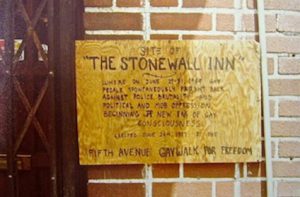
Stonewall Plaque placed in 1977 by the 5th Ave. Gay Walk of Freedom. LGBT Community Center Archives, Grillo Collection.
Pioneering gay journalist Mark Segal provides a first hand account of being inside the bar that night:
I remember the lights flashing. I remember asking somebody …“what does that mean?” And someone said, “Oh we’re just going to be raided!” And everybody who was a regular there took that very nonchalant. They were just used to it cause that was part of what life was like for gay people at that point. Me on the other hand had never been through a raid. I tried to look nonchalant but I gotta tell you its not –[laughs] I was very nervous. … As people were coming out they started forming a semi circle around the door and that eventually – and as the police let out more and more people at one point the only people left in the bar or most of the people left in the bar were the people that worked there and the police. At which point people just started throwing things at the door. Um, [sigh] that’s basically when people started breaking things, running up and down the street. [3]
Activist Martha Shelly recalls in my interview with her last year, how the liberation movement was energized by Stonewall:
Monday I read about the riots in the newspaper and I thought that was what it was about! I read about the Stonewall Riot in some small article in the New York Times or the New York Post I don’t remember which and I immediately called . . . Jean Powers and she was the person who was getting out the newsletter and organizing meetings. I called her and said we have to have a protest march. She told me to call the head of the Mattachine Society and she said if they’re interested we could jointly sponsor it. …So I called Dick Leitsch who was the head of the Mattachine Society. He said they were having a meeting at Town Hall to discuss all of these things and what it meant for the gay community and come to the meeting and put my proposal out and that’s what I did.
Craig Rodwell, owner of the Oscar Wilde Memorial bookshop on Mercer St. at the time of the riot, sums up the significance of Stonewall:
Immediately I saw that this was something that was going to have an impact in the future for the movement because I’d been saying for years that something would happen- there would be a spark. I recognized instantly that this was it.[4]
Today the Stonewall Inn is an iconic symbol of the birth of LGBT rights and has secured its place in history by being designated a National Monument. To learn more about the liberation movement and hear more of the interviews I conducted visit www.stonewallhistory.us and for additional first hand testimony about Stonewall listen to a wonderful radio segment from 1989 here: Remembering Stonewall
At a performance upstairs at the Stonewall Inn not too long ago, I was shoulder to shoulder with a truly diverse mix of patrons: trans women and men, lesbians, drag queens, regulars who call the bar a hangout, more than a few allies, and of course tourists checking another landmark off their list. I like to think that the pioneers of the liberation movement who have passed, would be proud of what the reincarnated Stonewall represents, but I’m sure if asked a contentious debate would ensue. After all, if its not worth arguing about, was it worth fighting for?
Gay Power!
[1] Lucian Truscott IV, “Gay Power Comes to Sheridan Square,” Village Voice, July 2, 1969, accessed December 10, 2016, http://www.villagevoice.com/news/stonewall-gay-power-comes-to-sheridan-square-6670443.
[2] Felice Picano, “The Remains of the Night: Six Observers: Felice Picano Talks with Eyewitnesses to the Stonewall Riots,” The Gay & Lesbian Review Worldwide, 2015 (4): 29.
[3] Mark Segal, interview by Christopher L. Gioia, February 7, 2017, interview.
[4] Tina Crosby, “The Stonewall Riot Remembered, Excerpt 2,” Stonewall: Riot, Rebellion, Activism and Identity, accessed April 14, 2017, https://stonewallhistory.omeka.net/items/show/25.
Queering the Indy 500
BY Eric Gonzaba ON May 24, 2015
 That’s right. I’m attempting the impossible. I’m going to suggest that there is something queer about the Indy 500. Any event that brings in a viewership of nearly six million people is bound to be a little gay, right?
If you’re not familiar, the Indianapolis 500 is a car race that takes place every May in Speedway, Indiana, just outside the state capital of Indianapolis. The speedway itself is arguably the largest arena in the world, with a seating capacity of more than 400,000. To give you some perspective, that’s five times the seating capacity of the Dallas Cowboys’ stadium. Point being: the 500 is a big deal, not just for Hoosiers, but to lots of racing fans.
But is there really anything gay about the Indy 500? After all, the race has no halftime show like during the Superbowl to relieve gay men from the boredom of football with the likes of Beyonce or Katy Perry, even if just for a painfully short ten minute set. Ok, I’m being extremely stereotypical, but people buy into these stereotypes, that all queer people live by a set standard of likes and dislikes, that we all bow to the gods of urbanism, pop, and liberalism.
As important as it is to find and identify the unique sites of our LGBT communities (the underground urban discos, the disappearing feminist bookstores, the black fraternities, the vogue balls etc.), it’s quite extraordinary to discover the ways queer communities in the past sought to both integrate and remake mainstream cultural events and sites like the Indy 500.
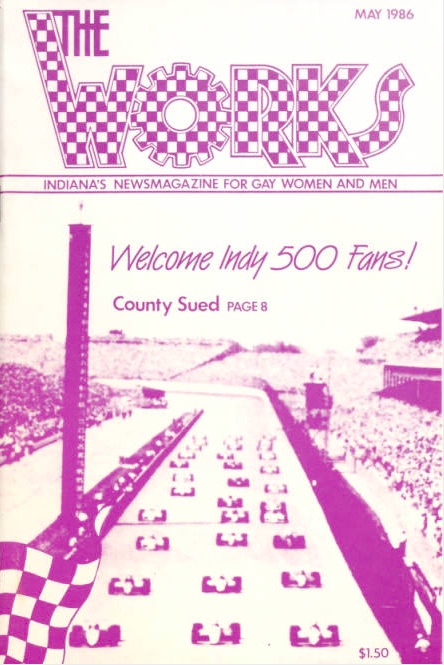
Looking through Indianapolis gay magazines of the past 30 years, it’s incredible to see the warm welcome of gay fans to the racing capital. The entire cover of the May 1986 issue of Indiana’s gay newsmagazine The Works was a greeting message to out of town gay racing fans. As one queer commentator put it, “Hope to see all you fags up in Indy this month to ‘see’ the 500 race,” probably in reference to either the quickness of the Indy racecars or perhaps the draw of gay men to other, non race events in May. Either way, the race meant at least something to Indy’s gay community.
Throughout the 1980s, Indianapolis’ queer community used the race and its out of town gay fans as a reason to congregate and party. Indianapolis’ gay bars hosted race-themed disco dances, complete with drag queen contests like the “Club 500 Queen” or the “Speedway Housewives” as well as the “500 Follies.” Disco divas like Linda Clifford were brought in to entertain fans over the qualification weekends and the famous race day.
Hardcore race fans could watch the races and local bars and clubs during special barbecue cookouts. A 1984 gay writer suggested that though latecomer gay race fans probably couldn’t get grandstand seats on the last weekend before race day, infield tickets were still on sale. “If you thought the Romans had orgies,” the columnists wrote, “try the infield!”
Even the race’s longtime traditions have a queer angle. For over forty years, Jim Nabors of Gomer Pyle fame sang “Back Home Again in Indiana” just before the race to the delight of adoring race fans. In 2013, Nabors married his longtime partner of nearly forty years, Stan Cadwallader. Granted, Nabors’ sexuality remains largely unknown to many Speedway fans but this didn’t stop the infamous Westboro Baptist Church from protesting the event in 2014 (Nabors’ last singing appearance), with the hate group citing Nabors’ homosexuality as one of their main grievances. Regardless of the Westboro morons, I cannot help to think how ironic it is that a state marred in scandal the past few months over allegations of anti-gay discrimination and religious freedom could let a gay man become so attached to a time honored Hoosier tradition.
Today’s racing fans don’t have to look very far to find likeminded compadres. In recent years, a dedicated queer racing community has sprung up online. Sites like Queers4Gears serve as resources for dedicated gay Indy and NASCAR racing fans, offering visitors “gaynalyses” as opposed to traditional, yawn-inducing coverage on conventional news platforms. Queers4Gears founder Michael Myers presents balanced reporting on races, but his queer perspective means a new vocabulary fit for his gay audience, sometimes, for example, referring to drivers as “divas.”
Maybe it’s not important whether or not there is a queer history of the Indy 500. Maybe we should just leave the pit stop and investigate how LGBT people are not always separatists but sometimes active definers of wider, normative culture. The 500 is one reminder that our unique queer perspectives can penetrate even the most “redneck” of institutions.
I Remember Julius
BY John D'Emilio ON December 10, 2014
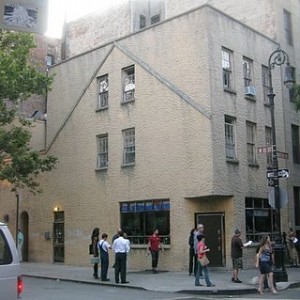 One of the things that I like about knowing lots of history is that it makes the present overflow with opportunities to recall and reflect on the past – both my own past and a larger social and cultural past. This past Sunday, for instance, I was scanning through the wedding announcements in the New York Times Style Section [yes, I am a critic of the campaign for marriage equality, but yes, I also love to read the love stories embedded in wedding announcements]. I noticed that one of the male couples was getting married at Julius, a gay bar in the West Village in Manhattan.
Julius! It advertises itself today as New York’s oldest gay bar. And it was the scene in 1966 of a “sip-in” by members of the New York Mattachine Society. They went in, announced that they were homosexuals, and asked to be served. They were challenging a New York State Liquor Authority policy that prohibited establishments with liquor from serving homosexuals. The bartender dutifully supported the protest by refusing to serve them, and the SLA responded by publicly announcing that, contrary to the charges of the protesters, it did not prohibit serving homosexuals. The demonstration had the effect of reducing significantly police raids of gay bars in New York and, in a sense, can be said to have helped provoke the Stonewall rebellion three years later. By 1969, enough bar patrons had come to expect that they would be left alone that, when the police raided the bar that June night, all hell broke loose as patrons and people on the street fought back. The rest, as we say, is history.
But Julius also brought up memories of my own queer history. It was the first gay bar I ever went to, as a 19-year-old in the fall of 1967. I was taken there by Jim, an “older” gay man [he was 26!] whom I had met while waiting on line for standing room tickets at the Metropolitan Opera House. That summer, I had for the first time fallen passionately in love, with a much older gay man [he was 29!], who worked as a travel agent, sang in the choir of St. Bartholomew’s Church on Park Avenue, and was as passionately in love with opera as I was with him. So, as part of my determination to win his heart, I rapidly developed an interest in opera, and discovered that the waiting line at Lincoln Center for standing room tickets [the line for a week of standing room tickets started forming at about midnight on Saturday, and grew until the box office opened mid-morning on Sunday] was like an outdoor gay community center. Masses of opera queens gathered there, gossiped about their favorite divas, and meanwhile cruised everyone there. Jim befriended me and for a couple of months acted almost as an older gay brother as he introduced me to this new world that I knew very little about. We went to some operas together; we walked the streets of Greenwich Village together, which I had never before experienced; and he took me to Julius.
All this came to mind as I paged through the wedding announcements. The lesson is clear: learn history, and your lifetime of memories will be so much richer and more vibrant!