


Grappling With Carson McCullers: 100 Years
BY Sarah Schulman ON July 20, 2017
This essay, and the short fiction with which it ends, was presented at the Carson McCullers Centenary in Rome on July 16, 2017.
It was a green and crazy summer.
Carson McCullers is one of those singular artists who inspires us over time, and yet is impossible to imitate. Much of the worst of American literature has been created by multi-generations of inadequate Hemingway impersonators. But no one tries to imitate McCullers. One of the many things about her that I try to understand is why, unlike Elvis, she is impossible to imitate and how at the same time she is able to influence us.
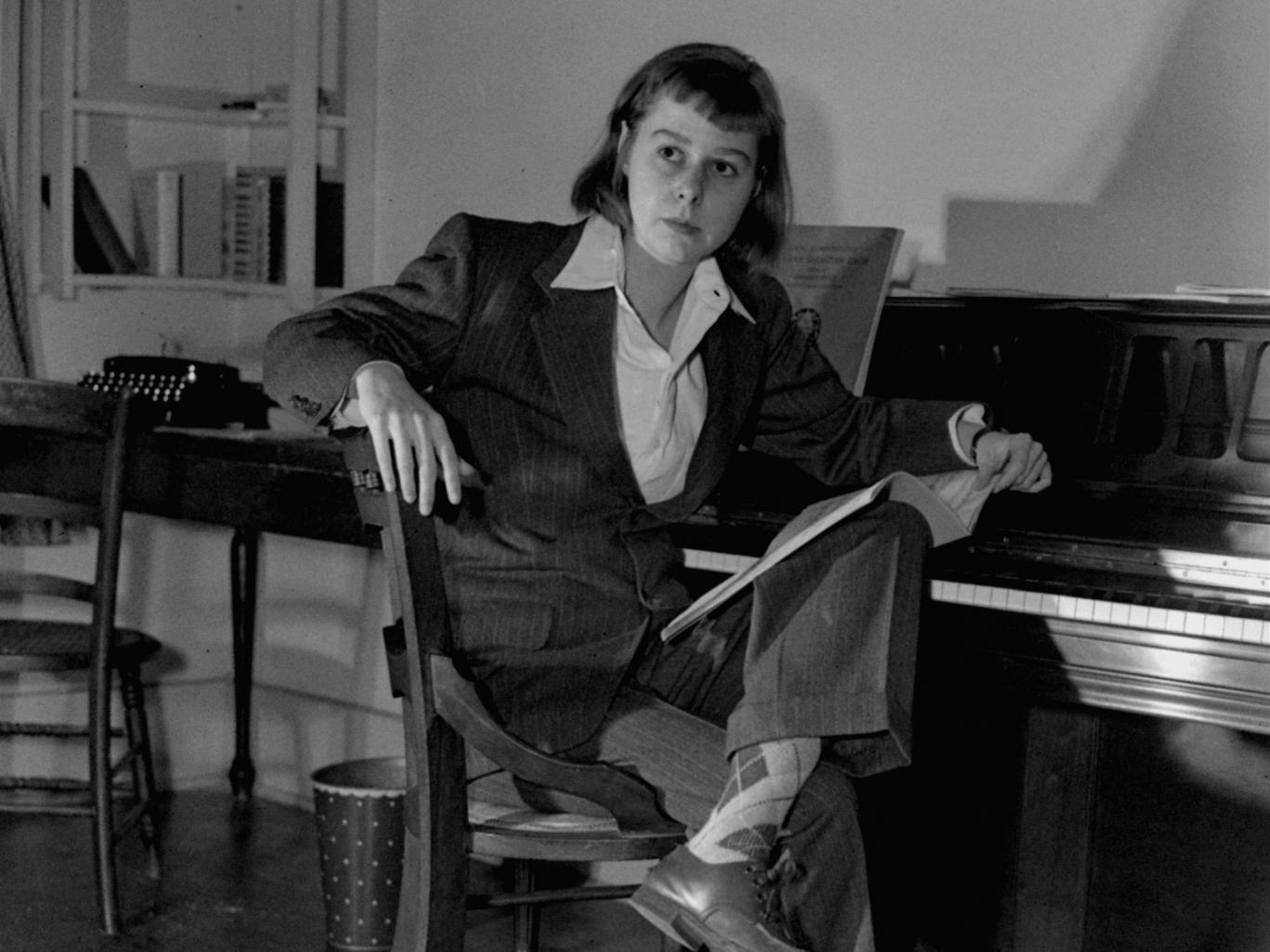
“Carson had a male identity, and if she lived today I believe she would be on the continuum of what we call `trans.’”
Lets start with the opening words of Member of The Wedding: It was a green and crazy summer… On a superficial reading it might remind us of “It was a dark and stormy night” but actually the phrase works in very unusual ways. Dark and Stormy are both on the same plain. We are separate from the night: looking out at it from inside a shelter, or we are surrounded on the deck of a ship, but dark and stormy are evoking the same state of experience. On the other hand green and crazy are two entirely different spheres of perception, because green is a visual and crazy is interior: a state of mind, an evaluation as well as a feeling. So, Carson manages, within the frame of seven simple, almost minimalist, words, to evoke multi-dimensions of interiority and exteriority: emotion and perception. In this way, she is a master of the American thought sentence. And that is why we cannot imitate her.
So, how is it that she influences us?
I was re-reading the beautiful anthology that Carlos Dews edited for the Library of America, and went back to her short story “Court In The West Eighties” – written in 1935 at the age of 18, when she left her Columbus, Georgia home to study writing at Columbia University. This was her second pilgrimage to New York Earlier she had come to Julliard to study classical piano, but something happened and she ended up giving all her money to a prostitute and had to return. This time, more familiar with the ways of the City, she looks out her apartment window at the neighbors on the other side of the courtyard, who she will never meet or know. Particularly, interesting is one man, with red hair, who has a drink at the window after work. She, the narrator, is reading Karl Marx, and that enhances her understanding of the people with whom she shares this quiet knowledge.
“I felt that this man across from me understood the cellist and everyone else in the court as well. I had a feeling that nothing would surprise him and that he understood more than most people.”
I had a feeling says this young woman for whom thoughts, ideas, and insights would always be feelings.
Most of the story involves descriptions of her feelings about her neighbors until suddenly, a very surprising thing occurs. The narrator tells us, her readers, that she thought about sharing this information by letter with a friend back home but that the description would be “too hard” to write. Wait a minute! Didn’t she already write it to us? Isn’t that what we have been reading, her description? And then it sinks in. She does not consider us to be readers, she does not consider us to be separate human beings, suddenly it becomes clear that the reader is in fact part of her, and is living inside her mind. That the page is actually her feeling, and we are in her consciousness, and the story becomes more intimate than even a whisper on a pillow.
This is what influences us: McCullers’ vulnerability, the total openness, the invitation to know all that she has to know. This is what makes us inspired.
It certainly worked for me.
In 1999 I had a workshop of a new play called “The Child” (that later became a novel) and I mentioned to the young lead actress, Angelina Phillips,
“You know, you look like Carson McCullers.”
And she said: “Who’s that?”
Making Lesbian History Possible: A Proposal
BY admin ON June 6, 2016
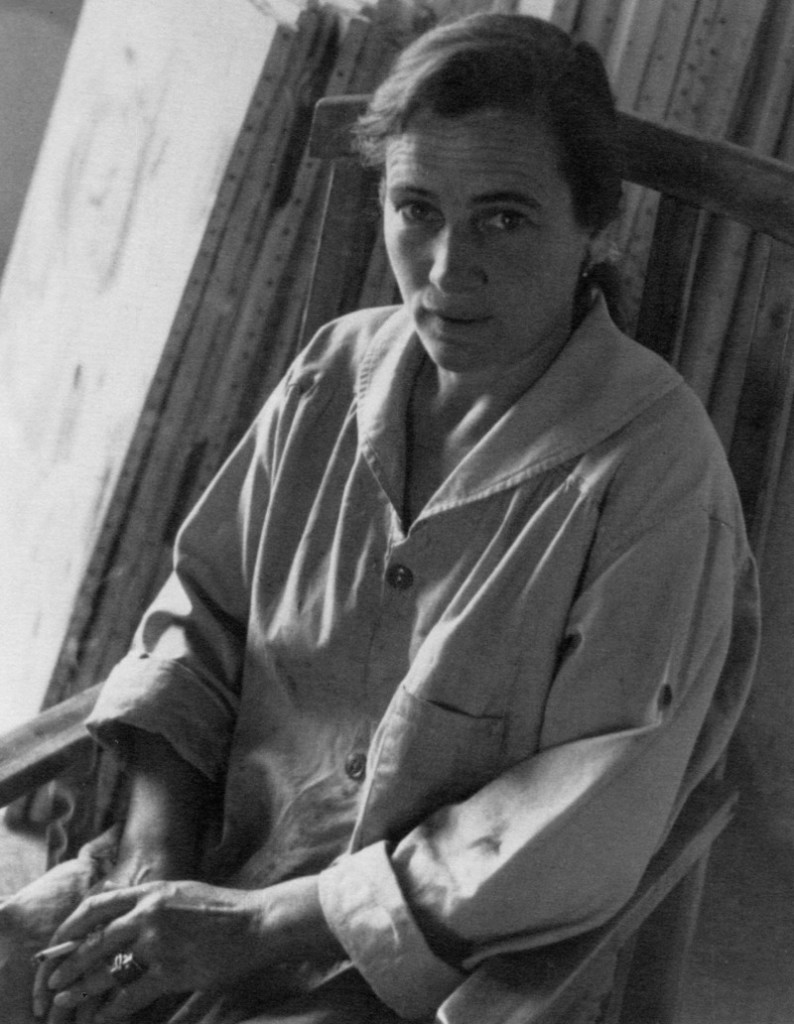
Mildred Tolbert, Agnes Martin, ca. 1954
Today’s guest blogger is Sarah Schulman, a writer, activist, and Distinguished Professor of the Humanities at College of Staten Island. Her most recent novel is The Cosmopolitans (New York: The Feminist Press, 2016.) Read about it in Slate.
“To forbid something is to make it unforgettable.” – Adam Phillips
At the OutHistory.org conference in New York in May, I heard two of my favorite historians, Marcia Gallo and Nan Alamilla Boyd, confirm that the problem of “identity categories” has become a significant obstacle to researching, documenting and analyzing the history of lesbian lives, politics, culture, experiences, and feelings. Both of these fascinating scholars use oral history as a foundational practice for their work, which to date has focused on the 1950’s and 60’s. They found that in talking to those who produced and lived these histories, the word “lesbian” was complex, problematic, had divergent meanings, and was a source of both attraction and refusal. This problem of the elusiveness of “identity categories” is one reason that documentation of lesbian history from the 1970’s onward has been seen as a kind of swamp into which few trained and seasoned historians wish to sink.
Certainly these confusions pervade most of our social institutions and conversations. While many of us rely on our definitions to ground our perspectives, and some of us rely on negating definitions to do the same, it is clear from the not-functional divisions of books for Lambda Literary Awards to the endless list of letters at the end of queer organizational mission statements, that we need definition. And yet the current cataloguing system has become obstructive. The focus on what categories mean, and why we do or do not want to be in them, has brought some essential documentation and grappling with historic events, emotions, and actions to a screeching halt. For lesbian history in particular, there are so many reasons to abandon ship: no other movement in American radicalism has been so mocked; the subjects, themselves, promise grief to the enterprising scholar. And, I think, most importantly, the psychological, emotional and relational complexities, conflicts, and deprivations are a necessary but very difficult centerpiece of events and how they unfold.
What is to be done?
A few weeks after the conference I read a gorgeously written biography of the iconic and reclusive painter Agnes Martin by art historian Nancy Princenthal, winner of The National Book Critics Circle Award this year. The author was respectful of all Martin’s dimensions, eccentricities, impulses and shifts in feeling and ideas. She recorded conflictual statements and claims by Martin about her own life and experiences without judgment, embracing these complexities as an organic part of her creative imagination and emotional lens. Nuance, complexity, contradiction, vagueness, ambivalence, confusion and dislocation were all seen as elements worthy of record and relevant to understanding her life and, more importantly her artwork, and their inter-connections.
There was one arena, though, in which variation, levels and counter-indication were deemed too difficult to articulate: Martin’s emotional and sexual feelings and actions towards women. Even though there was a clear resonance between how Martin lived and described, or withheld and obscured, her emotional and sexual interiority and exteriorization with the ways she lived and made art, the author enthusiastically delved into art practice, while sidelining desire and the emotions of erotic feeling. Yet Princenthal’s reasoning was not the usual blindness or ick-factor when it comes to a historic figure’s sexuality. Instead, she evoked the problem of identity categories as the reason to sideline these themes in the artist’s life. Princenthal documents instances in Martin’s life where the artist said that she was “not a lesbian,”“not a woman,” and that she was “a man”. Certainly that is all important, and can bring a lot to understanding Martin’s lived erotics and repressions. Instead the author uses this information to downplay the role and importance of Martin’s relationships, and non-relationships, with women.
Right away, on page 11 of Agnes Martin: Her Life and Art (Thames and Hudson, 2015), Princenthal writes:
Martin’s romantic attachments, if that is the right term – she was not given to sentiment and preferred living alone – were largely with other women. But she refused the label lesbian (as she did the term feminist when it was applied to her). In her life, as in her work, renunciation was as important as embrace.
But, what about the renunciation of embrace? Isn’t that also filled with meaning and therefore with history? The “romantic,” which I would define as the spark of opening, are experiences that can come to dominate an imagination: artistic, political, intellectual, emotional and certainly sexual. Both the recognition of open-heartedness, of connection, of the pleasure of knowing each other, as well as the refusal to allow the real to develop, the shutting down, the rejection of pleasure- all of these experiences are significant in the lives of human beings, and particularly of artists. They produce aesthetics. Artistic voice, after all, expresses the contested and resists repression. Repression, similarly, is a resonant key to the question of lesbian, queer, bisexual, and trans existence, even in our contemporary moment: repression of information, of feeling, of knowledge, of existence, of potential and risk. And when examining a self-described “hermit” like Agnes Martin, aloneness also has a specificity in lesbian, queer, bisexual, and trans life, whatever those words mean to you.
Whether Martin was a lesbian, a woman, and/or a man does not mean that feelings, desires, longings, refusals, experiences, conversations, silences, actions and repressions with women are not deeply and fundamentally relevant to her history. And the content of those experiences, and refusals of experience, are more important than the question of Martin’s sexual or gender category.
Later, on page 51, Princenthal drops, in an aside, that when Martin went to live and work in New Mexico in the 1940’s, she found a culture in Taos where noted collector and saloniste Mabel Dodge Luhan, (though married to a Native American man,) was “among the many women at the time in Taos (and Santa Fe) to have had romantic relationships with other women, as did O’Keefe.” My eye falls on the word many. And of course the name O’Keefe. Where can I read that book? Or does this not matter because the word “lesbian” is not operational?
At this point I would like to make a radical proposal: that we temporarily forget about who calls themselves a lesbian; why, or why not. Instead, I propose that we look into the emotional, psychological, economic, political, intellectual, artistic, sexual, daily and life long experiences of women who allowed or refused the embrace. The conversations that did happen and did not. The words permitted, and those uttered without permission. The invitations refused and accepted. The fears. The imaginations, erotic and projected. The walks in the woods, the fucking, the pleasure of the company acknowledged and refused. The meals, the conversation, how and what conversations provoked, the actions, the artworks, the articles, books, tears, orgasms realized/failed/imagined/remembered, caresses, tendernesses, the refusals of tenderness, kisses that were and should have been, and how this moved the earth, the culture, the society or even just one or two people’s small lives. I propose that we call this whatever we want to call it, but that we not let it fall by the wayside, because when those of us creating queer history and culture display a reluctance to go deeper and transcend the artifice of restrictive thinking, the mainstream representations are handed a convenient model of hesitant obscuration. Lesbians give each other meaning in private, and it is too easy to keep the secret. It doesn’t have to be clean, neat, safe, compartmentalized, or expected. Show it all and let the chips fall where they may.
Princenthal mentions that among the women who had romantic attachments to other women in Taos was Betty Parsons, who later opened a gallery in New York. Princenthal writes that when Parsons’ gallery represented Agnes Martin (along with other clients like Jackson Pollack), Agnes and Betty lived together in Betty’s studio in NYC for a year. Nothing further. She quotes from different sources, some saying that a sexual relationship between the two would have been impossible. Others, like Betty’s assistant Jack Tilton, felt sure that they did allow the embrace. Certainly that the one lesbian gallerist was the person who first showed the work of Agnes Martin, implies some kind of openness, some kind of love. And it is fair to imagine that had there been no Betty Parsons, it is possible that no man ever would have shown Martin’s work. But despite the living together, despite the testimony of Tilton, despite the investment in each other’s dreams and visions, Princenthal just isn’t sure. “In the long interview conducted with Parsons for The Archives of American Art in 1969,” Princenthal writes, “Agnes Martin’s name does not come up.” But, that is so lesbian, to pretend we never loved, to erase the attraction, to deny the opening because of complexities of historical, emotional and psychological reasons that I wish our historians would help us articulate and unravel.
She goes on to discuss some other “friendships”, one with artist Lenore Tawny of whom Agnes wrote: “There is an urgency that sweeps us up, a originality and success that holds us in wonder.”
An elusive Greek woman artist, twenty years younger, with one name, Chryssa, is alluded to in Martin’s New York Times obituary, as the reason she left New York to live alone on a New Mexico mesa. But Princenthal thinks that was instead a relationship of professional assistance on Agnes’s part. Yet, I would say to Princenthal that if lesbian artists don’t help each other, it is hard to know who is going to help us. And if we love someone’s work, there is more possibility for …romance. Without the lesbian identity, there was still the romance. As Agnes Martin wrote:
When you’re in life-drawing, you’re really thinking of all the women you’ve ever seen, and all the gestures they’ve ever made. That’s what brings life into the drawing….It’s just your real self.
The Punchline: decades past, I had a lesbian literary agent named Diane Cleaver, who died over twenty years ago. Diane was very old school. “I’m out,” she once told me. “But I am not out and about.” At her memorial service, the only person who said the word “lesbian” was a straight writer. Diane once told me that Betty Parsons and Agnes Martin were lovers, but that Betty dumped Agnes for Greta Garbo, and this was the catalyst for Agnes’s great depression.
This could easily be untrue, of course. Not being an historian, I have no way of confirming or denying. But being an artist, I was able to embed this piece of wish/knowledge into a scene in my novel The Cosmopolitans, where Earl, the Black, gay working-class protagonist, stumbles home from a day at the meatpacking plant. He runs into a good looking Black actor, Frank, now employed as a chauffeur for a beige Bentley parked outside of Betty Parson’s gallery, carrying a mysterious passenger. Miss Parsons emerges, slips into the back seat and Frank drives the shining chassis away. “Who was that?” asks a young Irish girl on the way to run her mother’s errands. “That was Frank,” the smitten Earl replies. “That was not Frank,” a drag queen from the adjacent Hotel Albert corrects him. “Honey, that was Greta Garbo. Dot vas Ninotchka.”
Second Punchline: I was in residency at the Yaddo artist’s colony and shared the summer with an 83 year-old painter named Buffie Johnson. Buffie was blind at this point but still painting “spheres.” She told me that she had had three husbands, one of whom died of AIDS, and two girlfriends, Jane Bowles and Patricia Highsmith. “Wow, Buffy” I said. “They both were so difficult, they must have been tough girlfriends. Were they really that bad?” “Oh,” she assured me in her Katherine Hepburnesque upper-class trill. “They were horrible.”
Anyway, I once visited Buffie at her home on Greene Street, where her front door was a sculpture made by Louise Nevelson (who also said she was not a lesbian, lived with a woman for the final 26 years of her life, who- after Nevelson’s death- sued her family for “palimony.”) Buffie told me about the time, when she was young, that Georgia O’Keefe came to her studio. “She looked at my paintings and said, ‘Ah those are….’” And then Buffie faltered “What word did she use? What words did she use? It was a twenties word…ah yes, keen. She said my paintings were keen.”
But now that I learn from Princenthal that not-lesbian O’Keefe had women lovers like many women in Taos and Santa Fe, and I know that not-lesbian Buffie did too, I start to wonder about who told Georgia O’Keefe to go check out young Buffie Johnson, and why Georgia bothered to support this unknown woman painter. And I, based in my own artist’s life, know it had something to do with the lesbiannesss of these not lesbians, which is also a force of history and of culture. The romance, the special surprise of openness, and what it produces, whether we want it or not, is worth noting.
Biography and History
BY John D'Emilio ON February 11, 2015
 Bear with me as I think while I type:
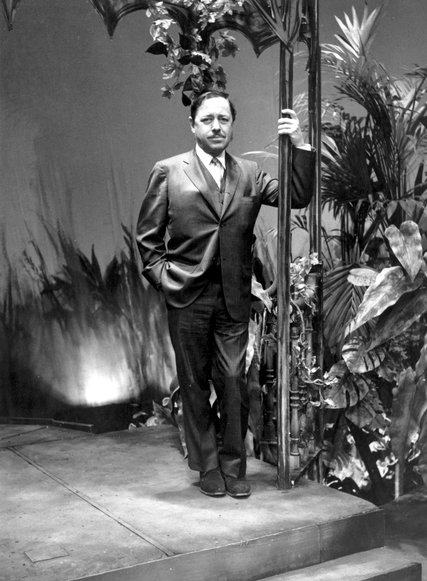
Last weekend, I was paging through an old unread pile of The New York Review of Books. A review of John Lahr’s recent biography of Tennessee Williams caught my attention. At one point, the reviewer quoted at length from a diary entry in 1941 where Williams was questioning the self-hatred of a gay friend of his who had said “We ought to be exterminated for the good of society.” In response, Williams wrote: “How many of us feel that way, I wonder? Bear this intolerable burden of guilt? To feel some humiliation and a great deal of sorrow at times is inevitable. But feeling guilty is foolish. I am a deeper and warmer and kinder man for my deviation. More conscious of need in others, and what power I have to express the human heart must be in large part due to this circumstance.”
Even though I have written a biography, I am not a great fan of the genre. Almost every full-length biography tells me much more than I ever want or need to know about an individual. And, given whose records are likely to exist and be preserved, biography as a genre too easily plays into “great white man” approaches to the understanding of history. No, I prefer the study of collective movements and community life, both of which are much more likely to provide a sense of the lives of everyday people and how they made a mark on their worlds.
But then I think about my undergraduate students over the years. When I lectured on the broad social and economic forces that gave rise, say, to urban reform efforts in the early 20th century or the black freedom movement of the mid-twentieth century, they might be able to resurrect a bit or a piece of it for an exam essay. But, if I organized my lecture on Progressive reform around the life and work of Jane Addams, or the history of the black freedom movement around the life and work of Bayard Rustin, they seemed to retain every last detail. A life was something most of them could intimately relate to and a life story became the doorway through which they began to understand historical change.
A few years ago, when I signed on to work on Outhistory and its redesign, I invited a group of sharp undergrads to produce material for the site. We settled on a “birthday biographies” project – researching the lives of LGBT people in the past and producing short profiles that became the basis for the “Happy Birthday” feature on the home page. I included some “high profile” names, such as Jane Addams and James Baldwin and Oscar Wilde, but most of the names, not surprisingly, were thoroughly unfamiliar to contemporary undergraduates – people like Perry Watkins, Marijane Meaker, Alberta Hunter, and Bill Strayhorn. In thirty years of teaching, this proved to be one of the most rewarding experiences I had. The level of excitement that discovering and learning about these lives generated among them was extraordinary. It led me to a second project with two students who did more extensive profiles that came together in the “Big Lives” exhibit, and it persuaded another faculty member, Cat Jacquet, to have students in a Transgender History course produce a series of biographies that are also now on the site.
All of which is to say: while I’m not about to write another biography, and while I will probably not become a reader of full-length biographies, I don’t want to underestimate the power and value of biography as a way to generate interest in the study of the past.
And, I come back to the Williams diary of 1941. This was before Williams had become a literary celebrity. He was just turning thirty, the product of an economically struggling white middle class family. His words provide a piece of evidence of how, even during an era of intense oppression, a gay man could generate a counter-narrative of what it means to be gay, one that emphasized self-respect. I think back to my research on Bayard Rustin. The life experience of this African American man from a hard-working family in the early 20th century also produced a self-image that did not accept the homophobia of American society. Maybe, I find myself thinking, the biographies of those-who-became-famous-but-didn’t-start-out-that-way could be sources of evidence to reconstruct the history of broader LGBT communities, the consciousness of earlier generations, and much more.