


Looking back and Listening: Memories of Stonewall
BY Chris Gioia ON June 27, 2017
“Sheridan Square this weekend looked like something from a William Burroughs novel as the sudden specter of ‘gay power’ erected its brazen head and spat out a fairy tale the likes of which the area has never seen.” [1] This is how Lucian Truscott IV rather disparagingly characterized the Stonewall rebellion of 1969 in his eyewitness account published in the Village Voice on July 2nd of that year. The event was indeed something never before seen in New York City’s West Village, but was not the first time LGBT people stood up to police harassment. The Black Cat Tavern raid in Los Angeles and the Compton’s Cafeteria riots in San Francisco a few years prior also saw members of the community fight back against unfair treatment, police brutality and discriminatory laws that targeted the most unambiguous members of the community.
Its hard to imagine that in New York City in 1969, laws prohibited members of the same sex dancing together, restricted the sale of alcohol to homosexuals and penalized those who wore articles of clothing of the opposite sex, but it would take years of activism and action to have these officially taken off the books in the following decades. So, how did the Stonewall Inn become the birthplace of LGBT civil rights? Many details are hard to nail down and many debates have focused on the myths and mysteries of the Stonewall incident, but specific memories and stories help to paint a picture of the place and of the times. Bars like the Stonewall Inn represented a kind of reluctant haven for New York City’s downtown gay scene. Most patrons had a love hate relationship with the bar and its mafia controlled operators. The drinks were weak and over priced, the ambiance was dive bar but the vibe was by most accounts intoxicating if not fully liberating.
Bruce Monroe, who was a college student visiting from Indiana in 1969, describes his memory of Stonewall to me:
I remember … two dance floors and a big long wall down the middle. But I remember it being a very young lively crowd that I could relate to. It was like really exciting to see all these other young men that were around my age. I guess it was one of the most popular places for dancing in NY at that- there weren’t very many places around like that. And I remember having a great time there and I remember having to leave by myself because my friends had found elsewhere to spend the evening.
Historian John D’Emilio’s experience of the West Village as a college student in the late 1960’s is of a “whole gay world.” On two occasions he visited the Stonewall Inn with a friend and remembers the following:
. . . so anyway we go to Stonewall and of course the thing that was immediately apparent to me I mean besides the fact that it was, unlike Julius’ where there were a lot of people but it was conversation, and it was kind of quiet, Stonewall was wildly noisy and what do they have, but go go boys who were dancing you know, up on a platform wearing you know, kinda nothing, like a g-string, or just underpants, and it seemed very exciting to see and experience something like that!
Author Felice Picano has written about Stonewall and been involved in gay literature/publishing since the 1970’s. He wasn’t a fan of Stonewall in 1969, but recalls that it could be useful:
. . . if you found somebody interesting and you sorta wanted to feel them up and feel them out before you took them home you’d take them around the corner to the Stonewall and slow dance in the dark and figure out what you wanted . . . it became by the time the incident happened, a place for trannies and for people who were not quite street people but almost, and sometimes the hustler boys who would hang out in front of it in the park in Sheridan Square would go in too. So it had this very, very mixed vibe and, and I was always hearing that it was closing down, that it was going bankrupt.
Trans activist Miss Majors introduces her story to Felice Picano in a rare correspondence:
Miss Majors: I’d had a tough day, and I heard that that singer Judy Garland had died. I wasn’t a fan of hers, but I didn’t feel like being alone, so I went down to the Stonewall. That was our club, where the other “T’s” and I could hang out and relax and be ourselves. [2]
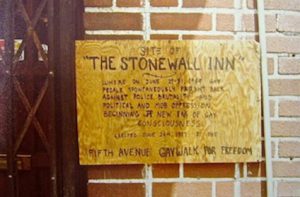
Stonewall Plaque placed in 1977 by the 5th Ave. Gay Walk of Freedom. LGBT Community Center Archives, Grillo Collection.
Pioneering gay journalist Mark Segal provides a first hand account of being inside the bar that night:
I remember the lights flashing. I remember asking somebody …“what does that mean?” And someone said, “Oh we’re just going to be raided!” And everybody who was a regular there took that very nonchalant. They were just used to it cause that was part of what life was like for gay people at that point. Me on the other hand had never been through a raid. I tried to look nonchalant but I gotta tell you its not –[laughs] I was very nervous. … As people were coming out they started forming a semi circle around the door and that eventually – and as the police let out more and more people at one point the only people left in the bar or most of the people left in the bar were the people that worked there and the police. At which point people just started throwing things at the door. Um, [sigh] that’s basically when people started breaking things, running up and down the street. [3]
Activist Martha Shelly recalls in my interview with her last year, how the liberation movement was energized by Stonewall:
Monday I read about the riots in the newspaper and I thought that was what it was about! I read about the Stonewall Riot in some small article in the New York Times or the New York Post I don’t remember which and I immediately called . . . Jean Powers and she was the person who was getting out the newsletter and organizing meetings. I called her and said we have to have a protest march. She told me to call the head of the Mattachine Society and she said if they’re interested we could jointly sponsor it. …So I called Dick Leitsch who was the head of the Mattachine Society. He said they were having a meeting at Town Hall to discuss all of these things and what it meant for the gay community and come to the meeting and put my proposal out and that’s what I did.
Craig Rodwell, owner of the Oscar Wilde Memorial bookshop on Mercer St. at the time of the riot, sums up the significance of Stonewall:
Immediately I saw that this was something that was going to have an impact in the future for the movement because I’d been saying for years that something would happen- there would be a spark. I recognized instantly that this was it.[4]
Today the Stonewall Inn is an iconic symbol of the birth of LGBT rights and has secured its place in history by being designated a National Monument. To learn more about the liberation movement and hear more of the interviews I conducted visit www.stonewallhistory.us and for additional first hand testimony about Stonewall listen to a wonderful radio segment from 1989 here: Remembering Stonewall
At a performance upstairs at the Stonewall Inn not too long ago, I was shoulder to shoulder with a truly diverse mix of patrons: trans women and men, lesbians, drag queens, regulars who call the bar a hangout, more than a few allies, and of course tourists checking another landmark off their list. I like to think that the pioneers of the liberation movement who have passed, would be proud of what the reincarnated Stonewall represents, but I’m sure if asked a contentious debate would ensue. After all, if its not worth arguing about, was it worth fighting for?
Gay Power!
[1] Lucian Truscott IV, “Gay Power Comes to Sheridan Square,” Village Voice, July 2, 1969, accessed December 10, 2016, http://www.villagevoice.com/news/stonewall-gay-power-comes-to-sheridan-square-6670443.
[2] Felice Picano, “The Remains of the Night: Six Observers: Felice Picano Talks with Eyewitnesses to the Stonewall Riots,” The Gay & Lesbian Review Worldwide, 2015 (4): 29.
[3] Mark Segal, interview by Christopher L. Gioia, February 7, 2017, interview.
[4] Tina Crosby, “The Stonewall Riot Remembered, Excerpt 2,” Stonewall: Riot, Rebellion, Activism and Identity, accessed April 14, 2017, https://stonewallhistory.omeka.net/items/show/25.
In the Archives | Black and White Men Together
BY John D'Emilio ON May 8, 2017

Illustration courtesy of the Ken Allen Papers, Gerber/Hart Library and Archives, Chicago.
When historians do their research, many of us often operate with a set of categories that help to sort and divide the past into neatly organized separate boxes. There are histories of politics and movement activism; of social life and community; of culture and artistic production. But, alas, life is not always so neatly segmented. Political activism can be a force for building community. Socializing in bars sometimes became the setting for mobilizing people, most famously at the Stonewall Inn in 1969. And cultural creativity can help articulate political grievances and rouse people to action.
The haziness of history’s boundaries came home to me as I worked my way through two small, but related, collections at Gerber/Hart: the papers of Ken Allen and Wendell Reid. Their materials stretch across the 1980s and 1990s. Each of them was active in the Chicago chapter of Black and White Men Together (BWMT) which, in some cities, morphed over time into Men of All Colors Together.
Black and White Men Together formed in San Francisco in the spring of 1980. By the time it held its first conference in San Francisco during Pride Month in 1981, there already were ten chapters, stretching from cities in California to Arizona, Missouri, Florida, North Carolina, Pennsylvania, and Michigan. Three hundred men attended that first national convention. By 1987, based on the holdings in these collections, at least 17 chapters were regularly producing newsletters, some of which were quite substantial. In 1991, on the 10th anniversary of its first convention, there were at least 25 chapters, including in cities not generally thought of as hubs of gay male life – among them, Hartford, Connecticut; Youngstown, Ohio; and Louisville, Kentucky.
From the outside, BWMT was often perceived as what today one might describe as a “meet-up” group for gay men whose sexual attractions crossed a color line. And, undoubtedly, it did serve that purpose, filling a need that was all the more pressing because evidence abounds that in the 1970s many gay bars implemented policies of excluding African American men by demanding extra pieces of identification. BWMT provided safe spaces for interracial socializing. That socializing in turn helped build broad social networks that facilitated organization building.
Even a quick look through the papers of Allen and Reid shows how strong the activist motivations were in BWMT. For instance, the programs of the 1991 and 1992 national conventions, held in Detroit and Dallas respectively, provide ample evidence of political consciousness and intentions. Keynote speakers included Perry Watkins, an African-American soldier who was challenging the military’s LGBT exclusion policy; Keith St. John, a member of the Albany, New York city council and the first openly gay black man elected to public office; Mandy Carter one of the most politically progressive grassroots community organizers in the U.S; and Marjorie Hill, the director of New York City’s Office for Lesbian and Gay Community Concerns. Many of the workshops at these conferences were unmistakably activist in their focus: “You Can’t Fight AIDS from the Closet”: “Lesbians and Gays of Color as a Political Force in the ’92 Elections”; “A History of Gay Rights”; and “Establishing Your Own HIV/AIDS Agency.”
This orientation toward movement activism also shows up at the local level. Box Six of Ken Allen’s papers is filled with newsletters from local chapters. Those from 1987 are overtly recruiting and encouraging readers to come to the 1987 March on Washington. Many newsletters were important sources of information on the growing AIDS epidemic, at a time when mainstream media coverage was still inadequate. The Los Angeles chapter successfully applied for a grant to engage in community-based AIDS education.

Illustration courtesy of the Ken Allen Papers, Gerber/Hart Library and Archives, Chicago.
Of all the materials I found in these collections, the piece that most caught my attention and that serves as powerful evidence of the activist intentions of BWMT’s leadership was a 150-page publication, Resisting Racism: An Action Guide. It included outlines and resource materials for twenty different workshops intended to equip participants with tools and knowledge to counter racism. There was material from lesbian writers like Audre Lorde and Cherrie Moraga. There were articles on “Racism in the Movement” and “What Black History Month Should Mean to White Gays.”
Taken together, these collections provide a glimpse into the kind of organizing that was being done by gay men in the 1980s and 1990s to challenge racism both within and beyond the gay community in many cities across the U.S.
Stonewall: Riot, Rebellion, Activism and Identity
BY Chris Gioia ON April 24, 2017
My objective in creating stonewallhistory.us has been to collect a range of documents, images, texts and testimony about the controversial and crucial Stonewall rebellion. Presenting these items in an online digital database provides an entry point into the complex, tangled, web of stories and memories that construct the Stonewall narrative. Through this engagement with the past, the audience can determine for themselves if answers to the many questions that remain are possible – or even desirable. The accepted Stonewall narrative is that the riots are the spark that ignited the LGBT rights movement. For the most part, the community has embraced this view. Although the collective understanding that Stonewall is significant is not debated, on most other aspects agreement is hard to find: Which segment of the community led the way organizing protest? Did gay male social networks have a profound effect on organizing in the gay rights movement? Was the early homophile movement influential, or even considered by the more radical movement that emerged post-Stonewall? Were trans individuals influential in gay liberation? Were people of color invited to participate in activism? Who was really there that night in June of 1969? Who started the rebellion?
The facts and details of the rebellion are open for interpretation and in my opinion should remain so, for as this project hopes to demonstrate, Stonewall and the resulting birth of the “gay revolution” were very much spontaneous and creative. Barbie Zelizer writes in Remembering to Forget (a study of the impact of images of the Holocaust on collective memory) “…we allow collective memories to fabricate, rearrange, elaborate and omit details about the past, pushing aside accuracy and authenticity so as to accommodate broader issues of identity formation, power and authority, and political affiliation.”[1] Zelizer’s thesis, which could also be considered a warning, helped me to recognize that even the stories that emanate from those with the least power, who exist on the margins of society, are impacted by political and social influences. In the case of the Stonewall narrative the broader social movements of the time, the militant protest culture, the youth-oriented counterculture and consciousness raising all converged to help leaders of the nascent gay rights movement form a concept of identity, affiliation, and authority for the community. In this case, the authority that was exerted was the concept of oppression. Prior to Stonewall, many gays and lesbians existed quietly in the closet but enjoyed a moderate level of comfort and stability within their social lives and to a degree in society at large as long as they were reserved and respectable. The new authority, exercised by the liberation movement, was one that asked for more than tolerance and required acceptance.

Come Out! newspaper of Gay Liberation Front, 1970
I decided early on that recording oral histories would be a crucial part of this public history project. Alessandro Portelli’s examination of the history of the labor movement in Italy through oral histories was an inspiration for this decision. I found some similarities in the blurring of facts and chronology between the story of Stonewall and the narrative he chronicles in The Death of Luigi Trastulli and Other Stories. Nan Alamilla-Boyd notes that when writing his book, Gay New York George Chauncey states, “early in my research it became clear that oral histories would be the single most important source of evidence concerning the internal workings of the gay world.”[2] In my interviews I too became keenly aware of the hierarchies present within gay social circles. The power of listening to the recorded voices of my informants, elder members of the community, provides a uniquely accessible point of entry for those who may not be familiar with the events described. The crucial next step now that the site is built, the data collected and content written, is to disseminate it. Hearing the voices of older members of the community is something that can draw a listener into the rich history of the liberation movement. Alamilla-Boyd talks about the voices heard in oral histories as texts “…open to interpretation and their disclosures should be understood as part of a larger process of reiteration.” She questions whether factual details matter or whether a more romantic story is told through oral history.[3] Certainly the Stonewall story is romanticized as any other “battle” or “revolution” has been throughout history. But for some, it was perceived as a tool in a broader series of actions and reactions. The activist community in New York was clearly media savvy and therefore capitalized on the attention the unrest attracted, even the most disparaging. If it were not for the media coverage and the ensuing controversies, the commemorative potential of Stonewall may not have been realized.
The individual interpretations of participants, witnesses, activists, and authors also provide the means to shape the factors that contributed to Stonewall’s “success” as a catalyst and create a narrative that resonates beyond simple facts and a linear sequence of events. The development of this schematic narrative is echoed in the testimony of those I interviewed and also in the earliest written accounts such as the Rat Subterranean News coverage of the incident: “Soon pandemonium broke loose. Cans, bottles, rocks, trash cans, finally a parking meter crashed the windows and door,” the Rat reporter, known only as “Tom” writes. He concludes, “What was and should have always been theirs, what should have been the free control of the people was dramatized, shown up for what it really was: an instrument of power and exploitation. It was theater, totally spontaneous. There was no bullshit.”[4]

Come Out! newspaper of Gay Liberation Front, 1970
The development of this story into the schematic narrative of Stonewall is set in motion by the grassroots organizing that develops almost immediately after the first night of the rebellion. The narrative that develops represents elements that are derived from the protest movement culture of the late sixties and is tied to notions of identity that envelop the specific narrative (individual components that are arranged and interpreted schematically). [5] Craig Rodwell, Jim Fouratt, Martha Shelley as well as Sylvia Rivera can be seen as shaping this narrative of Stonewall Rebellion, while Dick Leitsch, Vito Russo and others authorize its re-telling. Despite the fact that this was by no means the first violent protest against police harassment, the event is instilled with the significance of the activist’s interpretation within the context of broader social movements of the time.
I hope to continue building the collection of stories, images, and documents contained on Stonewallhistory.us with the goal of bringing in as many voices and interpretations of the past as possible. Contributions of digitized archival material or written testimony and comments are welcome and can be submitted through the “contribute an item” tab on the home page.
__________________________________________________________________
[1] Barbie Zelizer, Remebering to Forget, University of Chicago Press; 1998
[2] Nan Alamilla-Boyd. 2008. “Who is the Subject? Queer Theory Meets Oral History.” Journal of the History of Sexuality (2): 177
[3] Ibid.
[4] Unknown, “The Rat, July 9-23, 1969, pg 6.,” Stonewall: Riot, Rebellion, Activism and Identity, accessed April 7, 2017, https://stonewallhistory.omeka.net/items/show/56.
[5] Knut Lundby. 2008. Digital Storytelling, Mediatized Stories: Self-Representations in New Media Peter Lang.
Digital Archives | Bridging the Gap
BY Chris Howard-Woods ON April 20, 2017
Founded in 2010, the Archives of Lesbian Oral Testimony is an online archival research project based in Burnaby, British Columbia, Canada. The archives work in partnership with Simon Fraser University (SFU) and supported by the Social Sciences and Humanities Research Council of Canada.
This week, the Archives of Lesbian Oral Testimony (ALOT) launches Bridging the Gap, a research initiative that aims to connect the broader community with their archives through the use of digital technologies. Now, users can record and contribute oral history interviews to the archives themselves and engage with other participatory features. To increase awareness about ALOT’s holdings and enable users to learn how to conduct oral interviews, they are also launching a new podcast and blog, both of which you can find here: http://www.alotarchives.org/bl
Interest in lesbian and queer women’s history is on the rise. Recent research by the ALOT team found that people searching for the term “lesbian history” have increased by 30% in the past two years alone. This proves that there are people who want to learn about and engage with their history. The Archives of Lesbian Oral Testimony is a much-needed resource to hear real, raw, and honest accounts of lesbian and queer history.
You can find them on Twitter and Facebook.
In the Archives | Chicago’s Gay Academic Union
BY John D'Emilio ON March 13, 2017

A flyer from a 1983 Chicago GAU event. Courtesy of the Gerber Hart Library and Archives.
At the University of Illinois at Chicago, where I taught for fifteen years, there is a Gender & Sexuality Center that provides services, meeting places, and programming for LGBT students; a Chancellor’s Committee on LGBTQ Concerns, which has access to upper-level administrators and makes recommendations about LGBT-related issues; many “out” faculty who do research on LGBT topics; a Gender and Women’s Studies program with courses related to LGBT history, culture, and experience; and an annual Lavender Graduation which is a joyous celebration of student success. UIC admittedly has a reputation as an especially LGBT-friendly campus. But its situation is not unique. LGBT people, issues, and research are very visible on college and university campuses across the United States.
Needless to say, this has not always been the case. A full history of how scholarly research, writing, and teaching developed and how a visible LGBT presence became institutionalized in U.S. higher education has not yet been written. But when that does finally happen, an important early piece of the history will be the story of the Gay Academic Union and the work it did in the 1970s and 1980s.
I was part of the small but steadily growing group that began meeting in New York early in 1973 and eventually formed the GAU. It served as an invaluable networking and support function at a time when most university faculty, graduate students, and staff were still in the closet and very little non-homophobic research was being done. I helped plan the first three national conferences, held in New York over Thanksgiving weekend in 1973, ’74, and ’75. Roughly three hundred people came to the first; by 1975, almost a thousand attended. (The proceedings of that first conference, and an account of how the GAU was formed, can be found here on the Outhistory site.
The Gerber/Hart Library and Archives has a number of collections related to the GAU in its Chicago incarnation – the papers of Randy Grisham, Stan Huntington, and James Manahan. They provide insight into the local workings of the organization and its national structure and activities as well. Reading through them, and especially the Grisham collection which has the most material, I came away with a clearer picture of both the extent of the national network that GAU sustained and the local workings of the Chicago chapter.
Above all, in the context of the 1970s when most LGBT individuals were not open about their identities, the national Gay Academic Union allowed local chapters to feel themselves part of a bigger network. A list of GAU chapters in 1979 included not just obvious places, like New York, San Francisco, and Los Angeles, but also cities like St. Louis, Dallas, and Greensboro, North Carolina. The national GAU, which by the end of the 1970s was based in Los Angeles, maintained a mailing list of 6000, quite impressive for those times. It held national conferences that drew hundreds and allowed attendees to connect with people beyond their own city of residence.
The Chicago chapter formed in 1978. It held its first conference the following year, in May 1979. Only 50 people attended. But, when it organized a second conference in 1980, attendance jumped to 250. The conferences, as well as public lectures that it sponsored, allowed it to bring some of the authors of the first books on LGBT history, culture, and politics to Chicago. Speakers included James Steakley, who did pioneering research on the early gay movement in Germany; Lillian Faderman, whose Surpassing the Love of Men covered several hundred years of women’s intimate relationships with each other; and John Boswell, whose Christianity, Social Tolerance, and Homosexuality was a publishing sensation when it appeared in 1980. These events gave visibility to the intellectual and cultural work being done as well as helped to build community locally.
Besides functioning as something of a network node, GAU in Chicago also served as incubator for other projects. One of its members, Gregory Sprague, used GAU as a base from which to launch a Chicago Gay and Lesbian History Project. Sprague went on to do extensive research on Chicago’s pre-Stonewall LGBT history, going back to the early 20th century. He put together an illustrated slide lecture [this was before the days of PowerPoint presentations!] that he not only gave many times to audiences in Chicago, but that he also traveled with. Sprague was also a key player helping to organize historians within the American Historical Association.
Another project that GAU helped launch was a community-based library. It began collecting a wide range of books, both fiction and non-fiction, on LGBT topics. By November 1981 when the library opened as an independent organization at 3245 Sheffield Road, it was named – you guessed it – the Gerber/Hart Library and had a collection of over a thousand books.
Grisham’s papers also reveal the increasing difficulties GAU faced as a national organization. The national seemed to be in trouble as early as 1981, and by 1985 it dissolved, taking many of its local chapters down with it. The material at Gerber/Hart, including in the Huntington and Manahan collections, do not make it absolutely clear why this happened. But my sense, as I read through the materials, is that it was undone by its own successes. As GAU created a safe environment for LGBT faculty in higher education to meet and discuss issues, it made it more likely that these individuals would begin networking and organizing within their own professional associations – with other historians, anthropologists, sociologists, literary scholars, etc.
As a closing note: I’ve suggested in some of the earlier blog posts that one of the great joys of doing archival research is coming upon the unexpected pleasure – not so much something that changes my interpretation of the past, but that brings a big smile to my face. Well, there was one in Grisham’s papers. At the national GAU conference in 1982 that the Chicago chapter hosted at the Conrad Hilton Hotel, the high-profile gay journalist Randy Shilts was one of the plenary session speakers. He was described as delivering a “rambling” address, during which he happened to mention that he had just smoked a marijuana joint.
In the Archives | Gay Liberation
BY John D'Emilio ON February 7, 2017
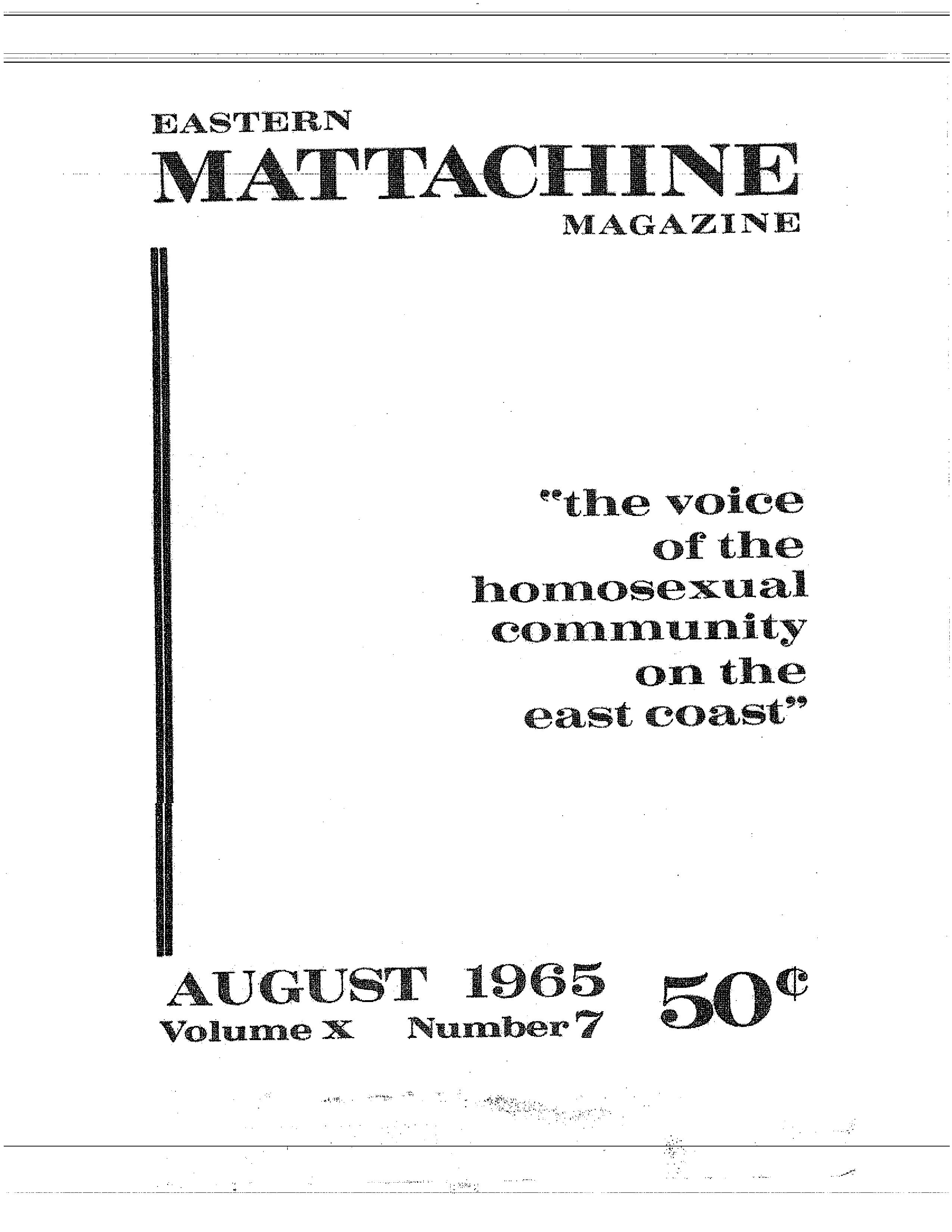
August 1965 Cover of Mattachine Magazine, from OutHistory.org
Besides the papers of individuals and organizations, an archive like the Gerber/Hart Library in Chicago also contains LGBT periodicals. This can be especially important when the periodicals are the newsletters of local organizations. Most of these did not have massive circulation or long runs. Yet they do often provide thorough and detailed reports on local events and the work of the organization. They also frequently contain opinion pieces and commentary written by local activists that give a vivid sense of the times.
Two such periodical collections are the newsletters of Chicago Gay Liberation and the Chicago Gay Alliance. These were two of the very earliest post-Stonewall organizations to form in Chicago, and the newsletters at Gerber/Hart stretch from 1970 to 1972. They report on the broad range of activities that the groups engaged in, the demonstrations they organized, and the tensions and challenges they each confronted.
At first glance, the story that unfolds in Chicago seems to parallel the narrative that historians have constructed of early post-Stonewall activism in New York. In the wake of Stonewall, a group calling itself the Gay Liberation Front quickly formed in New York. Self-declared militant revolutionaries, they conducted sassy public actions, urged people to come out, declared solidarity with other radical movements of the day, and displayed that solidarity by participating as openly queer contingents in marches against the Vietnam War and at rallies in support of the Black Panther Party. Within months, a group of white gay men split from the GLF and formed the Gay Activists Alliance. It, too, was committed to militant public action, but it broke with the multi-issue coalition politics of the Gay Liberation Front and declared itself solely focused on gay issues.
Reading the Chicago Gay Liberation Newsletter, one immediately encounters its multi-issue orientation. Besides organizing a Pride March and Rally in June 1970, and conducting demonstrations at restaurants that refused to serve gay customers, it also sent a contingent to participate in the march commemorating those who died in the atomic bombing of Hiroshima, and it organized support for the Venceremos Brigade, a group of young radicals who were supporting the Cuban revolution and defying the U.S. boycott of the island nation. One of its issues contained a report on the Revolutionary People’s Party Convention, held in Philadelphia in September 1970 and organized by the Black Panther Party. Chicago Gay Liberation included both a women’s caucus and a black caucus, which worked to keep issues of sexism and racism in the vision of the organization while also remaining active in the organization as a whole.
The October 1970 issue of the newsletter reports that Chicago Gay Liberation is experiencing a “schism.” A large group of white gay men decided to secede from the organization because it was “too political, too radical” and was “allying itself too closely to Movement groups.” They formed a new group, Chicago Gay Activists. The first issue of its newsletter, published in November 1970, announced that “our politics are that of homosexuality.” Another article declared that “the most important part of liberation is personal.” CGA definitely remained a militant organization. It planned and conducted public demonstrations that could be rowdy and disruptive. But it continued to proclaim that CGA “is devoted solely [emphasis in original] to the politics of homosexuality.”
Although this seems to mirror what had happened a few months earlier in New York, a closer reading of the newsletters leads to a more complicated and nuanced analysis. Chicago Gay Liberation, for instance, might declare itself a revolutionary organization, but a surprisingly large number of its demonstrations were focused on obtaining the right to dance. The famous retort by Emma Goldman notwithstanding (“If I can’t dance, it’s not my revolution”), one could reasonably argue that the right to dance was not the cutting edge of revolutionary change for LGBT people. Meanwhile, though CGA stated that its only focus was on homosexuality, its newsletter reported on gay contingents at antiwar marches, provided its readers with information about the Hiroshima Day rally, and joined in a broad coalition action to protest President Richard Nixon’s appearance in Chicago. At least in Chicago, the divide between revolutionary and reformist, between multi-issue and single-issue politics, was a good deal hazier than it might seem upon first analysis.
What I found most exciting about reading these newsletters was encountering the intensity and extent of activism in this three-year period. Especially when one considers that both organizations were run entirely on volunteer labor and had almost no budget to consider, the amount of work they did in the three years covered by these newsletters was huge. Between them, they organized protests against police harassment and violence. They demonstrated against gay bars that discriminated to keep women and people of color out, and against other commercial establishments that discriminated against LGBT people. They appeared on radio and TV shows, at a time when a visible queer presence was still extremely rare. They maintained a speakers bureau and sent speakers to high schools in the greater Chicago area. They polled candidates for Chicago’s city council, and they testified at city council hearings about the need to enact laws banning discrimination. They helped organize student groups on campuses around the state. CGA opened Chicago’s first community center for LGBT people, located in a house at 171 Elm Street. CGA maintained a mailing list of 1300, at a time when doing a hard-copy mailing was the main way to communicate to people en masse, and that involved a lot of work. CGA likewise produced 3,000 copies of its newsletter, and distributed it in many venues in the city.
Today, when so many LGBT organizations have paid staff, when many elected officials seek out LGBT endorsements, and when there is so much cultural visibility and attention by news media, it can be hard to appreciate just how cutting edge the work of these two early post-Stonewall organizations in Chicago was. It made a difference. It created a beginning foundation upon which later organizations and activists built. And the work of Chicago Gay Liberation and Chicago Gay Alliance comes down to us today in part because an archive like the Gerber/Hart Library contains precious copies of many of the newsletters of these organizations.