


Grants | William Nelson Cromwell Foundation | Due July 11 2017
BY admin ON June 20, 2017
In 2017, the William Nelson Cromwell Foundation will make available a number of $5,000 fellowship awards to support research and writing in American legal history by early-career scholars. Early career generally includes those researching or writing a PhD dissertation (or equivalent project) and recent recipients of a graduate degree working on their first major monograph or research project. The number of awards made is at the discretion of the Foundation. In the past several years, the trustees of the Foundation have made five to nine awards. Scholars who are not at the early stages of their careers may seek research grants directly from the Foundation. For more information, see the Grants page at cromwellfoundation.org.
Application Process for 2017
The Committee for Research Fellowships and Awards of the American Society for Legal History (ASLH) reviews the applications and makes recommendations to the Foundation. (The Cromwell Foundation was established in 1930 to promote and encourage scholarship in legal history, particularly in the colonial and early national periods of the United States. The Foundation has supported the publication of legal records as well as historical monographs.)
Applicants should submit a description of their proposed project (double-spaced, maximum 6 pages including notes; include a working title), a budget, a timeline, and a short c.v. (no longer than 3 pages). The budget and timeline can be part of the Project Description or separate. (There is no application form.) Two letters of recommendation from academic referees should be sent directly to the Committee Chair via email attachment, preferably as .pdf files. Applications must be submitted electronically (preferably in one .pdf file) no later than midnight July 11, 2017.
Successful applicants will be notified by early November. An announcement of the awards will also be made at the annual meeting of the American Society of Legal History.
This announcement was originally posted at H-Net by Joanna Grisinger.
Stonewall: Riot, Rebellion, Activism and Identity
BY Chris Gioia ON April 24, 2017
My objective in creating stonewallhistory.us has been to collect a range of documents, images, texts and testimony about the controversial and crucial Stonewall rebellion. Presenting these items in an online digital database provides an entry point into the complex, tangled, web of stories and memories that construct the Stonewall narrative. Through this engagement with the past, the audience can determine for themselves if answers to the many questions that remain are possible – or even desirable. The accepted Stonewall narrative is that the riots are the spark that ignited the LGBT rights movement. For the most part, the community has embraced this view. Although the collective understanding that Stonewall is significant is not debated, on most other aspects agreement is hard to find: Which segment of the community led the way organizing protest? Did gay male social networks have a profound effect on organizing in the gay rights movement? Was the early homophile movement influential, or even considered by the more radical movement that emerged post-Stonewall? Were trans individuals influential in gay liberation? Were people of color invited to participate in activism? Who was really there that night in June of 1969? Who started the rebellion?
The facts and details of the rebellion are open for interpretation and in my opinion should remain so, for as this project hopes to demonstrate, Stonewall and the resulting birth of the “gay revolution” were very much spontaneous and creative. Barbie Zelizer writes in Remembering to Forget (a study of the impact of images of the Holocaust on collective memory) “…we allow collective memories to fabricate, rearrange, elaborate and omit details about the past, pushing aside accuracy and authenticity so as to accommodate broader issues of identity formation, power and authority, and political affiliation.”[1] Zelizer’s thesis, which could also be considered a warning, helped me to recognize that even the stories that emanate from those with the least power, who exist on the margins of society, are impacted by political and social influences. In the case of the Stonewall narrative the broader social movements of the time, the militant protest culture, the youth-oriented counterculture and consciousness raising all converged to help leaders of the nascent gay rights movement form a concept of identity, affiliation, and authority for the community. In this case, the authority that was exerted was the concept of oppression. Prior to Stonewall, many gays and lesbians existed quietly in the closet but enjoyed a moderate level of comfort and stability within their social lives and to a degree in society at large as long as they were reserved and respectable. The new authority, exercised by the liberation movement, was one that asked for more than tolerance and required acceptance.
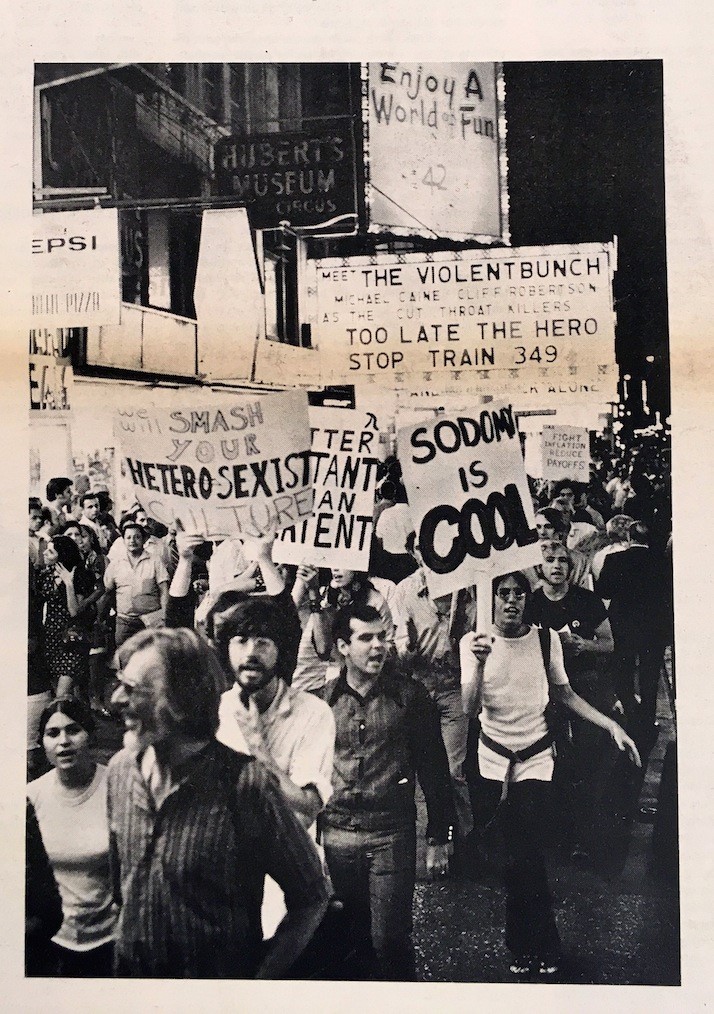
Come Out! newspaper of Gay Liberation Front, 1970
I decided early on that recording oral histories would be a crucial part of this public history project. Alessandro Portelli’s examination of the history of the labor movement in Italy through oral histories was an inspiration for this decision. I found some similarities in the blurring of facts and chronology between the story of Stonewall and the narrative he chronicles in The Death of Luigi Trastulli and Other Stories. Nan Alamilla-Boyd notes that when writing his book, Gay New York George Chauncey states, “early in my research it became clear that oral histories would be the single most important source of evidence concerning the internal workings of the gay world.”[2] In my interviews I too became keenly aware of the hierarchies present within gay social circles. The power of listening to the recorded voices of my informants, elder members of the community, provides a uniquely accessible point of entry for those who may not be familiar with the events described. The crucial next step now that the site is built, the data collected and content written, is to disseminate it. Hearing the voices of older members of the community is something that can draw a listener into the rich history of the liberation movement. Alamilla-Boyd talks about the voices heard in oral histories as texts “…open to interpretation and their disclosures should be understood as part of a larger process of reiteration.” She questions whether factual details matter or whether a more romantic story is told through oral history.[3] Certainly the Stonewall story is romanticized as any other “battle” or “revolution” has been throughout history. But for some, it was perceived as a tool in a broader series of actions and reactions. The activist community in New York was clearly media savvy and therefore capitalized on the attention the unrest attracted, even the most disparaging. If it were not for the media coverage and the ensuing controversies, the commemorative potential of Stonewall may not have been realized.
The individual interpretations of participants, witnesses, activists, and authors also provide the means to shape the factors that contributed to Stonewall’s “success” as a catalyst and create a narrative that resonates beyond simple facts and a linear sequence of events. The development of this schematic narrative is echoed in the testimony of those I interviewed and also in the earliest written accounts such as the Rat Subterranean News coverage of the incident: “Soon pandemonium broke loose. Cans, bottles, rocks, trash cans, finally a parking meter crashed the windows and door,” the Rat reporter, known only as “Tom” writes. He concludes, “What was and should have always been theirs, what should have been the free control of the people was dramatized, shown up for what it really was: an instrument of power and exploitation. It was theater, totally spontaneous. There was no bullshit.”[4]
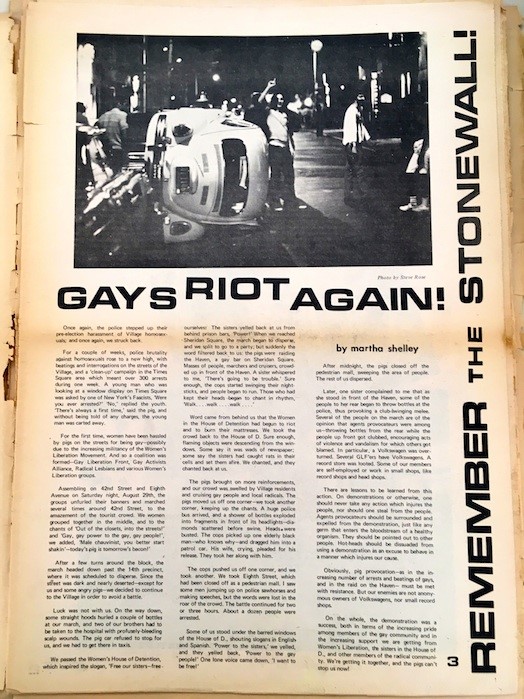
Come Out! newspaper of Gay Liberation Front, 1970
The development of this story into the schematic narrative of Stonewall is set in motion by the grassroots organizing that develops almost immediately after the first night of the rebellion. The narrative that develops represents elements that are derived from the protest movement culture of the late sixties and is tied to notions of identity that envelop the specific narrative (individual components that are arranged and interpreted schematically). [5] Craig Rodwell, Jim Fouratt, Martha Shelley as well as Sylvia Rivera can be seen as shaping this narrative of Stonewall Rebellion, while Dick Leitsch, Vito Russo and others authorize its re-telling. Despite the fact that this was by no means the first violent protest against police harassment, the event is instilled with the significance of the activist’s interpretation within the context of broader social movements of the time.
I hope to continue building the collection of stories, images, and documents contained on Stonewallhistory.us with the goal of bringing in as many voices and interpretations of the past as possible. Contributions of digitized archival material or written testimony and comments are welcome and can be submitted through the “contribute an item” tab on the home page.
__________________________________________________________________
[1] Barbie Zelizer, Remebering to Forget, University of Chicago Press; 1998
[2] Nan Alamilla-Boyd. 2008. “Who is the Subject? Queer Theory Meets Oral History.” Journal of the History of Sexuality (2): 177
[3] Ibid.
[4] Unknown, “The Rat, July 9-23, 1969, pg 6.,” Stonewall: Riot, Rebellion, Activism and Identity, accessed April 7, 2017, https://stonewallhistory.omeka.net/items/show/56.
[5] Knut Lundby. 2008. Digital Storytelling, Mediatized Stories: Self-Representations in New Media Peter Lang.
In the Archives | The Irwin Keller Papers: 1987 Sexual Orientation and the Law Conference
BY John D'Emilio ON January 9, 2017
 To research and write about Chicago’s LGBT history is to engage in a form of what’s often described as “local” history, writing about a particular place within a larger nation. Yet local history also reaches beyond the place it describes. The “local” can be used to illustrate broader historical patterns and to make generalizations about an era or a topic. And, sometimes, a place like Chicago can be the setting for events that might be considered national in their reach and consequence.
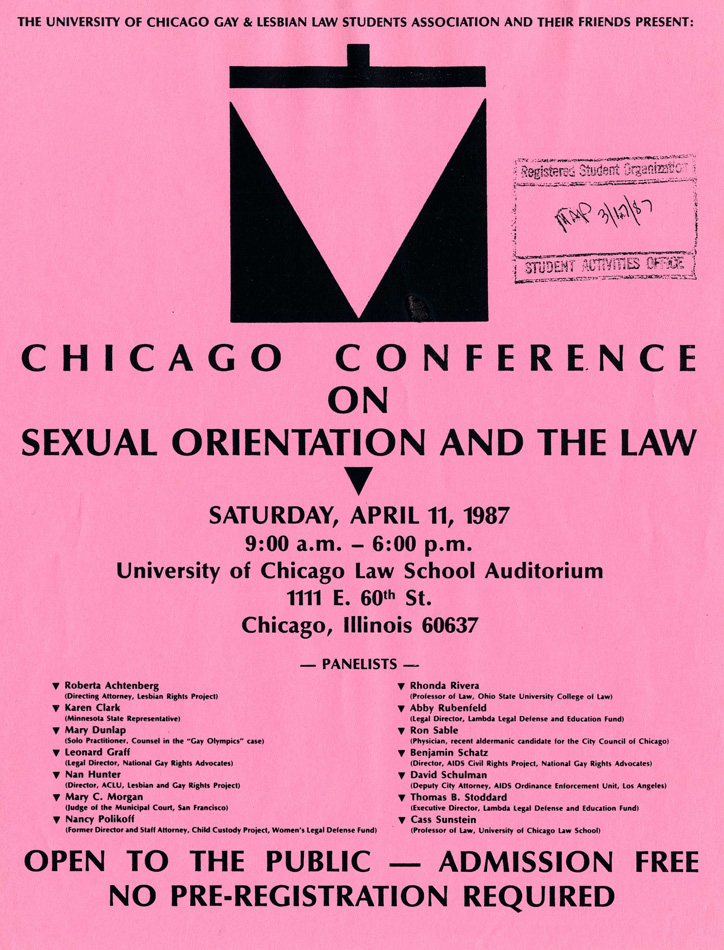
Such was the case in April 1987 when Chicago hosted a conference on “Sexual Orientation and the Law.” Held at the University of Chicago, it was organized by the Gay and Lesbian Law Students Association at the University. Twenty years later, Irwin Keller, who was one of the key organizers of the Conference and a student in the Law School, donated the papers related to the conference to the Gerber/Hart Library and Archives. The Keller Papers provide great insight into the state of the law in the mid-1980s and the strategic thinking of key LGBT legal activists.
Think about the moment. It was several years into the AIDS epidemic, with caseloads and deaths growing in number exponentially. The Reagan presidency was unrelentingly hostile to anything gay, completely ignored the AIDS crisis, and welcomed the religious right into the center of the Republican Party. And, as all this was going on, in June 1986 a 5-to-4 Supreme Court decision in the Bowers v. Hardwick case upheld the constitutionality of state sodomy laws. Bad as the decision waBowers v. Hardwick cases, the language used by the justices in the majority was hostile and derogatory. It described the claims made by those challenging the constitutionality of sodomy statutes as “facetious.” The laws, it said, were rooted in “millennia of moral teaching.” The Constitution offered “no such thing as a fundamental right to commit homosexual sodomy.”
But sometimes defeats can have benefits. Hardwick was a spur to action. It helped to create the demand for a national March on Washington, scheduled for October 1987, a march that would prove to be a demonstration of staggeringly large numbers. And it provided the impetus for members of the Gay and Lesbian Law Students Association at the University of Chicago to propose and organize the first national conference on “Sexual Orientation and the Law,” scheduled for April 11, 1987.
Organizers of the conference cast a wide net. They sent mailings announcing the conference to every law school in the country, hoping not only to reach law students everywhere but also, perhaps, to spur LGBT law students to organize. Estimates of the number who attended the conference that day ranged from five to six hundred. The conference planners also sent invitations to participate to a broad range of legal activists and constitutional lawyers.
The list of those who spoke at the conference reads like a roll call of the pioneers in LGBT legal activism: Thomas Stoddard, Executive Director of Lambda Legal Defense, the first national LGBT legal organization, and Abby Rubenfeld, who was Lambda’s legal director; Nan Hunter, the founding director of the ACLU’s Lesbian and Gay Rights Project; Mary Dunlap, a lawyer who just a few weeks before had argued the “Gay Olympics” case before the Supreme Court and was awaiting the Court’s decision in the case; Roberta Achtenberg, the chief attorney for the National Lesbian Rights Project; and Nancy Polikoff, who had been an attorney for the Women’s Legal Defense Fund and helped cut a path for feminist and LGBT family law.
At times the tone of the sessions was somber. On the opening panel, Tom Stoddard commented on the impact of Hardwick. Looking back on some earlier lower court victories, he said that Hardwick “erases that progress in the federal courts to a very strong degree . . . [and] makes it harder to win on state issues as well.” Evaluating the state of immigration law as it related to lesbians and gays, another panelist frankly said “it is a mess.” Panelists debated whether it made more sense in the future to argue cases on the basis of equal protection principles or from the perspective of the right to privacy. A theme that surfaced repeatedly was the impact that the AIDS epidemic was having. It was stoking deeply irrational fear and prejudice, encouraging more overt discrimination, and justifying that discrimination because of the threat to public health.
Yet there was also a fighting tone to many of the presentations and discussions. Despite the loss in Hardwick, speakers agreed that it was “a risk we had to take.” The loss in the Supreme Court would encourage activists to work for state repeal and lawyers to explore whether some state constitutions might provide grounds for court challenges. Discussions of family law seemed to produce a great deal of energy. In 1987, no state sanctioned same-sex intimate relationships, and state cases about child custody for lesbian mothers were mixed in their outcome. Anticipating the intensifying focus that the 1990s and beyond would bring to marriage and other forms of family law, Abby Rubenfeld stated unambiguously that “we need the sanction of the state” and Nan Hunter declared “we should have it all.” Hunter explained her support of a fight for access to marriage in terms of “the power of marriage as a symbol.”
Most of all, perhaps, the conference was valuable because of the power of bringing so many legal activists together to discuss what the future might bring. As Keller described it in a letter he wrote when he donated the papers to Gerber/Hart, “it was a hugely exciting event – the air was alive with crisis and possibility.”