


Gay Gotham | Museum of the City of New York | 10.7.2016
BY Claire Potter ON September 20, 2016
 Gay Gotham: Art and Underground Culture in New York is opening at The Museum of the City of New York on October 7. Stephen Vider and Donald Albrecht, co-curators of the exhibit, also have a book of the same name available for pre-order on Amazon.
The exhibit and book explore the lives, works, and networks of ten LGBT artists across the 20th century — Harlem Renaissance writer Richard Bruce Nugent; lesbian poet and playwright Mercedes de Acosta; ballet impresario Lincoln Kirstein; photographer George Platt Lynes; composer Leonard Bernstein; artist Andy Warhol; photographer Robert Mapplethorpe; lesbian feminist artist Harmony Hammond; transgender artist Greer Lankton; and dancer/choreographer Bill T. Jones. It also examines the broader cultural world around them, with additional original works, including photographs by Carl Van Vechten; Charles Henri Ford’s copy of The Young and Evil, with drawings by Pavel Tchelitchew; one of Beauford Delaney’s portraits of James Baldwin; Larry Rivers’s portrait of Frank O’Hara; photographs of WOW Cafe performers by Eva Weiss; Chantal Regnault’s photographs of Octavia St. Laurent, Willi Ninja, and others from the house ballroom scene; as well as video, music, and poetry read by Carmelita Tropicana, Moe Angelos, and Rodney Evans.
You can read a little more about the exhibit in the New York Times. Tickets are available for the opening event, a discussion on the past and future of LGBTQ New York featuring Sarah Schulman, Jack Waters, Peter Cramer, and Harmony Hammond, and moderated by Slate editor Bryan Lowder, at 6 pm October 6.
The Victory of Self
BY Kevin Ewing ON December 22, 2014
by Alyssa Purvis
San Francisco, 1982. 1,350 athletes from all over the world came together to make history in the most inspiring way ever during the first ever Gay Games. This past summer, Cleveland hosted the 9th Gay Games and with the celebratory nature of the Games came 20,000 participants and over $50 million in spending. 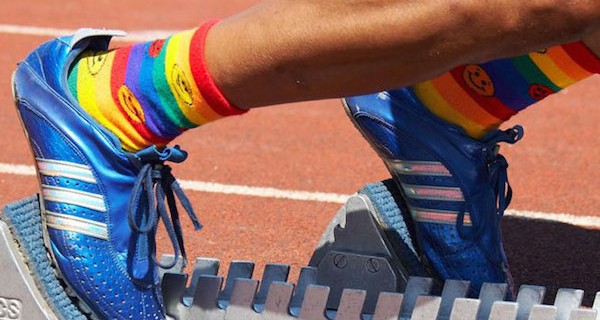 For the city, this was an opportunity to showcase its gems. For the Western Reserve Historical Society (WRHS), it was a way to tell the story we’ve been collecting for 23 years.
As it does with many current events in Cleveland, WRHS identified with the Gay Games through its extensive archival collections, specifically the LGBT Archives. This collection, which includes papers, documents, memorabilia, and more from the LGBT movement in Northeast Ohio, has been held by WRHS since 1991. From this archival collection, and with the help of friends at the Lesbian Gay Bisexual Transgender Center at Case Western Reserve University and the LGBT Community Center of Greater Cleveland, WRHS formed The Victory of Self, an exhibit focused on the history of the LGBT community in Northeast Ohio.
The cohesive gay community in Cleveland took on an approach of gradual change, as opposed to some of the more high-profile happenings, such as the Stonewall riots in New York City. Community centers began springing up in Greater Cleveland neighborhoods, publications informed individuals and groups of news from the local and national movements, and social hotspots formed over the course of the last 40 years. The circles of influence within the gay community have led to milestones including Cleveland Pride, the ongoing publication of the Gay People’s Chronicle, and of course Gay Games 9.
Dr. John Grabowski, who worked on the exhibit with student interns from Case Western Reserve University, once referenced an old warning about talking politics or religion in the neighborhood bar. 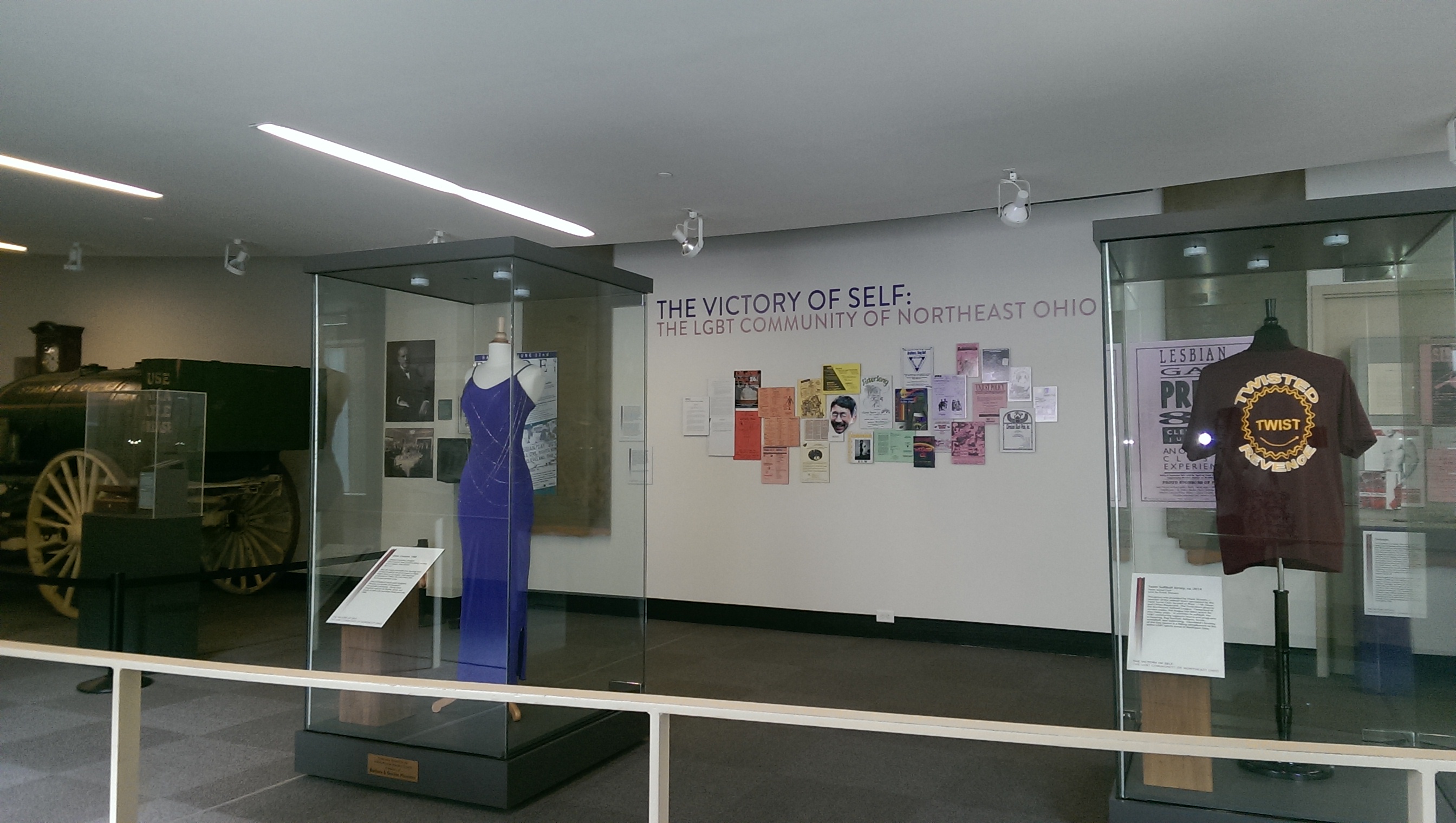 The topic of the LGBT rights can sometimes be heated between those who disagree but you won’t find room for argument in the preservation of the collections at WRHS. We take our responsibility to continue telling the stories of Northeast Ohio’s people seriously; so seriously that you’ll find the papers of former political rivals and foes occupying neighboring stacks in the Research Library.
That said, there were challenges with putting The Victory of Self together. In the early stages of collecting for the LGBT archives, the challenge was to discover and open up a history that had been largely hidden or denied. The close relationships with members of the LGBT community allowed WRHS to piece together the lives of many individuals and organizations that changed the landscape of the LGBT community in Cleveland. At WRHS, we’re proud of our ability to continue telling the stories of all Clevelanders and the impacts they’ve made – large or small.
The Victory of Self will remain on display at the WRHS History Center into 2015.
For more information on the collections of WRHS, visit www.wrhs.org/research.
The Public Display of Queer History
BY John D'Emilio ON November 26, 2014
Last month I made a trip to Cleveland to lecture at Case Western Reserve University. While there, I paid a visit to the Western Reserve Historical Society which currently has an exhibit on the LGBT history of northeast Ohio. The exhibit relies on materials in the collections of the Historical Society and moves from the 1930s forward to the present.
For the earlier period, it centers on life stories of some prominent members of Cleveland society who, while not “out” in the way we use that phrase today, were known to be gay – individuals like Winsor French, a Cleveland Press reporter; Leonard Hanna, Jr, a philanthropist; and Jerome Zerbe, a celebrity photographer. As the exhibit moves into the 1970s, the content becomes more overtly political and activist in its emphasis. Cleveland’s What She Wants, a feminist monthly magazine, which began publishing in 1973 is well-represented, as well as materials from the All-Ohio Gay and Lesbian Conferences that were a fixture of the 1980s.
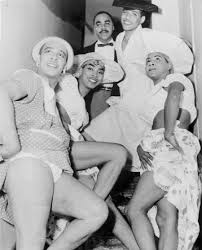
Performers in Chicago’s Queer Bronzeville
The exhibit, which is well-placed on the ground floor not far from an entrance, is hard to miss if you are visiting the Historical Society. It was a reminder to me of how important such public displays of LGBT history are and how almost unimaginable they would have been a generation ago. Three years ago, the Chicago History Museum mounted a major exhibit, “Out in Chicago,” that was curated by Jill Austin and Jennifer Brier. It was extraordinary. Organized thematically rather than chronologically, it filled something like five galleries in the museum, with photos, art, objects, music, film, newspapers, clothing, organizational materials, and video. Its time frame stretched from the mid-19th-century to the present. It was so rich that I found it impossible to take it all in on a single visit, and I’m someone who already knows a lot of queer history. Squadrons of students from the greater Chicago area visited the exhibit, and I could only imagine what an eye-opener it would have been for them, given how non-existent LGBT history is in high school classrooms.
The same year as the Chicago exhibit, 2011, the GLBT History Museum opened in San Francisco in the Castro district. Though it only occupies one large room in a storefront on 18th Street, the Museum’s exhibits are so rich and carefully organized that, on my visit, I felt as if I had worked my way through several halls of a museum. It is the first such museum in the world, and its opening attracted world-wide attention, with media coverage in dozens of nations and languages.
While the web represents a relatively new medium of communication that, through sites like OutHistory and others, is becoming a vehicle for the dissemination of LGBT history, museums and historical societies are public spaces that have been with us a much longer time but are now starting to display these histories. In presenting queer history outside the academic world, they help to make it part of public life. Cleveland, Chicago, and San Francisco are just three examples. I know there are more spaces that have already displayed this history. It would be a great project for local people to press more institutions to make LGBT history visible in their communities. What an achievement that would be!