


Looking back and Listening: Memories of Stonewall
BY Chris Gioia ON June 27, 2017
“Sheridan Square this weekend looked like something from a William Burroughs novel as the sudden specter of ‘gay power’ erected its brazen head and spat out a fairy tale the likes of which the area has never seen.” [1] This is how Lucian Truscott IV rather disparagingly characterized the Stonewall rebellion of 1969 in his eyewitness account published in the Village Voice on July 2nd of that year. The event was indeed something never before seen in New York City’s West Village, but was not the first time LGBT people stood up to police harassment. The Black Cat Tavern raid in Los Angeles and the Compton’s Cafeteria riots in San Francisco a few years prior also saw members of the community fight back against unfair treatment, police brutality and discriminatory laws that targeted the most unambiguous members of the community.
Its hard to imagine that in New York City in 1969, laws prohibited members of the same sex dancing together, restricted the sale of alcohol to homosexuals and penalized those who wore articles of clothing of the opposite sex, but it would take years of activism and action to have these officially taken off the books in the following decades. So, how did the Stonewall Inn become the birthplace of LGBT civil rights? Many details are hard to nail down and many debates have focused on the myths and mysteries of the Stonewall incident, but specific memories and stories help to paint a picture of the place and of the times. Bars like the Stonewall Inn represented a kind of reluctant haven for New York City’s downtown gay scene. Most patrons had a love hate relationship with the bar and its mafia controlled operators. The drinks were weak and over priced, the ambiance was dive bar but the vibe was by most accounts intoxicating if not fully liberating.
Bruce Monroe, who was a college student visiting from Indiana in 1969, describes his memory of Stonewall to me:
I remember … two dance floors and a big long wall down the middle. But I remember it being a very young lively crowd that I could relate to. It was like really exciting to see all these other young men that were around my age. I guess it was one of the most popular places for dancing in NY at that- there weren’t very many places around like that. And I remember having a great time there and I remember having to leave by myself because my friends had found elsewhere to spend the evening.
Historian John D’Emilio’s experience of the West Village as a college student in the late 1960’s is of a “whole gay world.” On two occasions he visited the Stonewall Inn with a friend and remembers the following:
. . . so anyway we go to Stonewall and of course the thing that was immediately apparent to me I mean besides the fact that it was, unlike Julius’ where there were a lot of people but it was conversation, and it was kind of quiet, Stonewall was wildly noisy and what do they have, but go go boys who were dancing you know, up on a platform wearing you know, kinda nothing, like a g-string, or just underpants, and it seemed very exciting to see and experience something like that!
Author Felice Picano has written about Stonewall and been involved in gay literature/publishing since the 1970’s. He wasn’t a fan of Stonewall in 1969, but recalls that it could be useful:
. . . if you found somebody interesting and you sorta wanted to feel them up and feel them out before you took them home you’d take them around the corner to the Stonewall and slow dance in the dark and figure out what you wanted . . . it became by the time the incident happened, a place for trannies and for people who were not quite street people but almost, and sometimes the hustler boys who would hang out in front of it in the park in Sheridan Square would go in too. So it had this very, very mixed vibe and, and I was always hearing that it was closing down, that it was going bankrupt.
Trans activist Miss Majors introduces her story to Felice Picano in a rare correspondence:
Miss Majors: I’d had a tough day, and I heard that that singer Judy Garland had died. I wasn’t a fan of hers, but I didn’t feel like being alone, so I went down to the Stonewall. That was our club, where the other “T’s” and I could hang out and relax and be ourselves. [2]
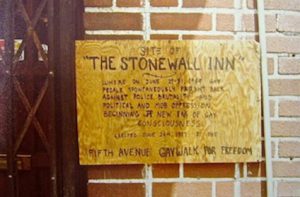
Stonewall Plaque placed in 1977 by the 5th Ave. Gay Walk of Freedom. LGBT Community Center Archives, Grillo Collection.
Pioneering gay journalist Mark Segal provides a first hand account of being inside the bar that night:
I remember the lights flashing. I remember asking somebody …“what does that mean?” And someone said, “Oh we’re just going to be raided!” And everybody who was a regular there took that very nonchalant. They were just used to it cause that was part of what life was like for gay people at that point. Me on the other hand had never been through a raid. I tried to look nonchalant but I gotta tell you its not –[laughs] I was very nervous. … As people were coming out they started forming a semi circle around the door and that eventually – and as the police let out more and more people at one point the only people left in the bar or most of the people left in the bar were the people that worked there and the police. At which point people just started throwing things at the door. Um, [sigh] that’s basically when people started breaking things, running up and down the street. [3]
Activist Martha Shelly recalls in my interview with her last year, how the liberation movement was energized by Stonewall:
Monday I read about the riots in the newspaper and I thought that was what it was about! I read about the Stonewall Riot in some small article in the New York Times or the New York Post I don’t remember which and I immediately called . . . Jean Powers and she was the person who was getting out the newsletter and organizing meetings. I called her and said we have to have a protest march. She told me to call the head of the Mattachine Society and she said if they’re interested we could jointly sponsor it. …So I called Dick Leitsch who was the head of the Mattachine Society. He said they were having a meeting at Town Hall to discuss all of these things and what it meant for the gay community and come to the meeting and put my proposal out and that’s what I did.
Craig Rodwell, owner of the Oscar Wilde Memorial bookshop on Mercer St. at the time of the riot, sums up the significance of Stonewall:
Immediately I saw that this was something that was going to have an impact in the future for the movement because I’d been saying for years that something would happen- there would be a spark. I recognized instantly that this was it.[4]
Today the Stonewall Inn is an iconic symbol of the birth of LGBT rights and has secured its place in history by being designated a National Monument. To learn more about the liberation movement and hear more of the interviews I conducted visit www.stonewallhistory.us and for additional first hand testimony about Stonewall listen to a wonderful radio segment from 1989 here: Remembering Stonewall
At a performance upstairs at the Stonewall Inn not too long ago, I was shoulder to shoulder with a truly diverse mix of patrons: trans women and men, lesbians, drag queens, regulars who call the bar a hangout, more than a few allies, and of course tourists checking another landmark off their list. I like to think that the pioneers of the liberation movement who have passed, would be proud of what the reincarnated Stonewall represents, but I’m sure if asked a contentious debate would ensue. After all, if its not worth arguing about, was it worth fighting for?
Gay Power!
[1] Lucian Truscott IV, “Gay Power Comes to Sheridan Square,” Village Voice, July 2, 1969, accessed December 10, 2016, http://www.villagevoice.com/news/stonewall-gay-power-comes-to-sheridan-square-6670443.
[2] Felice Picano, “The Remains of the Night: Six Observers: Felice Picano Talks with Eyewitnesses to the Stonewall Riots,” The Gay & Lesbian Review Worldwide, 2015 (4): 29.
[3] Mark Segal, interview by Christopher L. Gioia, February 7, 2017, interview.
[4] Tina Crosby, “The Stonewall Riot Remembered, Excerpt 2,” Stonewall: Riot, Rebellion, Activism and Identity, accessed April 14, 2017, https://stonewallhistory.omeka.net/items/show/25.
Emerging LGBTQ Scholars Reflect on Dawn of Trump Presidency
BY Eric Gonzaba ON January 2, 2017
 I like to think of OutHistory as a sort of historical queer think tank, allowing scholars and the wider public alike to engage with LGBTQ studies and to ponder difficult questions about sexuality and gender. The OutHistory team graciously lets me muse about various topics from time to time, and America’s fractured political atmosphere seemed an obvious angle on which to write. However, with a Trump presidency just on the horizon, collaboration with various colleagues seemed more fitting a means of contemplation.
Below, I’ve invited a group of emerging LGBTQ scholars to reflect on the era of Trump, curious of what they think led to this man’s ascendency to the highest political office in the land, how they believe his administration will affect current LGBTQ movements, and in what way their own work in LGBTQ studies reflects the current political atmosphere. These individuals represent the future of LGBTQ scholarship. If their words indicate anything, it’s that the vigorous study of the queer past and present appears in good hands.
Best,
Eric Nolan Gonzaba
——————————————————————
Harrison Apple, Our Situation is White Supremacy and Mass Incarceration
Rachel Gelfand, Surveillance Constancy: Trump on the Threshold
Eric Nolan Gonzaba, The Queer Arc of Justice
Daniel Manuel, Complexity Can Give Us Hope
Sarah Montoya, We Stand On the Backs of Many
Chris Parkes, Reflecting From Across the Pond
Kristyn Scorsone, Oral Histories Speak Truth to Power
Terrance Wooten, Against the Romance of Futurity
 Our Situation is White Supremacy and Mass Incarceration
Harrison Apple
PhD Student, Gender & Women’s Studies, University of Arizona
Co-Director, Pittsburgh Queer History Project
In the summer of 2016, I was interviewing a woman as a part of my research on working class LGBT history in Pittsburgh, PA. Speaking about her feelings of contradiction she said, “for being gay, I have liberal policies on some things, but very conservative on others…” She then asked me, “Who do you like for President?” I had never been asked that question in an interview before, and I quickly began to ramble before settling on, “I just don’t know.” Mirroring her, I asked who she liked and she said, “I’m leaning towards Trump.”
I reflect on that conversation often, and the way she phrased it. “Who do you like?” sounded as much like a bet as a preference. Perhaps interpreting it as a bet was a form of disavowal. Rather than believe someone when they tell you that their imagined future is anchored in your own oppression, I pretended she was making due with her options, in the same ways he described her distaste for political correctness and our waning ability to take a joke.
Moments like these – of which there are plenty, believe me – demonstrate what I believe Teresa de Lauretis meant when she said, “the time for theory is always now.” Regardless of who is elected, in the next four years we are all going to be asked to make decisions that we will want to believe are unmotivated, objective, or neutral when they are not. We will be asked to preserve our own sense of security-futurity through the punishment-death of others.
This is by no means a new phenomenon. For many, the reality of a Trump presidency may mean little substantial shift in their everyday lives. The white supremacy that was eluded to by the woman I spoke with, saying that political correctness has hindered out ability to effectively enact racially profiling and support homeland security, is only one manifestation of anti-blackness that subtends LGBT U.S. history as a frequently deracialized field of study.
Rejecting the reality that a rights-based political platform is made possible with the same apparatus that has subtended white supremacy and cishetero-patriarchy (such as the prison industrial complex, overreaching surveillance, and dubious hate-crime legislation) is another form of disavowal. I’m reminded of Jonathan Ned Katz’s introduction to Gay American History in which he says, “all homosexuality is situational.” A political climate of white supremacy and mass incarceration is our situation. It is our responsibility to think through it.
——————————————————————

Surveillance Constancy: Trump on the Threshold
Rachel Gelfand
PhD Student, American Studies, University of North Carolina
Outhistory is a space, digitally housed, for historicizing queer movements. It holds what Ann Cvetkovich termed “archives of feeling,” an attention to the loves, losses, and liminalities of queer historical subjects. My research for the last few years has attended to questions of intergenerational history-making, the transmission of gay and lesbian activist strategies, and the passing along of experiences of surveillance. I am interested in how archives and oral history offer forms of time travel that transgress while simultaneously being institutionally bound, preserved by universities, libraries, government bureaus.
Living in North Carolina, I have focused on the Atlanta Lesbian/Feminist Alliance and traced how founding members “came out” of left movements. Many Atlanta feminists were on Cuba’s Second Venceremos Brigade, a part of Civil Rights activism, and key organizers working against the Vietnam War. For these actions, surveillance followed. While FBI agents struggled to find information about lesbian feminists, their presence was soon felt. In Atlanta, the FBI arrested an ALFA member in her lesbian collective house for antiwar activities. In Lexington Kentucky, a grand jury probed local lesbian connections to Susan Saxe, an underground lesbian activist.
With Donald Trump’s impending inauguration, my thoughts have been on his connections to this lineage of surveillance. I have been reading Simone Browne’s Dark Matters, in which she historicizes surveillance and its counterpart sousveillance, the people’s capacity to record state mechanisms. Surveillance systems grew out of histories of colonization and enslavement, a centuries-long process of biometrics. In my own research, I see cyclical fears of FBI presences. COINTELPRO and the anxiety it mustered echoed the McCarthy era of ALFA activists’ childhoods. Grand juries mirrored the House Un-American Activities Committee. Trump’s ideologies resound those of his mentor Roy Cohn, Joseph McCarthy’s star litigator (famously depicted in Angels in America). J. Edgar Hoover’s wiretap methods have played out on a digital scale in my lifetime and it seems the NSA’s role will only intensify. Reflecting on these connections, I think of my grandparents and great-grandparents living in Trump’s Brooklyn tenements. I think of my lesbian mother’s red-diaper-baby childhood and the fear she carries today.
Last Friday, I went to a protest here in Raleigh. Republican state legislators were in the process of passing bills to strip the incumbent Democrat governor of that post’s customary powers. Protests were loud and coalition-based, but Republicans did not bat an eye. With both press and police filming protestors, state legislators voted unviewed.
My time in North Carolina has made me acutely aware of legislative violence. Trump is one thing—something quite scary. His presidency emboldens patriarchy. The bullying culture he incites inherently hurts minoritarian communities, hurts queer people. But the racism of federal and state legislatures works on the level of the everyday. While Trump stokes white fears of a demographic shift toward black and brown political power, Paul Ryan and Mitch McConnell stall on passing an updated Voting Rights Act. The lack of preclearance, or federal oversight of voting law, is felt in quotidian life. The Supreme Court’s 2013 decision to gut the Voting Rights Act has led to violence that cuts across identity categories. In North Carolina, legislative gerrymandering has precipitated HB2, no Medicaid expansion, ransacked public education, voter suppression, and measures against police transparency. At Friday’s protest it was clear: the same politicians who are transphobic, are racist, sexist, anti-worker, xenophobic, islamophobic, and are swiftly moving on legislation in line with those ideologies. As a queer Jewish historian, I hope the Trump years increase solidarity and the fusion politics North Carolinians utilize. I hope, for example, Jewish communities will ally with Muslim communities.
Surveillance for my generation has been a constant. But for me it has been helpful to understand the racist historical underpinnings that produced the data-driven system we live within. My study of lesbian activism has been grounded in ALFA’s grassroots archives and FBI archival materials. I encourage historians thinking about this historical moment to look to both those archives for insight into creative resistance (radical softball teams, newsletters, bar life) and surveillance’s stumbling blocks. For historians of queer life, this work must continue to be framed by intergenerational dialogue. Outhistory can be a great resource toward these ends!
——————————————————————

The Queer Arc of Justice
Eric Nolan Gonzaba
PhD Candidate, History, George Mason University
Director, Wearing Gay History
Echoing the words of 19th century abolitionist clergyman, Dr. Martin Luther King, Jr. proclaimed many times throughout his life “the arc of the moral universe is long, but it bends toward justice.” Assuming King is right (and that’s a big assumption) after the recent election, it’s really hard to see that bend, especially if you’re a person with a disability, someone of Latino heritage, a Muslim seeking asylum in the “land of the free,” or anyone who understands that grabbing anyone by their private parts without consent constitutes sexual assault.
And yet, Donald Trump won a majority of votes in the Electoral College, and will become the 45th US President. President Obama’s departure from the White House seems so devastating to so many LGBTQ people because the Obama years felt like an era of change. Certainly there were big victories—marriage equality, the end of Don’t Ask Don’t Tell, the election of the first openly lesbian woman to the US Senate and the first openly bisexual person to become a governor. President Obama’s Attorney General Loretta Lynch even launched a suit against North Carolina and it’s anti-trans bathroom law. On behalf of the administration she served in, Lynch told trans communities that “we see you; we stand with you; and we will do everything we can to protect you going forward.”
There were also setbacks—the continuing attacks on trans people, especially trans women of color, persistent bullying in schools, the passage of so called “religious freedom bills” in GOP controlled statehouses, and the fact that LGBTQ people made up the vast majority of victims at the deadliest terrorist attack on U.S. soil since 9/11.
As historians, Trump’s victory is a call for us rethink how we teach history. The cliché answer students give me when I ask “why do we study history,” is some variation of the famous Santayana quote “Those who cannot remember the past are condemned to repeat it.” I mean . . . I guess? Though, I know lots of historians and we aren’t an army of modern Nostradamuses over here. Historians can certainly inform the present and give us tools to shape our futures, but I often respond to this answer by asking my students why they assume we’re living in some utopia compared to the past? Maybe those who cannot remember the past are condemned not to repeat it. Imagine for a moment future Attorney General Jefferson Beauregard Sessions ever telling transgender Americans that they have a friend in the Trump administration. While we all may be guilty—at times—of interpreting the past through rose colored glasses, it is clear that our future is no safe haven.
The Obama years were—by no means—Camelot, but the social progress during those eight years for some queer people was laid brick by brick by those who fought decades and centuries earlier. Our queer past isn’t something we study to pat ourselves on the back; rather, these requisite recounts of past tragedies and achievements give us necessary perspective to celebrate change and acceptance. More importantly, this history should embolden us all to fight injustices that some continue to overlook—and many continue to endure. The comfort of a supportive president is gone, and along with him should go our complacency to challenge and fight inequalities.
King may have been right; the arc may bend toward justice, but let’s not wait around to find out. We ought to bend it ourselves.
——————————————————————

Complexity Can Give Us Hope
Daniel Manuel
PhD Student, History, Rutgers University
I am a historian of the AIDS crisis in Louisiana in the 1980s and 1990s. I spent the first twenty-four years of my life in Louisiana, and my research is as much an effort to understand the world in which I came of age as it is an effort to historicize why Louisiana is at the forefront of the contemporary HIV epidemic.
Yet, my work also recognizes possibilities for resistance, even in hostile times and places. In recent days I have conceived of my work, and the work of historians, as arguing for the complexity of the past. Under an administration whose campaign suppressed narratives it found troublesome and rejected complexity in favor of simplistic mantras, historians are truly obligated to uphold complicated truths. In this disempowering post-election moment, a complicated past is a powerful past. I would like to explain by offering a few takeaways from the history of AIDS activism:
The Right is not monolithic. Historians, including Jennifer Brier in Infectious Ideas, have highlighted Republicans’ fault lines during the Reagan administration, as multiple issues divided the Right in the 1980s. Gary Bauer and other members of Reagan’s cabinet sharply conflicted with Reagan’s own Surgeon General, C. Everett Coop, over the administration’s approach to preventing HIV transmission. Similarly, we witnessed Trump’s difficult relations with the Republican establishment during the primaries, and, while many establishment figures have attempted to atone for earlier disagreements, the Right remains visibly fragmented. We should recognize that Trump’s administration comprises cabinet members and advisers with competing interests and outlooks. Despite the wishes and pronouncements of Trump and others, the Right is not unified, and its internal disagreements are potential sites of challenge and contest.
The Left lives on. Particularly when riven by internal conflict, the Right cannot quash all opposition. Populations and people marginalized by Trump’s victory are not powerless. Even in moments when conservative social and political messages predominate, they do not stymie the vital and ongoing work of the Left. Our organizing efforts endure, perhaps with renewed vigor and inspiration in the face of a hostile political administration and social climate. What we have to recognize is that the Left is alive in ways that are often ignored. In the 1980s everyday actions, like grocery shopping for a person with AIDS or writing a letter to a newspaper editor about living with HIV, were profoundly powerful. We can remember that in uncertain times, as the AIDS epidemic began to rage in the early 1980s, marginalized populations banded together to care for one another. These simple acts disrupted and displaced, even if temporarily, public rhetoric and attitudes that were heterosexist, racist, misogynistic, and classist. These simple acts asserted the value of lives deemed worthless by mainstream conservative attitudes. Many disregarded the social stigma attached to AIDS to care for friends, family members, lovers, and strangers. These practices were never perfect, and we should keep in mind the need for intersectional organizing, as we simultaneously reject limited conceptions of community. Nonetheless, the Left is alive and powerful.
Accordingly, we should recognize local and everyday politics as sites to challenge oppression. National elections and legislation are not the only measures of power. As HB2, the transphobic bathroom bill, in North Carolina and the recent rash of legislation restricting abortion access in Ohio and Texas have shown, we will be fighting for bodily autonomy and personal dignity at the state and local levels, too. Moreover, we have to remember that political power also lies beyond legislation. Local organizations provided the first care for people with AIDS, and I think often of what it meant to care for a person with AIDS before the advent of life-sustaining drugs. By refusing to let lives slip away and refusing to let people die in degrading circumstances, AIDS activists sent a political, life-affirming message. Caring for one another is a potent and meaningful political and human victory.
All this to say, historians are obligated to challenge narratives that claim the Right is all-powerful, that the Left is utterly lost, or that national electoral and legislative victories are all that matter. The present, like the past, is more complicated. That complexity can give us hope to carry on.
——————————————————————

We Stand On the Backs of Many
Sarah Montoya
PhD Student, Gender Studies, University of California, Los Angeles
In the days after the election, I found myself profoundly numb. The stillness was only periodically punctured by waves of fear and anger. As a victim and survivor of domestic violence and sexual assault, I wept. As a queer woman of color, I wept. For two weeks, I recoiled into myself and did not write. But I knew better than to ask the question, how could this happen?
The ideology and political, imperialist practices of this country are deeply invested in a white supremacist capitalist heteropatriarchy. The creation of this country was and remains contingent upon the dispossession of Native peoples and the systematic denial of their sovereignty. The American economy was built upon the backs of Black slave labor. It remains contingent upon the exploitation of people of color both here and abroad. This was never a place that offered recognition or protection to Black folks, Native folks, or queer folks of color. The promises of citizenship and legal recognition or protection have largely been illusory. Today, we see this legacy of violence at Standing Rock, in the state-sanctioned murders of men and women of color in our streets, in the brutality visited upon transwomen of color, and the rampant xenophobia aimed at Muslim communities and the undocumented.
For many of these communities, life will continue to be as precarious as it has always been. Perhaps we can begin the necessary work by holding ourselves accountable. I am a Ph.D. student at a Tier-One University on what was once Tongva territory. I value my work as an educator, but I am not naïve to its context. The university is, first and foremost, a business. The work I do is only valuable if it is accompanied by daily practice and I am willing to put my energy into the community outside the university grounds. We must continually ask ourselves, how can I be of service to the community? How is the work that I am doing helping to redistribute resources to those most vulnerable?
We cannot build radical communities or movements if we do not grapple with these realities. Many of us were not afforded the luxury and privilege of “shock” at this election’s outcome. We cannot afford to confuse progress towards social justice with neoliberal progressive politics. Here, we see the failure of single-issue politics and the need for intersectional analysis and political practice. Our political agendas should advocate for those continually and repeatedly rendered most vulnerable. To celebrate our existence is not enough, and our mobilization in the wake of a Trump regime means that coalition building is crucial.
In “The Transformation of Silence into Language and Action,” Audre Lorde writes, “For to survive in the mouth of this dragon we call america, we have had to learn this first and most vital lesson – that we were never meant to survive. Not as human beings. And neither were most of you here today, Black or not. And that visibility which makes us most vulnerable is that which also is the source of our greatest strength.” Lorde delivered this paper in 1977, and, nearly forty years later, the sentiment rings true. There is a long and storied history of survival and resilience around us – in the faces and stories of our elders and in the literature of women and queers of color. This is not the first time that we are struggling against domination and injustice. We are not doing this alone; we stand on the backs of so many.
——————————————————————

Reflecting From Across the Pond
Chris Parkes
Graduate Teaching Assistant, International History, London School of Economics and Political Science
More than once in the past month I have encountered historians here in the UK contemplate refusing to return to the United States because of the election of Donald Trump. There is something about the prospect of his presidency that fills some Americanists in this country with a palpable sense of revulsion. Much of it is distaste at the xenophobia, racism, sexism, homophobia, and a litany of other obloquies that can be rightly leveled at the candidate and his campaign. But there is something deeper, too. Perhaps it is the inevitability of having to see Mr. Trump’s incandescent mug displayed in the entryways to the National Archives and the Presidential Libraries in which we conduct much of our research. More likely it is a sense of anguish, despair, or even betrayal that the United States – a beacon of hope amid the gloominess of Britain’s Brexit winter – would succumb to the same populist backlash that has roiled this country. Best to turn our back, impose a personal embargo on the Yanks, and hope things turn around in four years time.
Those of us outside the US have the luxury of being able contemplate such remedies. But how much comfort does distance really provide given the enormity of recent events? For LGBT historians in particular the populist revolt of recent years portends a deeper crisis. The rise of the far right in France, the Netherlands, and other European countries, the clampdown on academic and press freedom in Turkey, the spike in hate crimes in the UK following the victory of the Leave campaign in the EU referendum, and, of course, Mr. Trump’s election represent not only a rejection of ‘elites’ but also a repudiation of the pluralist ethos that has underwritten the study of sexuality as a historical subject. For a (sub)discipline built on the recognition of the lives of the powerless, the nonconforming, and the despised, validation of casual bigotry and alt-right authoritarianism by the imprimatur of electoral success poses an existential threat.
If this sounds alarmist, it should. LGBT historians have a particular incentive to speak out in times of rising intolerance to dissent. Our subjects and their stories are salient because, more often than not, they concern those who occupied the margins of society. They were the first targets of oppression by the state, the mob, and civil society when demagogues fanned populist anger or induced people to look for scapegoats. Sexologists in Weimar Germany, gay and lesbian civil servants in the Federal Government during the Lavender Scare, and radical AIDS activists during the 1980s, to name but three examples, all endured official opprobrium in a political climate that deemed sexual diversity to be dangerous. Studying their successes and failures reminds us of how tenuous gains in civil rights can be and how intolerance of one minority group is rarely an isolated lapse in a society’s treatment of its most vulnerable citizens.
Bearing this in mind, LGBT historians in the coming years can reassure themselves that they have more resources, colleagues, and platforms to draw on than preceding generations did. The interconnectedness of contemporary scholarship – spanning continents and crossing disciplines – provides an armature to withstand the coming trials, provided we keep speaking out and do not stay home hoping it will all pass.
——————————————————————

Oral Histories Speak Truth to Power
Kristyn Scorsone
MA Student, History, Rutgers University – Newark
Team Member, Queer Newark Oral History Project
In the short time we have before the President-elect takes office, scientists are pushing to archive as much U.S. government data on climate change as possible. According to a recent article from the Washington Post, the scientific community is highly concerned about the new administration’s bent towards scientific suppression. Although the inauguration is still a few weeks away, there has already been an insidious request by Trump’s transition team for lists of Energy Department employees and contractors who have taken part in climate change talks. To date, the Energy Department is resisting and in Toronto, climate change data from the Environmental Protection Agency will be mass copied as part of a “guerrilla archiving” hackathon event.
As these storm clouds continue to gather over our political landscape and the word of the year is “post-truth,” the work of the Queer Newark Oral History Project feels more crucial than ever. Writer and activist Darnell Moore, who was also the first chair of the City of Newark’s Advisory Commission on LGBTQ Concerns, Rutgers-Newark history professor Beryl Satter, and Rutgers-Newark Department Administrator for History and African American and African Studies Christina Strasburger started the project in 2011 as a community-based and community-driven endeavor. Queer Newark’s focus is to document Newark’s urban communities of color in an effort to expand the dominant historical narrative, which largely ignores the contributions of queer people of color. In Trump’s Amerikkka, lies made up of 140 characters are eaten up by far too many people convinced a billionaire has their best interest at heart, while in depth political analysis and fact-finding by reputable journalists gets dismissed as “butthurt” rants. It is hard to say where the obfuscation of truth will extend its reach next. Therefore Queer Newark, and public history projects like it, are more than a repository of human experience, they become an important part of the defense against authoritarian influence.
While Tony Perkins, Trump ally and head of hate group, Family Research Council, calls for a “purge” of pro-LGBTQ employees from the State Department, Queer Newark provides a counter-narrative to the spread of hate speech and misinformation dangerously hostile to queer individuals and families. On our website, black lesbian narrators like Renata Hill and Venice Brown—two of four friends who were characterized by the news as a “Gang of Killer Lesbians” and sent to prison for defending themselves against a man who violently attacked them because of their sexuality—expose the intersections of racism and homophobia in our court system and media. You can also listen to Alicia Heath-Toby describe what it was like for her and her partner to be the only African American lesbian couple in the 2006 legal battle for marriage equality in New Jersey. Without the preservation of stories like these, the new administration’s vision for our nation gains another foothold.
Michel-Rolph Trouillot in his book, Silencing the Past: Power and Production in History, writes, “History is the fruit of power, but power itself is never so transparent that its analysis becomes superfluous. The ultimate mark of power may be its invisibility; the ultimate challenge, the exposition of its roots.” (xix) We must question what truths are lost from our historical records in order to dismantle dangerous ideologies of hegemonic forces. If you allow silences in the archive to persist, you allow power to exist unquestioned. The oral histories of Queer Newark speak truth to power. They disrupt the dominant paradigm and disseminate knowledge as a powerful act of resistance.
——————————————————————
Against the Romance of Futurity
Terrance Wooten
PhD Candidate, American Studies, University of Maryland
A little over a month ago I sat with a group of [predominantly liberal, white] coworkers processing various reactions to the outcome of the recent election. During our conversation, they almost uniformly expressed their genuine disappointment in the election results as well as their overall surprise at the increasing intensity with which acts of violence are happening against black and brown people—often queer and women of color—“in 2016.” Their surprise combined with the assumption that these issues should not be prevalent at this particular moment in our history suggests a progressive teleology wherein we should have arrived at a type of multicultural liberalism by now. We should be beyond sexism. And homophobia. And racism. The conversation sounded just like the ones I had with my [predominantly liberal, white] colleagues almost a decade ago during my undergraduate career while recounting childhood experiences growing up in a small rural town in central West Virginia.
My family moved from Sandusky, Ohio to West Virginia the summer before I started the seventh grade. At the time, the only cultural context through which I understood WV was the 1999 horror film The Blair Witch Project, which had just debuted. Needless to say, I was adamantly resistant to transplanting from a place where I had thriving friendships, familial relationships, and “a life” to one where an unidentifiable witch might lurk through the forest to claim my soul. On the first day of school, I found out how wrong I was; besides the fact that I had since dispelled all the myths presented to me in the film, I was confronted with the real threat lurking in the background.
It wasn’t witchcraft; it was racism. Interpersonal. Structural. Systemic. Racism. The stories are endless. Ask me.
That is to say, when I was just twelve-years-old I was forced to think deeply about how race, geography, and sexuality intersected. It was then that I started to realize the tapestry of American empire was sewn together through, against, and on the backs of black and brown folks, that there was no progress narrative to which I could cling, despite my colleagues’ desires, as the only progress I could ever measure was in my own change in height. And yet, every time I retell stories of my childhood, there is inevitably one—or four—person(s) who seems surprised, who is genuinely taken aback by how such racism could exist in 2000 (or 2005 or 2011 or 2016). What this tells me is people are profoundly committed to seeing this moment right now as one that is better than the moment preceding, as understanding the present as much better than the past and the future as always having the capacity to be even better than the now. And yet, there has been a cultural shift (at least amongst many liberals, perhaps exacerbated by Trump’s own campaign refrain to make American great “again,” which is to say to return to the past) since the election wherein the representations of the future have been fraught with a type of nihilistic, post-apocalyptic skepticism that suggests there is nothing forward to which we can look (presuming there ever was). While I want to otherwise resist this impulse, I think this is a productive place to sit for a while—a place of discomfort, a place that queer men and women of color often sit. Not to empathize. Not to know or consume the Other’s pain and trauma and trepidation. To strategize. To rethink time and the value of futurity. To reassess our relationship to the state and to think more critically and creatively about how to engage the state and state agents such that we account for the many people who cannot altogether afford to disavow it—people receiving housing subsidies, affordable healthcare, public assistance, and other forms of social welfare—while simultaneously not reinvesting in it as a site or recovery and retribution. It is a time to not only listen to but also center the voices and experiences of queer people of color. We have to work across and through difference, creating safety networks for when the state works—and it assuredly will—against us.
The day after the election, I did not mourn or cry or panic. Instead, I curled up and reread Wahneema Lubiano’s edited collection The House That Race Built. Not because I am better than or built differently from others but because being a black queer man in America has taught me that Trump is simply an embodiment of all of the intersecting modalities of oppression I—and many others before and with me—have encountered and been fighting against. I hope this moment encourages others to join. Right now. For now. Against the future.
What LGBT Digital Public History Requires
BY Claire Potter ON October 26, 2016
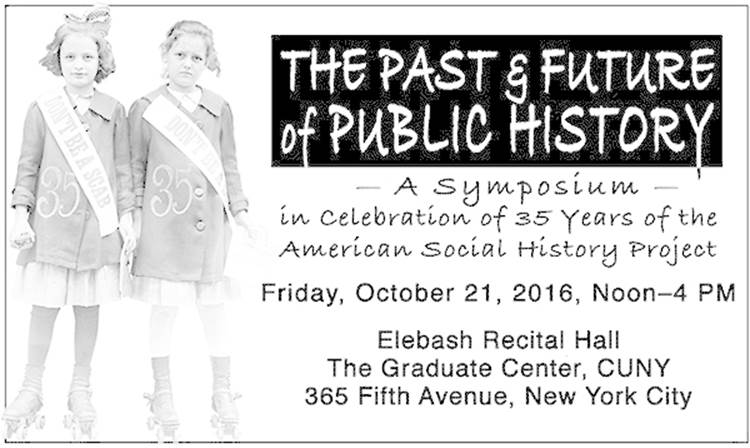 On Friday, October 21, the American Social History Project/Center for Media and Learning at CUNY Grad Center celebrated its 35th anniversary. As part of hte celebration, I participated in a roundtable about the achievements, and future challenges, of public history. These were my remarks.
First of all, Happy Birthday, American Social History Project, a collective scholarly effort that led the way in bringing social history’s commitments, not just into the mainstream of the historical profession, but also into the K-12 classroom. I think it’s reasonable to say that without ASHP, public policy interventions like California’s FAIR Act, that mandates LGBT history in secondary education, would have been far less likely. We would also know a great deal less than we do about how to transform the conversation about the history curriculum at all levels of education, and how to implement necessary changes. ASHP was a pioneer in the creation of digital resources that brought state of the art history to broad audiences. ASHP’s effort to put a ground-breaking textbook, Who Built America, in conversation with digital archives, helped to conserve the historical profession’s commitments to critical thinking, and to teaching students how to make arguments drawn from primary sources. Establishing itself in the 1980s and 1990s, our colleagues made an enormous contribution at a moment in history when high stakes testing based on so-called “content delivery” began to transform the landscape of the humanities and social studies.
As a young historian interested in women’s history and the history of sexuality, I had a front row seat while this was happening. In the 1980s, I was a graduate student at NYU, in a history department that had fine archives and public history programs, as well as a cadre of graduate students vitally interested in the women’s and LGBT history projects that were emerging from the social hisstory movement. For a time, I was also part of the Radical History Review collective, and all of these groups overlapped.
I never became a real public historian: I have to emphasize this to people all the time, because the increased association between public history and digital history, in which I now engage and that ASHP promoted, increasingly muddles the two – particularly in the minds of administrators. But my friends were public historians. Between those friends and the osmosis that naturally occurred as we all migrated between Columbia, CUNY, Rutgers and NYU, public history had a great impact on those of us in the emerging fields of women’s history and the history of sexuality. The public history commitment to change through uncovering a past and making it accessible was never distant from the projects I, or we, took up as we established ourselves in the profession. And I think public history has proliferated in ways it did not anticipate at its moment of origin: in blogging, particularly feminist and queer history blogging; podcasting; and in the emergence of #twitterstorians, who chronicle the present, create historical narratives on the web, and tweet conferences like this one.
So what remains to be done – other than getting rid of high stakes testing? First on my list, as a co-Director of OutHistory.org, where I have finally assumed a role as a public historian, would be digital literacy. This is a project in which I am engaged at the Digital Humanities Initiative at The New School, where OutHistory.org is currently based. One of the things I have learned since we launched the DHI is that the assumptions of digital practitioners and the ambitions of administrators to support public scholarship are profoundly at odds with the proficiency of most faculty and students to conceive or engage either digital pedagogies or publicly engaged digital projects. If you don’t know what you don’t know, creating the intellectual architecture for a digital public history project, even from the simplest tools, is difficult to impossible. Learning from one may be equally difficult, because of DH’s non-linear qualities. In addition, the problem with moving scholarship to the Internet, as many of us know, is that questions of accessibility are quite different and engage fields well beyond history: broadband access, universal design, reading practices, the capacity and durability of tools all have to be addressed to create a truly public project. None of these skills are routinely taught in history graduate programs.
The second is that queer digital projects need to be in better conversation with each other, and learn better how to support each other. In fact, I would like to see a major digital summit that brings all public history practitioners and digital historians together for a week to assess and refresh our collective practice and resources. ASHP has been consistently at the forefront of digital history practice, and its members and fellow travelers wrote some of the earliest and most important books about digital history practice and designing for the history web. Yet the digital requires particular acts of preservation and, most importantly, revision that too many of us are either not good at, uninterested in, or have no time for because we are moving towards our next project, grant or book. These acts of revision range from refreshing important early texts that have become outdated because of advances in technology, to routine maintenance of the kind that all platforms and sites require, to keeping up with new devices that change the way that people access web content. At OutHistory.org, part of our public history mission is to engage youth, who tend not to sit in front of computers, but use mobile devices. Thus, those of us who learned to design for the web as recently as ten years ago, now need to retool to design for iPhones and Galaxies. We may need to design for apps to truly keep up.
Which brings me to my final, and most important, point: most of us are in desperate need of money. We at OutHistory.org believe ourselves to be engaged in a public history project that may even save lives: suicide rates among LGBT youth are astronomical, as is homelessness, addiction and unemployment. It is a long standing premise of LGBT social history projects that we not only preserve and uncover, but use history to reach out to our brothers and sisters who are marginalized and oppressed because of race, age, nationality, gender and class. But although LGBT foundation and social justice funding has made the turn from marriage to youth outreach, they aren’t particularly interested in funding history. And frankly, public history – whether digital or not – is expensive. So at this 35 year birthday we want to look back at our successes – and we will want to work with practitioners across the profession to make the arguments that can take our scholarship and activism to the next level.
Even small donations suppot our work. If you want to donate to OutHistory.org, please click this link.
Gay Gotham | Museum of the City of New York | 10.7.2016
BY Claire Potter ON September 20, 2016
 Gay Gotham: Art and Underground Culture in New York is opening at The Museum of the City of New York on October 7. Stephen Vider and Donald Albrecht, co-curators of the exhibit, also have a book of the same name available for pre-order on Amazon.
The exhibit and book explore the lives, works, and networks of ten LGBT artists across the 20th century — Harlem Renaissance writer Richard Bruce Nugent; lesbian poet and playwright Mercedes de Acosta; ballet impresario Lincoln Kirstein; photographer George Platt Lynes; composer Leonard Bernstein; artist Andy Warhol; photographer Robert Mapplethorpe; lesbian feminist artist Harmony Hammond; transgender artist Greer Lankton; and dancer/choreographer Bill T. Jones. It also examines the broader cultural world around them, with additional original works, including photographs by Carl Van Vechten; Charles Henri Ford’s copy of The Young and Evil, with drawings by Pavel Tchelitchew; one of Beauford Delaney’s portraits of James Baldwin; Larry Rivers’s portrait of Frank O’Hara; photographs of WOW Cafe performers by Eva Weiss; Chantal Regnault’s photographs of Octavia St. Laurent, Willi Ninja, and others from the house ballroom scene; as well as video, music, and poetry read by Carmelita Tropicana, Moe Angelos, and Rodney Evans.
You can read a little more about the exhibit in the New York Times. Tickets are available for the opening event, a discussion on the past and future of LGBTQ New York featuring Sarah Schulman, Jack Waters, Peter Cramer, and Harmony Hammond, and moderated by Slate editor Bryan Lowder, at 6 pm October 6.
The Victory of Self
BY Kevin Ewing ON December 22, 2014
by Alyssa Purvis
San Francisco, 1982. 1,350 athletes from all over the world came together to make history in the most inspiring way ever during the first ever Gay Games. This past summer, Cleveland hosted the 9th Gay Games and with the celebratory nature of the Games came 20,000 participants and over $50 million in spending. 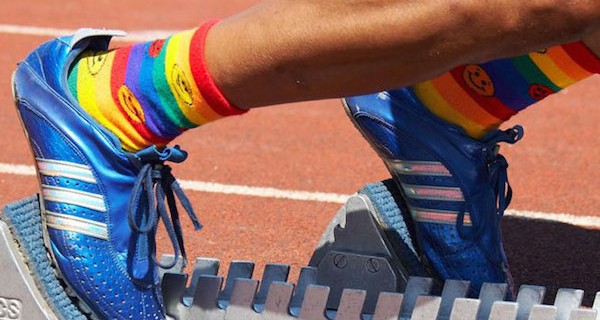 For the city, this was an opportunity to showcase its gems. For the Western Reserve Historical Society (WRHS), it was a way to tell the story we’ve been collecting for 23 years.
As it does with many current events in Cleveland, WRHS identified with the Gay Games through its extensive archival collections, specifically the LGBT Archives. This collection, which includes papers, documents, memorabilia, and more from the LGBT movement in Northeast Ohio, has been held by WRHS since 1991. From this archival collection, and with the help of friends at the Lesbian Gay Bisexual Transgender Center at Case Western Reserve University and the LGBT Community Center of Greater Cleveland, WRHS formed The Victory of Self, an exhibit focused on the history of the LGBT community in Northeast Ohio.
The cohesive gay community in Cleveland took on an approach of gradual change, as opposed to some of the more high-profile happenings, such as the Stonewall riots in New York City. Community centers began springing up in Greater Cleveland neighborhoods, publications informed individuals and groups of news from the local and national movements, and social hotspots formed over the course of the last 40 years. The circles of influence within the gay community have led to milestones including Cleveland Pride, the ongoing publication of the Gay People’s Chronicle, and of course Gay Games 9.
Dr. John Grabowski, who worked on the exhibit with student interns from Case Western Reserve University, once referenced an old warning about talking politics or religion in the neighborhood bar. 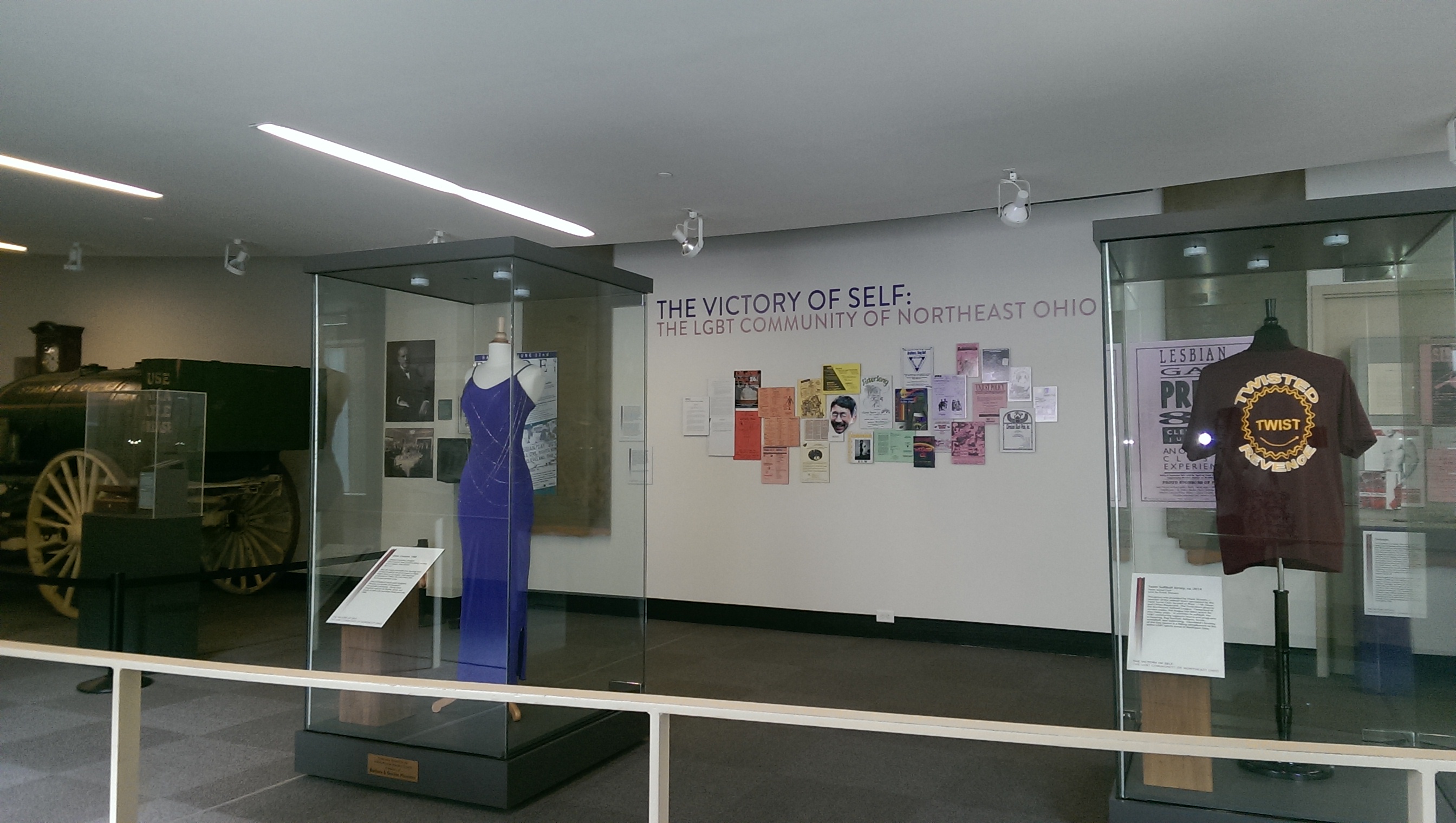 The topic of the LGBT rights can sometimes be heated between those who disagree but you won’t find room for argument in the preservation of the collections at WRHS. We take our responsibility to continue telling the stories of Northeast Ohio’s people seriously; so seriously that you’ll find the papers of former political rivals and foes occupying neighboring stacks in the Research Library.
That said, there were challenges with putting The Victory of Self together. In the early stages of collecting for the LGBT archives, the challenge was to discover and open up a history that had been largely hidden or denied. The close relationships with members of the LGBT community allowed WRHS to piece together the lives of many individuals and organizations that changed the landscape of the LGBT community in Cleveland. At WRHS, we’re proud of our ability to continue telling the stories of all Clevelanders and the impacts they’ve made – large or small.
The Victory of Self will remain on display at the WRHS History Center into 2015.
For more information on the collections of WRHS, visit www.wrhs.org/research.
A Wearable Archive Goes Online
BY Claire Potter ON December 19, 2014
by Eric Gonzaba

Tee shirts are a tangible memory of a day, an event or an organization
When I was growing up, I couldn’t wait to get out of rural southern Indiana. There wasn’t anything particularly wrong with my hometown; in fact, it was quite a wonderful place to grow up— friendly neighbors, inspiring teachers, and caring friends. But I always thought I was missing out on something. “There aren’t any gay people here,” I told myself. For me, gay life was exclusive to the hip neighborhoods of New York and San Francisco. Despite my blind admiration for the costal bohemias, I wasn’t going to turn down paying in-state tuition at a great state school in my backyard. The Castro and Chelsea would have to wait.
Indiana University proved a fantastic place to grow as a person and a historian. I had the pleasure to work at some amazing places like the GLBT Office and the Indiana Magazine of History. Both places helped me understand that there were diverse communities in my home state; I just wasn’t looking in the right places. To be sure, maybe Indiana didn’t have a Stonewall-like uprising or famous leaders Harvey Milk, but there were plenty of queer communities with rich histories that paralleled and sometimes contradicted the national LGBT narrative.
Hoping to find this history, I stumbled upon the Chris Gonzalez Library and Archives in Indianapolis headed by founded Michael Bohr. Bohr founded the archives in the early 1990s as an effort to preserve the history of the gay community at the height of the AIDS epidemic. Bohr hoped the archives could help prevent the loss of personal materials from the victims, some whose families hoped to purge their loved ones’ connections to the larger gay community following their deaths. At the archives, I discovered boxes of t-shirts Bohr and others had collected over the years that represented the culture of LGBT residents of Indianapolis and others from around the country. I created a small exhibit featuring some of these shirts at the Indiana University Gay, Lesbian, Bisexual, and Transgender Student Support Services office in April of 2012.
 Just before I started graduate school at George Mason University, I attended this posh (or at least posh for my Midwestern tastes) party in Washington where some attendees asked what I hoped to study. I told them that one of my interests was discovering queer history of rural communities and smaller American cities. “But that’s not where it happened,” one irritating guest interjected, presumably talking about the gay rights “movement,” as if that encompassed all aspects of gay history. Needless to say, this response annoyed me. Luckily, thanks to Mason’s history department and its push to have all their graduate students become digitally competent, I had the chance late in 2014 to return to the Chris Gonzalez archives and get the shirts online, available for access to any who dare to say that Indiana wasn’t “where it happened.”
Wearing Gay History, an online archive of t-shirts and other clothing items in the Chris Gonzalez Library and Archive, includes five short exhibits that help contextualize the shirts centered on pride, humor, advocacy, politics, and gay life in Indianapolis. Additionally, about half the shirts can be searched through a map feature, allowing users to see how the archives contains shirts from all corners of the country, and even a little international flavor with the addition of a ball cap from Toronto’s 2003 pride celebration. The map helps underscore the connections Hoosier LGBT communities have made outside their borders, evidence that their identities are not as isolated as we might imagine. Gay tourism, civil rights marches, gay choir competitions, and sporting events, to name a few, helped connect Indiana’s queer communities to other regions and cultures.
Sadly, despite being a seemingly inclusive LGBT archives, the t-shirt collection is by no means a completely fair representation of Indiana’s LGBT community. Most of the shirts in the collection allude to the culture of gay men, with very few shirts representing lesbian, transgender, or bisexual life. When underrepresented groups are highlighted in the exhibits, they are often discussed in the context of violence (Transgender Day of Remembrance) or betrayal (Mary Cheney and the 2004 presidential campaign).
Finding more shirts from these diverse communities to add to the digital archives is imperative. I’ve been lucky enough to get in contact with both the Gerber/Hart Archives in Chicago and the Rainbow History Project in Washington, DC, both that are highly interested in getting their extensive t-shirt collections digitized and opened to the public. Their inclusion will broaden the scope of the project to include much larger queer communities, but I feel the heart of the project—to uncover ignored histories of LGBT persons through their material culture—is still in place.
For more information please visit: www.wearinggayhistory.com.
———————
Eric Gonzaba is a PhD student in American history at George Mason University. He received his BA in history and political science from Indiana University in 2012 and his MA in history and women and gender studies from George Mason University in 2014. His work focuses on the politics of American popular culture in the 1970s and early 1980s.
The Public Display of Queer History
BY John D'Emilio ON November 26, 2014
Last month I made a trip to Cleveland to lecture at Case Western Reserve University. While there, I paid a visit to the Western Reserve Historical Society which currently has an exhibit on the LGBT history of northeast Ohio. The exhibit relies on materials in the collections of the Historical Society and moves from the 1930s forward to the present.
For the earlier period, it centers on life stories of some prominent members of Cleveland society who, while not “out” in the way we use that phrase today, were known to be gay – individuals like Winsor French, a Cleveland Press reporter; Leonard Hanna, Jr, a philanthropist; and Jerome Zerbe, a celebrity photographer. As the exhibit moves into the 1970s, the content becomes more overtly political and activist in its emphasis. Cleveland’s What She Wants, a feminist monthly magazine, which began publishing in 1973 is well-represented, as well as materials from the All-Ohio Gay and Lesbian Conferences that were a fixture of the 1980s.
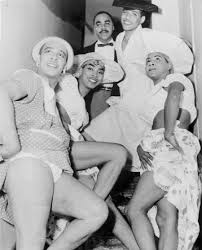
Performers in Chicago’s Queer Bronzeville
The exhibit, which is well-placed on the ground floor not far from an entrance, is hard to miss if you are visiting the Historical Society. It was a reminder to me of how important such public displays of LGBT history are and how almost unimaginable they would have been a generation ago. Three years ago, the Chicago History Museum mounted a major exhibit, “Out in Chicago,” that was curated by Jill Austin and Jennifer Brier. It was extraordinary. Organized thematically rather than chronologically, it filled something like five galleries in the museum, with photos, art, objects, music, film, newspapers, clothing, organizational materials, and video. Its time frame stretched from the mid-19th-century to the present. It was so rich that I found it impossible to take it all in on a single visit, and I’m someone who already knows a lot of queer history. Squadrons of students from the greater Chicago area visited the exhibit, and I could only imagine what an eye-opener it would have been for them, given how non-existent LGBT history is in high school classrooms.
The same year as the Chicago exhibit, 2011, the GLBT History Museum opened in San Francisco in the Castro district. Though it only occupies one large room in a storefront on 18th Street, the Museum’s exhibits are so rich and carefully organized that, on my visit, I felt as if I had worked my way through several halls of a museum. It is the first such museum in the world, and its opening attracted world-wide attention, with media coverage in dozens of nations and languages.
While the web represents a relatively new medium of communication that, through sites like OutHistory and others, is becoming a vehicle for the dissemination of LGBT history, museums and historical societies are public spaces that have been with us a much longer time but are now starting to display these histories. In presenting queer history outside the academic world, they help to make it part of public life. Cleveland, Chicago, and San Francisco are just three examples. I know there are more spaces that have already displayed this history. It would be a great project for local people to press more institutions to make LGBT history visible in their communities. What an achievement that would be!