


Looking back and Listening: Memories of Stonewall
BY Chris Gioia ON June 27, 2017
“Sheridan Square this weekend looked like something from a William Burroughs novel as the sudden specter of ‘gay power’ erected its brazen head and spat out a fairy tale the likes of which the area has never seen.” [1] This is how Lucian Truscott IV rather disparagingly characterized the Stonewall rebellion of 1969 in his eyewitness account published in the Village Voice on July 2nd of that year. The event was indeed something never before seen in New York City’s West Village, but was not the first time LGBT people stood up to police harassment. The Black Cat Tavern raid in Los Angeles and the Compton’s Cafeteria riots in San Francisco a few years prior also saw members of the community fight back against unfair treatment, police brutality and discriminatory laws that targeted the most unambiguous members of the community.
Its hard to imagine that in New York City in 1969, laws prohibited members of the same sex dancing together, restricted the sale of alcohol to homosexuals and penalized those who wore articles of clothing of the opposite sex, but it would take years of activism and action to have these officially taken off the books in the following decades. So, how did the Stonewall Inn become the birthplace of LGBT civil rights? Many details are hard to nail down and many debates have focused on the myths and mysteries of the Stonewall incident, but specific memories and stories help to paint a picture of the place and of the times. Bars like the Stonewall Inn represented a kind of reluctant haven for New York City’s downtown gay scene. Most patrons had a love hate relationship with the bar and its mafia controlled operators. The drinks were weak and over priced, the ambiance was dive bar but the vibe was by most accounts intoxicating if not fully liberating.
Bruce Monroe, who was a college student visiting from Indiana in 1969, describes his memory of Stonewall to me:
I remember … two dance floors and a big long wall down the middle. But I remember it being a very young lively crowd that I could relate to. It was like really exciting to see all these other young men that were around my age. I guess it was one of the most popular places for dancing in NY at that- there weren’t very many places around like that. And I remember having a great time there and I remember having to leave by myself because my friends had found elsewhere to spend the evening.
Historian John D’Emilio’s experience of the West Village as a college student in the late 1960’s is of a “whole gay world.” On two occasions he visited the Stonewall Inn with a friend and remembers the following:
. . . so anyway we go to Stonewall and of course the thing that was immediately apparent to me I mean besides the fact that it was, unlike Julius’ where there were a lot of people but it was conversation, and it was kind of quiet, Stonewall was wildly noisy and what do they have, but go go boys who were dancing you know, up on a platform wearing you know, kinda nothing, like a g-string, or just underpants, and it seemed very exciting to see and experience something like that!
Author Felice Picano has written about Stonewall and been involved in gay literature/publishing since the 1970’s. He wasn’t a fan of Stonewall in 1969, but recalls that it could be useful:
. . . if you found somebody interesting and you sorta wanted to feel them up and feel them out before you took them home you’d take them around the corner to the Stonewall and slow dance in the dark and figure out what you wanted . . . it became by the time the incident happened, a place for trannies and for people who were not quite street people but almost, and sometimes the hustler boys who would hang out in front of it in the park in Sheridan Square would go in too. So it had this very, very mixed vibe and, and I was always hearing that it was closing down, that it was going bankrupt.
Trans activist Miss Majors introduces her story to Felice Picano in a rare correspondence:
Miss Majors: I’d had a tough day, and I heard that that singer Judy Garland had died. I wasn’t a fan of hers, but I didn’t feel like being alone, so I went down to the Stonewall. That was our club, where the other “T’s” and I could hang out and relax and be ourselves. [2]
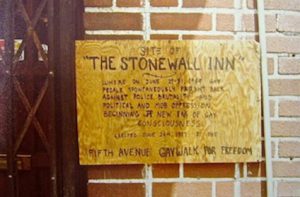
Stonewall Plaque placed in 1977 by the 5th Ave. Gay Walk of Freedom. LGBT Community Center Archives, Grillo Collection.
Pioneering gay journalist Mark Segal provides a first hand account of being inside the bar that night:
I remember the lights flashing. I remember asking somebody …“what does that mean?” And someone said, “Oh we’re just going to be raided!” And everybody who was a regular there took that very nonchalant. They were just used to it cause that was part of what life was like for gay people at that point. Me on the other hand had never been through a raid. I tried to look nonchalant but I gotta tell you its not –[laughs] I was very nervous. … As people were coming out they started forming a semi circle around the door and that eventually – and as the police let out more and more people at one point the only people left in the bar or most of the people left in the bar were the people that worked there and the police. At which point people just started throwing things at the door. Um, [sigh] that’s basically when people started breaking things, running up and down the street. [3]
Activist Martha Shelly recalls in my interview with her last year, how the liberation movement was energized by Stonewall:
Monday I read about the riots in the newspaper and I thought that was what it was about! I read about the Stonewall Riot in some small article in the New York Times or the New York Post I don’t remember which and I immediately called . . . Jean Powers and she was the person who was getting out the newsletter and organizing meetings. I called her and said we have to have a protest march. She told me to call the head of the Mattachine Society and she said if they’re interested we could jointly sponsor it. …So I called Dick Leitsch who was the head of the Mattachine Society. He said they were having a meeting at Town Hall to discuss all of these things and what it meant for the gay community and come to the meeting and put my proposal out and that’s what I did.
Craig Rodwell, owner of the Oscar Wilde Memorial bookshop on Mercer St. at the time of the riot, sums up the significance of Stonewall:
Immediately I saw that this was something that was going to have an impact in the future for the movement because I’d been saying for years that something would happen- there would be a spark. I recognized instantly that this was it.[4]
Today the Stonewall Inn is an iconic symbol of the birth of LGBT rights and has secured its place in history by being designated a National Monument. To learn more about the liberation movement and hear more of the interviews I conducted visit www.stonewallhistory.us and for additional first hand testimony about Stonewall listen to a wonderful radio segment from 1989 here: Remembering Stonewall
At a performance upstairs at the Stonewall Inn not too long ago, I was shoulder to shoulder with a truly diverse mix of patrons: trans women and men, lesbians, drag queens, regulars who call the bar a hangout, more than a few allies, and of course tourists checking another landmark off their list. I like to think that the pioneers of the liberation movement who have passed, would be proud of what the reincarnated Stonewall represents, but I’m sure if asked a contentious debate would ensue. After all, if its not worth arguing about, was it worth fighting for?
Gay Power!
[1] Lucian Truscott IV, “Gay Power Comes to Sheridan Square,” Village Voice, July 2, 1969, accessed December 10, 2016, http://www.villagevoice.com/news/stonewall-gay-power-comes-to-sheridan-square-6670443.
[2] Felice Picano, “The Remains of the Night: Six Observers: Felice Picano Talks with Eyewitnesses to the Stonewall Riots,” The Gay & Lesbian Review Worldwide, 2015 (4): 29.
[3] Mark Segal, interview by Christopher L. Gioia, February 7, 2017, interview.
[4] Tina Crosby, “The Stonewall Riot Remembered, Excerpt 2,” Stonewall: Riot, Rebellion, Activism and Identity, accessed April 14, 2017, https://stonewallhistory.omeka.net/items/show/25.
Not Rod McKuen
BY John D'Emilio ON March 4, 2015
 Last week, I was spending time working my way through my notes from the interviews I did back in the 1970s with pre-Stonewall “homophile” activists. I’ve been imagining that, at some point, I will put them all on Outhistory so that the material will be available to future researchers wanting to explore that topic. Almost everyone I interviewed at that time has since passed away, so there are no opportunities to explore their experiences directly today.
While reading through the notes of my interview with Gerard Brissette, who in the early 1950s was responsible for bringing Mattachine discussion groups to the San Francisco Bay Area, I noticed this: “Rod McKuen went to May 1953 convention.” It caught my attention, I think, because I had read just a few weeks earlier obituaries of McKuen, and did not remember any mention of his being gay, and certainly nothing about gay activism of any sort. I went on-line to read the New York Times obituary, and sure enough, nothing gay turned up [An excellent commentary on the silences in the accounts of McKuen’s life was posted by Gillian Frank on Notches.
I had absolutely no memory of Brissette mentioning McKuen when I interviewed him at his home in El Cerrito, California in November 1976. It was a detail that did not contribute to the narrative of what happened at the Mattachine meetings in 1953, so it never made its way into the account I wrote in Sexual Politics, Sexual Communities. As a result, for the last 40 years, this little tidbit has been lying untouched and unnoticed, of use to no one.
I interviewed my subjects with a purpose in mind: to reconstruct a history of pre-Stonewall activism. What mattered to me most in those interviews was to get enough background biographical information from my subjects in order to be able to situate and contextualize their move to activism, and then their recollections of the people, the organizations, the activities, and the events associated with this young, fledgling movement. But, not surprisingly, random bits and pieces of the past are scattered through my notes from these oral histories. Some mention bars they went to in the city where they first came out; others say something about the social networks that existed; still others might recall a news story or a police action. Someone else might throw in a reference to . . . Rod McKuen.
The experience confirmed for me that I do need to move forward with the project of putting all these interview notes online so that they can be accessible to others. Yes, they will be of special interest to those wanting to know about the history of queer activism in the 1950s and 1960s. But, given that LGBT history is not exactly “over-documented,” I hope that some of the details scattered through these reminiscences are able to find their way into histories of other topics that are still to be written.
I Remember Julius
BY John D'Emilio ON December 10, 2014
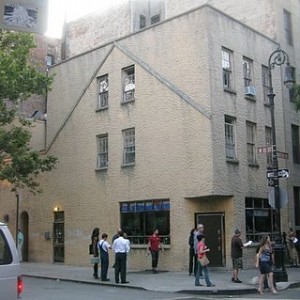 One of the things that I like about knowing lots of history is that it makes the present overflow with opportunities to recall and reflect on the past – both my own past and a larger social and cultural past. This past Sunday, for instance, I was scanning through the wedding announcements in the New York Times Style Section [yes, I am a critic of the campaign for marriage equality, but yes, I also love to read the love stories embedded in wedding announcements]. I noticed that one of the male couples was getting married at Julius, a gay bar in the West Village in Manhattan.
Julius! It advertises itself today as New York’s oldest gay bar. And it was the scene in 1966 of a “sip-in” by members of the New York Mattachine Society. They went in, announced that they were homosexuals, and asked to be served. They were challenging a New York State Liquor Authority policy that prohibited establishments with liquor from serving homosexuals. The bartender dutifully supported the protest by refusing to serve them, and the SLA responded by publicly announcing that, contrary to the charges of the protesters, it did not prohibit serving homosexuals. The demonstration had the effect of reducing significantly police raids of gay bars in New York and, in a sense, can be said to have helped provoke the Stonewall rebellion three years later. By 1969, enough bar patrons had come to expect that they would be left alone that, when the police raided the bar that June night, all hell broke loose as patrons and people on the street fought back. The rest, as we say, is history.
But Julius also brought up memories of my own queer history. It was the first gay bar I ever went to, as a 19-year-old in the fall of 1967. I was taken there by Jim, an “older” gay man [he was 26!] whom I had met while waiting on line for standing room tickets at the Metropolitan Opera House. That summer, I had for the first time fallen passionately in love, with a much older gay man [he was 29!], who worked as a travel agent, sang in the choir of St. Bartholomew’s Church on Park Avenue, and was as passionately in love with opera as I was with him. So, as part of my determination to win his heart, I rapidly developed an interest in opera, and discovered that the waiting line at Lincoln Center for standing room tickets [the line for a week of standing room tickets started forming at about midnight on Saturday, and grew until the box office opened mid-morning on Sunday] was like an outdoor gay community center. Masses of opera queens gathered there, gossiped about their favorite divas, and meanwhile cruised everyone there. Jim befriended me and for a couple of months acted almost as an older gay brother as he introduced me to this new world that I knew very little about. We went to some operas together; we walked the streets of Greenwich Village together, which I had never before experienced; and he took me to Julius.
All this came to mind as I paged through the wedding announcements. The lesson is clear: learn history, and your lifetime of memories will be so much richer and more vibrant!