


Defiance in Dixie
BY Eric Gonzaba ON March 9, 2015
 I wanted to spare readers yet another post on gay marriage, perhaps the most exhausted of topics written by and about LGBT communities. I figure we will all get our fill about the issue in the next few months as the U.S. Supreme Court is finally set to hear oral arguments on April 28th. I’m also fully aware about how problematic it is to focus on the issue of gay marriage (see Dan Royles excellent discussion about queer politics and Ferguson) That said, with all the mess same-sex marriage has caused in Alabama over the last few weeks, I couldn’t resist.
No, this won’t be a post where I try to convince you that gay marriage should be legalized. There are far too many eloquent writers who’ve already done that, and more importantly, far too many anti-gay marriage folk who’ve made it easier for those writers. (I’m looking at you, Dr. Ben Carson, who said this week that prison makes you gay.)
I wanted to focus on Alabama, which was ordered to begin granting marriage licenses to same-sex couples early last month following a ruling by a Federal District court judge. Unlike most states in similar situations that complied with federal rulings, Alabama’s deeply religious Chief Justice Roy Moore ordered probate judges to not grant marriage licenses. Probate judges split on the matter; some stood by their Chief Justice while others bowed to federal authority. All this became moot just a few days ago, however, after the Alabama Supreme Court (headed by Chief Justice Moore) halted all same-sex marriages in the state. Despite a tide of same-sex marriage acceptance nationwide, Moore and Alabama are prepared to take a stand.
It might be expected that same-sex marriage wasn’t going to go as smoothly in the state as it had in other parts of the country. After all, only 1 in 5 Alabamians approve of same-sex marriage (the state ranks 49th in the country. Your guess for #50 is probably correct). But the fight for marriage rights in Alabama was surprisingly civil. Despite some rare testy exchanges with protesters outside of county courthouses, news footage documented long waits for couples who waited to hear if their local probate judge would offer them a marriage application. Some were sustained, they said, by the kindness of strangers who brought them fast food during their day-long waits at the county offices, unwilling to miss being present in case any news trickled in. When Etowah County, far from the urban centers of Montgomery or Birmingham, opened their marriage windows, a lesbian couple remarked that the clerks were professional and courteous and “on their game.”
As of now, though, those windows remain closed to same-sex couples. The most frustrating thing about this whole fiasco is Chief Justice Moore himself. For over a generation now, the Deep South has been fighting the legacy of Jim Crow and segregation. Alabama and Mississippi (your guess as to #50) were the heart of white southern resistance during the black freedom struggle, and since then, outsiders have viewed them as the true racists of American society. Places like Alabama and Mississippi became what historian Joseph Crespino call “metaphor states,” sites the nation as a whole can point to as the genuine holders of racial and discriminatory animus, as if the rest of the nation is innocent of gross civil rights issues. For example, why does New York City, a beacon of gay tolerance we’re told, refuse to address rising LGBT homelessness. In terms of homophobia, the south is by no means exceptional.
To be sure, this doesn’t mean Alabama is off the hook. Alabama deserves our national anger. The legacy of lynching, voting disenfranchisement, peonage, slavery, and unethical medical experiments, to name just a few, is still very much real.
But Chief Justice Moore’s actions is so vividly reminiscent of Alabama Governor George Wallace’s famous stand in the schoolhouse door at the University of Alabama to protest desegregation in 1963. What’s mind boggling is that Moore is no dummy; he attended the U.S Military Academy and the prestigious, highly ranked law school at the University of Alabama. He’s fully aware of his home state’s tarnished racial legacy and yet still felt compelled to defy federal rulings on a monumental civil rights issue, which he opposed largely on religious grounds.
Now, I’m somewhat uncomfortable with the conflation of the black civil rights movement and the LGBT rights movement (the “new civil rights movement,” as some call themselves). Yet, Moore’s actions more easily merge the movements in the minds of the public. By doing so, it’s another anchor to pull down Alabama’s chances of ever really not being one of the focal points of national disgrace.
Maybe Alabama wasn’t going to be able to shed it’s racist label anytime soon, but Chief Justice Moore, a man overwhelming supported by his constituents, single handedly contributed to the state’s intolerant image. Like Wallace, I doubt history will be kind to him. Hopefully though, future historians will even care more about the clerks who opened their windows, the eager couples in line, and the vibrant queer communities of the South than they do about a cowardly Chief Justice.
Homophobia Isn’t Black
BY Eric Gonzaba ON February 23, 2015
 I remember being in college when, at 11pm on November 4, 2008, news networks announced the election of the first Black American president. The new president-elect even gave the LGBT community a shout-out in his acceptance speech that night, which was fitting since 70% of the gay community had supported him in that election.
Not too long after that, however, those same news outlets reported that Proposition 8 passed in California, barring same-sex marriage in the nation’s most populous state. It was stunning to many LGBT activists, since polls looked good going into Election Day. What went wrong? Pundits pointed to the immense turnout of black voters in California. 70% of African Americans helped land the first black president into the Oval Office and simultaneously voted to keep gay people away from the wedding chapels. See, the blacks are to blame! Sigh…the downfalls of supporting a coalition party.
It didn’t take long for more reasoned minds to explain that African Americans weren’t solely to blame for Proposition 8’s passage. As statistician Holy One Nate Silver pointed out, “ Prop 8’s passage was more a generational matter than a racial one.” Ta-Nehisi Coates was rightly more angered, lambasting political pundits and news outlets for citing overblown statistics; the 70% of African Americans number was probably closer to 58%.
I use this Prop 8 story because I think it suggests that liberal Americans are often too ready to attack black communities as anti-gay. We need to be much more conscious about how diverse communities confront LGBT experiences before we so-readily judge the gay-friendliness of certain groups. Our biases toward/against black culture can often shield us from understanding how diverse queer culture is in the African American community.
We’re told that black gay men, for instance, stay on the down low, afraid to embrace the rapidly changing, queer accepting, modern culture. Recently, however, excellent works have been produced that show that this stereotypical portrait of an exclusively heterosexual-affirming black culture is a fantasy at best. Take Terrance Dean’s 2008 memoir Hiding in Hip Hop: On the Down Low in the Entertainment Industry. The book’s cover photo depicts an African American artist holding his finger to his lips, insinuating the man is trying to keep something quiet. But Dean doesn’t suggest black American communities are terrifying places for LGBT people. In a discussion of his book with TIME magazine, Dean talked about down low culture for black men where there exist three identifications: down-low, down-low gay, and gay.
“What I consider to be in the closet is someone who I would call a down-low gay man. A down-low man is a man who considers himself a bisexual. He has relationships with both men and women but he would never identify his sexuality as that of a gay man because he doesn’t see the act of what he’s doing as that of being gay. Most times he is the penetrator or he’s the receiver in oral sex. So he doesn’t see himself as being gay. If you ask him, he would never admit to being gay.”
Of course, this is Dean’s assessment of his gay world, but the diversity of the identities he describes is a far cry from how many Americans think of sexual orientations, where we all fit neatly into predefined categories of gay or straight. Bisexuals, we hear all the time, just need to pick a team. (Tell this to Oregon’s new governor).
Dean’s discussion reminds me of historian George Chauncey’s work on early 20th century gay male culture. Chauncey argued that working class men in the early 20th century could engage in diverse sexual practices, including with other men, without necessarily being considered queer. Men who assumed the traditional sex role for men, even if their partner was another man, were not necessarily considered homosexuals by the wider society. In fact, such an act might enhance a man’s masculinity. “Sexual penetration,” Chauncey wrote, “symbolized one man’s power over another.”
Dean’s take on black sexual identities brings Chauncey’s discoveries into the 21st century and complicates our collective understanding of the homosexual/heterosexual binary. To be sure, the down low culture can breed social stigma of queer people in the black community and be cause for deep anxiety for LGBT black people. There’s no denying that homophobia exists in the African American community, but it’s not simply a problem that is inherently tied to black identity; homophobia is systemic, reaching beyond class, race, gender, and national boundaries.

Photo Credit: Kissmylisp.com
So tying blackness to homophobia is too reductive, but we also need to stop thinking of LGBT life as uniform among diverse communities. Historians have shed light on how gay identity hasn’t always been a central feature of African American lives. Take the American South, a place I’m sure many Americans would be surprised to know does actually have an LGBT history (and quite a rich one at that.) Historian John Howard, for instance, argued that black men in the south often viewed 20th century LGBT activism with suspicion, part of yet another “white-controlled, white dominated institution.” Terms like gay don’t always sum up the diverse experiences of Southern queer people. Read any of the incredible oral histories in E. Patrick Johnson’s Sweet Tea: Black Gay Men of the South and you’ll discover that black queer life has flourished even in what we sometimes target as the most hostile of places to LGBT African Americans—the black church. To the contrary, the church sometimes has served as a site of negotiation for African Americans, a place where spirituality and sexual desire can be explored and where black gay men can search for affirmation.
All this is to say, I think it’s imperative for us not to simply jump on the bandwagon of saying African American culture is homophobic by nature. Instead, we ought to be understanding of the diverse ways queerness is expressed in the black community and acknowledge that perhaps these practices can’t be readily understood through societal lenses that, more often than not, are heteronormative and white. The queer culture of people of color may not look like what’s shown in HRC commercials or on mainstream television sitcoms, but it’s a more dynamic culture that it is given credit for.
New and Noteworthy Books
BY Claire Potter ON November 29, 2014
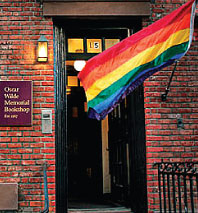
New York’s historic Oscar Wilde Memorial Bookshop is no longer there: don’t forget to support small businesses
Have you started your holiday shopping yet? Here are some ideas, old and new, for gifting queer readers:
- Alexis Coe, Alice + Freda Forever: A Murder in Memphis (San Francisco: Zest Books, 2014). If you liked Lisa Duggan’s account of lesbian passion thwarted, you will love this version of the story for young adults.
- Barbara Smith, Alethia Jones and Virginia Eubanks, Ed. Ain’t Gonna Let Nobody Turn Me Around: Forty Years of Movement Building with Barbara Smith (Albany: SUNY Press, 2014.)
- Martin Duberman, Ed. The Martin Duberman Reader: The Essential Historical, Biographical, and Autobiographical Writings (New York: The New Press, 2013.)
- Del LaGrace Volcano and J.Jack Halberstam, The Drag King Book (London: Serpent’s Tail Press, 1999.)
J. Edgar Hoover Uncensored
BY Claire Potter ON November 16, 2014
 Yale’s Beverly Gage has an essay in the New York Times about the famous letter sent to Martin Luther King on November 18, 1964 accusing him of being “a colossal fraud and an evil, vicious one at that.” The letter, sent by agents of the Federal Bureau of Investigation as part of its COINTELPRO operation intended to disable radical movements in the United States, catalogues a range of sexual misbehaviors. It uses the word “evil” multiple times, as Gage points out; and concludes with the well known phrase: “There is only one thing left for you to do. You know what it is.”
We have known about this letter for years, but it has always appeared in redacted form, and those who have used it have always presumed that it was intended to push King to suicide. But was that actually its purpose, and under what circumstances would Hoover have imagined that a man schooled in non-violence, a man who had seen people beaten and killed before his eyes, would commit the ultimate act of violence against himself?
Looking at the document, Gage isn’t so sure that was the point, and previous historians may have assumed that under the black magic marker strikeouts, this suggestion had been made explicitly. “Even now, looking at a full copy of the letter, it’s tough to puzzle out just what the bureau wanted King to do,” she writes. “The largest unredacted section focuses on King’s sex life, recounting in graphic language what the bureau believed it knew. Another uncovered portion of the note praises ‘older leaders’ like the N.A.A.C.P. executive director Roy Wilkins, urging King to step aside and let other men lead the civil rights movement. And some maintain that they simply meant to push King out, not induce suicide.”
Extra history fun? The Times article includes a high-quality reproduction of the full letter.
There are two big lessons about the historian’s craft here. The first is: never assume. Excerpts from a document, even one as shocking as this one, can significantly alter its apparent meaning, particularly if we insist on reading into the document our own sense of projected shame about sexual accusations made public. The second lesson is some version of “seek and ye shall find,” a particularly important lesson in a day and age when sitting patiently with paper archives, particularly those you think are well thumbed, is a lesser known virtue. Gage found the document in a reprocessed file that has been available for years in redacted form. “I was surprised to find a full, uncensored version of the letter tucked away in a reprocessed set of [Hoover’s] official and confidential files at the National Archives,” she writes. “The uncovered passages contain explicit allegations about King’s sex life, rendered in the racially charged language of the Jim Crow era.”
Fifty years later, Gage also draws another lesson — a more reserved media made it possible for history to move forward, without King being derailed by scandal. Hoover resorted to the so-called “suicide letter” because no member of the press would publish what the Bureau had learned about King’s private sex life. “Looking past the viciousness of the accusations,” she reflects, “the letter offers a potent warning for readers today about the danger of domestic surveillance in an age with less reserved mass media.”
For more potentially field-changing reflections on the civil rights movement, readers might want to turn to Renee C. Romano’s Racial Reckoning: Prosecuting America’s Civil Rights Murders (Harvard: 2014). Although these trials have brought the perpetrators of notorious acts of murder to justice decades after the crimes, they have also functioned to cleanse the United States of coming to terms with its full history of white violence against blacks. (Full disclosure: Romano is an old friend and a collaborator, as anyone who looks at the sidebar would know, but the only difference that makes is that I brushed aside the Leaning Towers of Books waiting to be read and got to this one first.)
Cross posted from Tenured Radical, my blog at The Chronicle of Higher Education
On Honoring History and Southern Queer Organizers
BY Sarah Neddo ON November 10, 2014
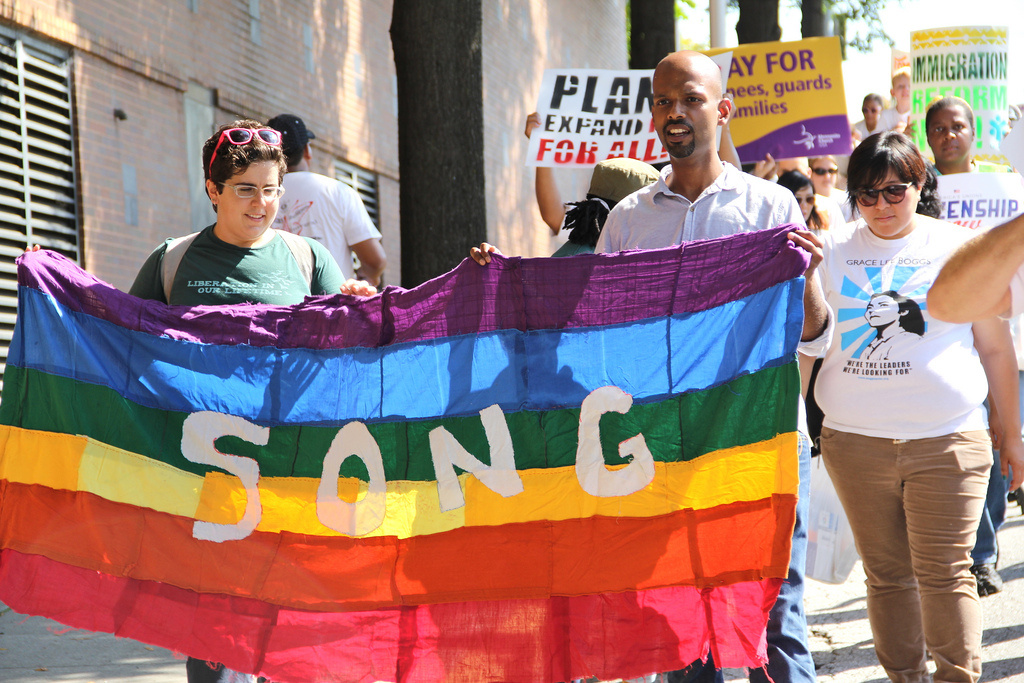
SONG marches in Atlanta to stop LGBTQ deportations. Photo courtesy of Angela Hill
In early September, Washington Post’s Sandhya Somashekhar penned an article highlighting the Human Right’s Campaign’s (HRC) recent $8.5 million grant to endow the LGBTQ equality campaign in the rural south. The New York Times followed suit underscoring how gay rights advocates are now focusing on this new frontier. The South however, is not a new frontier for civil rights or LGBT equality. The notion of a new frontier, coupled with HRC’s assimilationist title, “Project One America,” echoes the erasure of both historical and current efforts towards building an affirming LGBTQ community for everyone in the South.
This erasure has not been met with silence.
In the weeks following Somashekhar’s article, a wave of critical responses among Southern LGBTQ activists have appeared across the web in the Huffington Post and Advocate. The outrage is a testament to Southern activists and their long history of advocating for LGBTQ communities.“ Take some time to get to know the local communities who have been building bridges, winning and losing campaigns, and making a difference for generations,” wrote activist Kip Williams. “Enter these communities with humility and a beginner’s mind. And please, please don’t erase the rich history and culture of the queer South just because you finally started paying attention.”
What sets apart the HRC’s new campaign historically? A number of things, but one is money. The South lags far behind in LGBT funding compared to the rest of the country, and $8.5 million dollars towards LGBTQ work is unprecedented for this region of the country.
Yes money is important, but this should not overshadow the extraordinary ways Southern LGBTQ communities have and are living, organizing, agitating for change. One great example is Southerners on New Ground (SONG). Since 1993 SONG has been organizing LGBTQ Southerners across rural and urban communities and hosting sub-regional retreats for southern queer people of color.
For further reading on Southern LGBTQ History check out:
- E. Patrick Johnson, Sweet Tea: Black Gay Men of the South (2011)
- Karen Graves, And They Were Wonderful Teachers: Florida’s Purge of Lesbian and Gay Teachers (2009)
- Brock Thompson, The Un-Natural State: Arkansas and the Queer South (2010)
- John Howard, Men Like That: A Southern Queer History (2001)
- James T. Sears, Rebels, Rubyfruit, and Rhinestones: Queering Space in the Stonewall South (2001)