


The Homophobia Problem in Women’s Tennis Is Its Race and Gender Problem Too
BY Claire Potter ON July 11, 2015
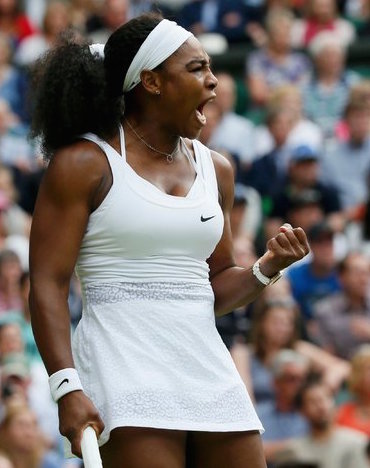
If you never saw her play a match, you would think that Serena Williams was an on-court bully.
Today I opened my New York Times app to find this in the sports section: “Tennis’s Top Women Balance Body Image With Ambition” (July 10 2015). As sportswriter Ben Rothenberg mansplained, many of the top women players are willing to sacrifice championships in order to not “bulk up” and — here’s the kicker — risk “looking like men.”
“It’s our decision to keep her as the smallest player in the top 10,” said Tomasz Wiktorowski, the coach of Agnieszka Radwanska, who is listed at 5 feet 8 and 123 pounds. “Because, first of all she’s a woman, and she wants to be a woman.”
Radwanska, who struggled this year before a run to the Wimbledon semifinals, said that any gain in muscle could hurt her trademark speed and finesse, but she also acknowledged that how she looked mattered to her.
“Of course I care about that as well, because I’m a girl,” Radwanska said. “But I also have the genes where I don’t know what I have to do to get bigger, because it’s just not going anywhere.”
For many, perceived ideal feminine body type can seem at odds with the best physique for tennis success. Andrea Petkovic, a German ranked 14th, said she particularly loathed seeing pictures of herself hitting two-handed backhands, when her arm muscles appear the most bulging.
“I just feel unfeminine,” she said. “I don’t know — it’s probably that I’m self-conscious about what people might say. It’s stupid, but it’s insecurities that every woman has, I think. I definitely have them and I’m not ashamed to admit it. I would love to be a confident player that is proud of her body. Women, when we grow up we’ve been judged more, our physicality is judged more, and it makes us self-conscious.”
Needless to say, the only woman Rothenberg could find who was willing to sacrifice her “femininity” for athletic excellence is Black, and the best player in the game. But even the legendary Serena Williams said that she prefers to cover up her arms in public. As Rothenberg points out, Williams’ “rivals could try to emulate her physique, but most of them choose not to.”
Lessons for young women athletes contained in this story:
- It is better to be feminine than successful.
- It is better for men to think you are pretty than for women to respect you.
- It is better to be childlike than to be powerful.
- If you get big and strong, everyone will think you are a lesbian and/or a transgender person.
- It is fine for White women to lose to Black women because they aren’t really women.
- Black women aren’t successful as athletes because they work hard and train but because they “naturally” grow big muscles and aren’t pretty anyway.
I don’t know why I am surprised that The New York Times would publish a piece that supports female body hatred, that a male reporter would support such a narrow beauty standard for women, or that women’s tennis players would be proud of their endless willingness to be gender police each other.
But I am. I guess I am also surprised that one of the women on the Times sports beat hasn’t pantsed Ben Rothenberg by now.
Most of all I am disgusted with the WTA which, for forty years, has been hiding lesbians, encouraging homophobia, and allowing less successful players on the tour to insult and badger gender non-conforming women, straight and gay, who train hard and win. I am also sick of the racist iconography that the women’s tennis establishment accedes to. If they are promoting femininity, why do they produce so many action shots of Serena Williams roaring and pumping her fist after winning a point, a “guy” photo pervasive in baseball and football, and which makes her look like a bully who is barely in control of herself? In contrast, White and Asian women’s tennis players are generally depicted in graceful, dance-like poses, their lovely slender limbs stretched out in mid point; or looking thoughtful and determined as they contemplate their game plan.
Back in the gay 1980s, a friend and I made it an annual event to go to the Women’s Tennis Association championships at Madison Square Garden. The tour was then known as the Virginia Slims. Of all the corporations and brands making money from women’s bodies, the only people who would sponsor women’s professional tennis were the folks at Philip Morris, a company that was also urging women to kill themselves with a dainty cigarette made just for them.
Not unlike the Nabisco Dinah Shore golf tournament, the Slims was dyke heaven. The ratio in the Garden was probably seven or eight women for every man, with we sporty butch types predominating. Yet if you looked at the tournament on TV, you would see none of that: television shots of the crowd always featured close frames of gender mixed groups, and it was rare to spot a masculine woman.
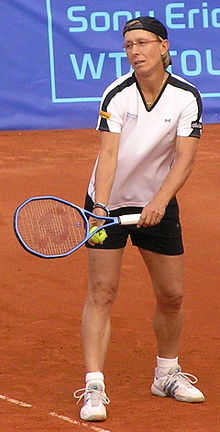
Navratilova’s consciously butch style, her refusal to wear skirts and dresses, and her muscularity all became “proof” for the gender police in the WTA that she was not really a woman.
This was quite a production feat, if you think about it, since the numbers of dyke tennis fans escalated after 1981. In that year Billie Jean King was forced out of the closet after a palimony suit filed by her so-called secretary Marilyn Barnett, and Martina Navratilova voluntarily disclosed that she was a lesbian in a newspaper interview. Navratilova expressed her fear to the reporter that her’s and King’s revelations would have a financial impact on the women’s game, and they did: the following year, Avon dropped its sponsorship of women’s tennis.
King and Navratilova survived, but barely. King lost her clothing contracts (she made a point of wearing some old sequined numbers her mother had made for her in the pre-sponsorship days until she got her contracts back, which I thought was cool.) Navratilova also lost sponsorships, but became so dominant because of a fitness, weight lifting and nutrition program that Chris Evert (a friend, rival and femme crowd favorite) was never able to knock her out of the number 1 spot again. Instead of praise, Navratilova’s success triggered shameful attacks on her gender presentation and sexuality. Players, their parents and coaches complained, often anonymously, to reporters that Navratilova ought not to be permitted to play women any more because real women weren’t that strong. Navratilova was also informally shunned. Only the classy Evert, who also publicly apologized for homophobic statements she had made earlier, would play women’s doubles with Navratilova for a number of years. This nasty form of gender policing has also been aimed at U.S. Olympic rower Chris Ernst, South African track star Caster Semenya, and basketball phenom Brittney Griner. Many other lesser known athletes are routinely asked to take chromosome tests and/or strip to prove that their biological sex matches their stated gender.
As we are all patting ourselves on the back about how cheerful the media has been about Caitlyn Jenner’s gender transition, pay attention to this: no one does anything about the gender-shaming of female athletes. In fact, it is often promoted by the sports establishment in articles like Ben Rothenberg’s. So it is no wonder that nearly all the lesbians on the women’s tennis tour, and many other lesbian and trans athletes, stay in the closet at a moment when lesser folk with lots of social and economic privilege can be as out as the please. Today, compared to the 18 women the World Cup soccer tournament who are publicly gay, tennis fans would be hard pressed to name an out lesbian currently active on the tour: France’s Amélie Mauresmo, who took a public relations beating after coming out in 1999, is now a coach.
Unsurprisingly, since news outlets pipe the WTA‘s gender policing into our homes uncritically (go here for the pink Hello Kitty line of girls’ tennis wear), players still feel free to make excuses for losing by gender shaming other players. This has been an open problem since 2006 when, following a loss to Mauresmo, The Guardian‘s Louise France wrote that
[Lindsay] Davenport, possibly in a fit of pique at having been knocked out, said playing Mauresmo was like ‘playing a guy’. (She later apologized, but the damage had already been done.) Not known for her friendly diplomacy, Martina Hingis pitched in. ‘She is half a man,’ she told the press.
But the damage is so much more complex: you don’t have to be a queer theorist to understand that Mauresmo’s muscularity and strength, a mannishness which many lesbians and genderqueer folks cherish and many athletes in other sports would kill for, is viewed by the tennis establishment as biologically freaky and sexually pathological.
So here’s the challenge for women’s professional tennis: is it a sport, or is it a modeling agency? If it is a sport, let’s cover these women as athletes, competitors and whole people with real lives and great bodies. If not, let’s move them — and ht sportswriters who want to cover them — to the fashion section.
Queering the Indy 500
BY Eric Gonzaba ON May 24, 2015
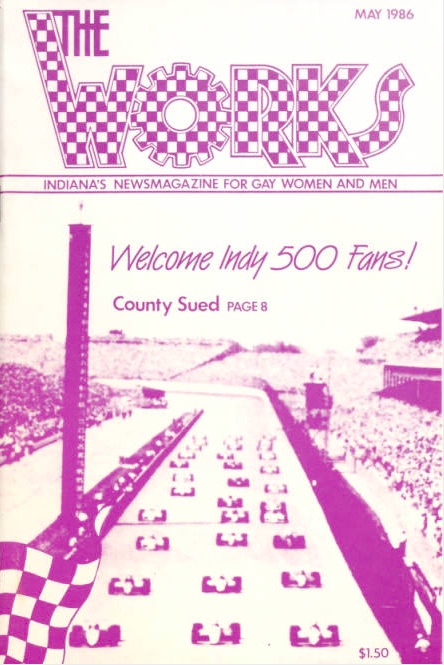 That’s right. I’m attempting the impossible. I’m going to suggest that there is something queer about the Indy 500. Any event that brings in a viewership of nearly six million people is bound to be a little gay, right?
If you’re not familiar, the Indianapolis 500 is a car race that takes place every May in Speedway, Indiana, just outside the state capital of Indianapolis. The speedway itself is arguably the largest arena in the world, with a seating capacity of more than 400,000. To give you some perspective, that’s five times the seating capacity of the Dallas Cowboys’ stadium. Point being: the 500 is a big deal, not just for Hoosiers, but to lots of racing fans.
But is there really anything gay about the Indy 500? After all, the race has no halftime show like during the Superbowl to relieve gay men from the boredom of football with the likes of Beyonce or Katy Perry, even if just for a painfully short ten minute set. Ok, I’m being extremely stereotypical, but people buy into these stereotypes, that all queer people live by a set standard of likes and dislikes, that we all bow to the gods of urbanism, pop, and liberalism.
As important as it is to find and identify the unique sites of our LGBT communities (the underground urban discos, the disappearing feminist bookstores, the black fraternities, the vogue balls etc.), it’s quite extraordinary to discover the ways queer communities in the past sought to both integrate and remake mainstream cultural events and sites like the Indy 500.
Looking through Indianapolis gay magazines of the past 30 years, it’s incredible to see the warm welcome of gay fans to the racing capital. The entire cover of the May 1986 issue of Indiana’s gay newsmagazine The Works was a greeting message to out of town gay racing fans. As one queer commentator put it, “Hope to see all you fags up in Indy this month to ‘see’ the 500 race,” probably in reference to either the quickness of the Indy racecars or perhaps the draw of gay men to other, non race events in May. Either way, the race meant at least something to Indy’s gay community.
Throughout the 1980s, Indianapolis’ queer community used the race and its out of town gay fans as a reason to congregate and party. Indianapolis’ gay bars hosted race-themed disco dances, complete with drag queen contests like the “Club 500 Queen” or the “Speedway Housewives” as well as the “500 Follies.” Disco divas like Linda Clifford were brought in to entertain fans over the qualification weekends and the famous race day.
Hardcore race fans could watch the races and local bars and clubs during special barbecue cookouts. A 1984 gay writer suggested that though latecomer gay race fans probably couldn’t get grandstand seats on the last weekend before race day, infield tickets were still on sale. “If you thought the Romans had orgies,” the columnists wrote, “try the infield!”
Even the race’s longtime traditions have a queer angle. For over forty years, Jim Nabors of Gomer Pyle fame sang “Back Home Again in Indiana” just before the race to the delight of adoring race fans. In 2013, Nabors married his longtime partner of nearly forty years, Stan Cadwallader. Granted, Nabors’ sexuality remains largely unknown to many Speedway fans but this didn’t stop the infamous Westboro Baptist Church from protesting the event in 2014 (Nabors’ last singing appearance), with the hate group citing Nabors’ homosexuality as one of their main grievances. Regardless of the Westboro morons, I cannot help to think how ironic it is that a state marred in scandal the past few months over allegations of anti-gay discrimination and religious freedom could let a gay man become so attached to a time honored Hoosier tradition.
Today’s racing fans don’t have to look very far to find likeminded compadres. In recent years, a dedicated queer racing community has sprung up online. Sites like Queers4Gears serve as resources for dedicated gay Indy and NASCAR racing fans, offering visitors “gaynalyses” as opposed to traditional, yawn-inducing coverage on conventional news platforms. Queers4Gears founder Michael Myers presents balanced reporting on races, but his queer perspective means a new vocabulary fit for his gay audience, sometimes, for example, referring to drivers as “divas.”
Maybe it’s not important whether or not there is a queer history of the Indy 500. Maybe we should just leave the pit stop and investigate how LGBT people are not always separatists but sometimes active definers of wider, normative culture. The 500 is one reminder that our unique queer perspectives can penetrate even the most “redneck” of institutions.
New and Noteworthy: What We’re Reading
BY Claire Potter ON April 9, 2015
-

Elton John as a boy, reading. Or posing with a book.
Heike Bauer, “Gender Matters at The Institute of Sexology,” Notches (April 7, 2015.)
- Philip Connors, “Confirmation: Love and Basketball,” n+1 (Spring 2015.) Sorry: this is behind a firewall, but if you don’t subscribe to n+1 already, we recommend that you do.
- Eric Lueshen, “The Gay Kicker and the Homophobe,” OutSports, (November 3, 2014.) A memoir about surviving homophobic abuse as a gay footballer for the Nebraska Cornhuskers.
- David von Drehle, “How Gay Marriage Won: The gay and lesbian community has gone from Stonewall to the altar in two generations,” Time (March 28, 2013.)
- Cole Delbyk, “‘Masturbation Will Lead to Homosexuality’: China’s LGBT Sex-Ed Problem,” The Nation (April 2 2015.)

News and Announcements
BY Claire Potter ON November 21, 2014
-
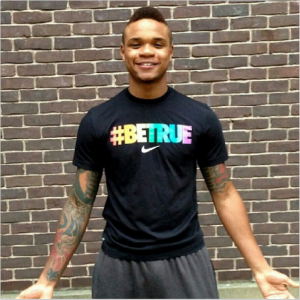
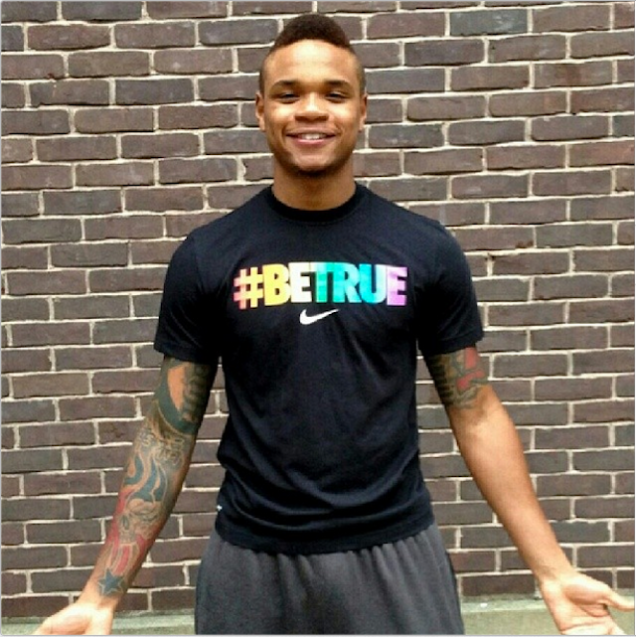
Making History at UMass: the adorable Derrick Gordon becomes the first publicly queer player to start a men’s DI basketball game.
This week, Derrick Gordon, of the University of Massachusetts, the only men’s DI college basketball player to come out as gay, made history by starting his first game since the announcement on April 9. Note to campuses trying to recruit athletes: the talented Gordon, like many other queer prospective college students, chose UMass because he knew he would be comfortable coming out there. “I definitely did my research,” he said. “I know it’s gay-friendly on campus. I’d see gay flags from time to time, or gay couples holding hands. So I know it was a great place for me to come out.”
- Also in Happy Valley, on Friday November 21, Edmond Chang, Assistant Professor of English at Drew University, is giving a talk at Smith College, Northampton, MA: “Unloving Mechanics: Queerness + Straightwashing in Digital Games.” For the full details, go to the 5 College Digital Humanities page.
- A powerful essay by Yale’s professor of women, gender and sexuality studies Inderpal Grewalabout explains why racial and gender diversity on the faculty is related to how women, people of color and queers are treated on campus. Check out the section of the comments thread where someone (presumably a Yalie but maybe not) claims WGSS is not getting adequate resources from the university because the courses are easy A’s, providing more evidence for what Grewal has argued.
- “Classical Nudes and the Making of Queer History,” a show curated by art historian Jonathan David Katz is up at the Leslie + Lohman Museum of Gay and Lesbian Art in New York from now until January 4, 2015. “These nudes are in every sense of the term iconic; they are the building blocks of our Western visual culture,” Katz argues.
- There’s nothing like a history bar with an S/M theme: The town of Lviv, Ukraine, sports ” a popular spot for dates and group outings” called The Masoch Cafe, honoring the 19th century’s proudest perv (and Lviv native) Leopold von Sacher-Masoch. You can order a caning, a little bondage or some hot wax torture with your drink. “Female customers are far less squeamish than their male counterparts, Sasha Bankovich, a waitress at the cafe said, cradling a whip in her hands. ‘We’ve noticed that men scream a lot,’ she said, adding that requests from customers for a whipping had remained constant throughout Ukraine’s months of [political] tumult. ‘In this respect, things are very stable in our country.'”
Some items in this post have appeared yesterday at Tenured Radical.