


Call Me a “Kinsey-ite”
BY John D'Emilio ON December 31, 2014
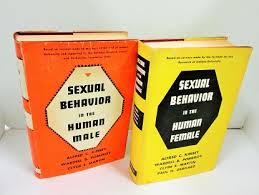
This weekend marks the anniversary of Alfred Kinsey’s study, Sexual Behavior in the Human Male. Published on January 3, 1948, it and its companion study, Sexual Behavior in the Human Female (1953), may very well be the most influential books on sexuality published in the U.S. in the twentieth century. The male study is over 800 pages long, written in dry un-sensational prose, and without a single illustration. But that did not stop it from becoming a best-seller and provoking wave after wave of media attention and commentary from politicians, religious figures, scientists, and pundits. It isn’t hard to argue that Kinsey’s studies and the discussion they provoked closed the door on what remained of Victorian standards of reticence about discussing sexuality in the public sphere and that Kinsey, who became a household name for a decade or two, helped push American society in the direction of the massive cultural and social changes that, later, were labeled “the sexual revolution.”
The response to the male study in particular focused on Kinsey’s findings on the incidence of male homosexual behavior: 50% of adult white males had experienced attraction to someone of the same biological sex; 37% had at least one post-adolescent sexual experience to orgasm with a male; 4% were exclusively homosexual in their behavior and desires; and one out of eight were predominantly homosexual for at least a three-year period. Nothing like these numbers had ever emerged before in scientific discussions of homosexuality.
Then and later, Kinsey was the target of much criticism, designed to discredit his findings. And there is much that can be criticized about the unscientific, non-representative nature of his “sampling.” Kinsey interviewed individuals wherever he could find willing subjects. He tended to use what today is called “snowball” sampling, in which one subject provides introductions to his friends and acquaintances. For a variety of reasons, it is doubtful whether, today, the “institutional review board” at Kinsey’s university would ever have approved his study.
Still, whatever the criticisms, Kinsey and his team had gathered more individual sexual histories than anyone before him. Regardless of whether his specific percentages around behavior – homosexual, pre-marital, masturbation, whatever – were accurate, he had a basis for what we might call “speculating” or theorizing about human sexuality. For instance, he created what he called his heterosexual/homosexual continuum – seven categories, from 0 to 6, ranging from completely heterosexual in behavior and desire to completely homosexual. But, with thousands and thousands of interviewees, he could just as easily have created a continuum with 14 or 28 or 70 categories differentiating behavior and desire.
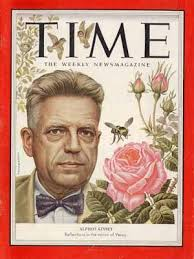
The point of the continuum for Kinsey was that human beings can’t be neatly categorized into heterosexual or homosexual. He refused to use the words as nouns that named a person and instead used them only as adjectives to describe a behavior or desire. The immense variety and range of human sexual desire led him to assert that human beings are born with a capacity for sexual arousal and response. That capacity is essentially without direction, or “object choice.” But, from the moment we are born, an array of experiences, emotions, cultural influences, and observation begins to shape and direct those desires.
Gay, lesbian, and bisexual activists made use of Kinsey’s findings over the next few decades to make the claim that there are lots of us, that it’s “normal,” and that the persecution of us therefore made no sense. Kinsey was a hallowed figure. But, beyond the statistical findings, his theory of human sexuality did not get picked up by activists, community members, and allies. It can too easily be bent to the service of those who say people “become gay” and that they become gay because of “bad” experiences that happen to them. It could play into sickness models of sexual identity.
But I find Kinsey’s perspective incredibly liberating. Kinsey basically argues that we are the sum of our experience, and our experience is infinitely various. We live in a world that seems to need categories, to need definitions. But wouldn’t it be wonderful to be able to accept whatever our own mix of sexual attractions was? I’m slipping into utopian fantasizing here, but still: I would like to live in such a world.
Read Kinsey! He still is thought-provoking, sixty-seven years after the first of his studies was published.
Comments