


Look to the Past: Our Military Grows With Inclusion
BY Eric Gonzaba ON August 28, 2017
 In this post, historian Beth Wolny explores US military integration in the wake of trans service ban.
She is introduced by Eric Gonzaba.
A few weeks ago, President Trump announced his intention to ban transgender people from United States military service. This move reverses the Obama Defense Department’s policy push to allow transgender people to serve openly. Since the sudden announcement, I’ve been happy to read some incredible response pieces on trans military service, including Landon Marchant for the Point Foundation and two great stories from OutHistory.
To make even more sense of this nonsensical action, I reached out to a historian friend of mine who graciously offered some different historical perspective. Lt Col.
Beth Wolny not only has an insanely impressive title I’ll never hold, but she is also a doctoral candidate in the history department at George Mason University specializing in military women’s history. She recently published “Female Marines Guard the Embassies: An Experiment in Social Progress and Cultural Change” in the International Journal of Naval History.
Beth is not an LGBT historian (sigh…), but her research on military integration and her own military service offers a great perspective on military and civilian politics regarding transgender ban.
Our Military Grows With Inclusion
By Beth Wolny
The military rarely, if ever, accepts change easily. The service protested against racial integration, gender integration and homosexual individuals serving openly. In each instance, senior leaders argued changes were unnecessary; that they would threaten cohesion and morale (and thus, it was assumed, combat effectiveness). In sum, it wasn’t worth it. But what is “it”, exactly? When President Trump tweeted that he has consulted with his “admirals and generals” and decided that transgender individuals cannot serve “in any capacity”, he acceded to the military’s desires but not necessarily to the nation’s best interests or even its military’s combat effectiveness.
During and after World War II, the services fought having African Americans in the ranks. U.S. Marine Corps Commandant Thomas Holcomb stated that given the choice between 5,000 white Marines or 250,000 black Marines, “I would rather have the whites.”[1] Despite the need for additional manpower, General Holcomb would have preferred to risk combat lethality than to accept African Americans. The U.S. Navy made African Americans cooks. The U.S. Army created separate ranks, away from the fighting, for African Americans. Yet how combat effective would the U.S. military have been in that war without its African Americans?
Women have faced similar challenges. Marginalized as mostly secretaries until the mid-1970s, women fought for equal pay, recognition and treatment at each step. In 1979, Marine Corps Commandant Robert Barrow stated,
The simple facts are we don’t need them. We can get all the males to do whatever needs to be done . . . so why experiment . . . because someone can make a boast or a claim that you have broadened the opportunity for women.[2]
General Barrow is speaking directly to the military’s constant concern – that politicians may prioritize inclusion to the detriment of combat effectiveness. When a traditional culture – such as the military – experiences any kind of cultural change, there will be pain. There may be violence. It may take a generation for cultural changes to solidify. Then there is growth and actually – a more combat effective military. Women’s roles in Iraq and Afghanistan, especially as Lionesses and as Female Engagement Team (FET) members, demonstrate how much our military benefits from the inclusion of all. Or do we currently not have the most powerful and lethal military in the world?
Almost a generation ago, Congress passed Don’t Ask Don’t Tell (DADT), which permitted homosexual members to serve, but in secret. The military moved forward under the auspices that if no one knew the sexual orientation of the other person in the fighting hole, then it did not matter. Did it really matter at all? Or did what matter was whether or not a person could do the job?
The repeal of DADT proved what the military had already learned through racial and gender integration. The most important aspect of any individual serving in any capacity in the armed forces of the United States is whether or not they can do the job – and that means whether or not service members trust that each member of the team is able to do the job. Cohesion and morale grow when individuals trust each other, through tests of capability and endurance. This is task cohesion, and this is what really matters to combat effectiveness. Military leaders more often worry about social cohesion – whether or not members of a group get along or like each other – and assume that social cohesion is necessary for task cohesion.
Marine Corps Commandant Amos went on record about the threats to cohesion and morale, DADT and combat effectiveness. In December 2010 he stated that on the battlefield, “you don’t want anything distracting. . . . Mistakes and inattention or distractions cost Marines’ lives.”[3] Today, service members of any sexual orientation are serving openly and with acceptance. The concerns over “distractions” and cohesion proved unfounded.
All of these concerns are the real reasons behind the reluctance to admit openly serving transgender service members – the desire for the known versus the new; the concern over politicians prioritizing inclusion over combat effectiveness and threats to cohesion and morale (and thus combat effectiveness). While these concerns will certainly require strong departmental policies, solid guidance and strong leadership to implement those policies, they are not reasons to restrict transgender members. Our military grows with inclusion. The integration of transgender individuals will proceed along similar lines to every other instance of integration. The process will be difficult. There may be protest. There may be violence. It may require a generation. Let’s hope it doesn’t, because in the end, it will be worth “it” because it will result in a stronger, more combat effective military.
[1] Nalty, Bernard G., “The Right to Fight: African-American Marines in World War II”, Marines in WWII Commemorative Series, Marine Corps History and Museums Division, https://www.nps.gov/parkhistory/online_books/npswapa/extcontent/usmc/pcn-190-003132-00/sec1.htm, accessed 7 August 2017.
[2] Robert General Barrow, Session XV, Transcript, December 20, 1991, 8, Archives and Special Collections Branch, Library of the Marine Corps.
[3] Whitlock, Craig. “Marine general suggests repeal of ‘don’t ask’ could result in casualties”, The Washington Post, 15 December 2010, http://www.washingtonpost.com/wp-dyn/content/article/2010/12/14/AR2010121404985.html, accessed 8 August 2017.
In the Archives | Running for Office
BY John D'Emilio ON August 21, 2017
 Since Trump’s election, protest has become a way of life for many in the U.S. A week doesn’t pass without a flood of emails and posts on social media announcing the next march or rally in cities across the country. But his election also puts front and center the question of how electoral politics needs to figure among the playlist of strategies and tactics that movement activists for social and economic justice deploy. As Bayard Rustin argued in a 1965 appeal to activists in the black freedom struggle, ultimate success requires engagement with the electoral system.
For identity-based movements, one form that electoral involvement takes is running for public office. The first explicit LGBT electoral campaign that I’m aware of was in 1961 in San Francisco, when Jose Sarria, a well-known and well-loved drag performer at one of the city’s popular bars, ran for the Board of Supervisors in response to intense police harassment of LGBT people. But Sarria’s campaign was an isolated one-of-a-kind effort. Not until the rise of a gay and lesbian liberation movement in the 1970s did running for office become one of the recognized forms of movement activism. Yet, even then, it was still relatively uncommon.
Gary Nepon was the first “out” LGBT candidate to run in Chicago for public office. His papers at the Gerber/Hart Library and Archives provide a view of how complex the relationship between a movement and electoral politics can be. In the fall of 1977, Nepon began putting a campaign together to win a place on the ballot as a candidate for the Illinois state assembly from the 13th district on Chicago’s northside lakefront. The district was already in the process of becoming identified as a center of LGBT (or “gay,” as the press referred to it then) life in Chicago.
 Interestingly, though there had been a continuous history of organized LGBT activism in Chicago at least since the mid-1960s, Nepon was completely unknown among movement participants. As he admitted to the press in the first round of interviews after he announced his candidacy in October, “I am not a gay activist.” But Anita Bryant’s successful campaign to repeal a gay rights law in Dade County, Florida a few months earlier “hit me like a brick,” according to his Statement of Candidacy. Nepon felt he could no longer remain silent about gay issues, and so he decided to run for public office. He made clear that he was not a “single-issue” candidate. He stood for full access to abortion, including state funding for low-income women; no-fault divorce law; increased funding of public schools; and an expansion of state-supported children and family services. But his identity as a gay man was something that he was choosing to wear openly and proudly, even if he was not emphasizing LGBT issues in the campaign.
One might assume that the LGBT community in Chicago would have jumped at the chance to rally behind one of its own. But nothing could be further from the truth. Nepon received virtually no endorsements of consequence from the LGBT community. Chuck Renslow, a gay entrepreneur and activist who was a precinct captain on the northside, did not support him. Gay Life, the main community newspaper, did not endorse him. In the view of Grant Ford, its publisher and editor, “the incumbents are our friends.” Nepon was running against incumbents [note: at this time, Illinois had districts that elected multiple candidates to the assembly] who had already shown their support for the community, according to Ford. He was wrong in assuming, as Renslow expressed it, that “the community will vote for him just because he’s gay.” When the votes were counted, Ford and Renslow were proven right. Nepon placed a distant last among the four candidates and, post-primary, was never heard from again in the world of Chicago LGBT activism.
So, what should we make of all this? Was his candidacy of no consequence? Was it nothing but a quirky oddity, a momentary distraction from the growing movement activism of the 1970s? The materials in the Nepon papers suggest otherwise.
What the campaign unquestionably produced was a level of press attention in Chicago that the LGBT movement did not yet commonly receive. The mainstream press seemed fascinated by Chicago’s “first avowed gay candidate,” as more than one newspaper described him. When San Francisco’s Harvey Milk, perhaps the LGBT political celebrity of the era, came to Chicago in a show of support for Nepon, it provided another excuse for journalists to report on what was otherwise a lackluster campaign. The Chicago Reader, a politically progressive weekly that was widely read, started their article about him, which ran for several pages, on its front cover. The headline read “Is Nepon the Great Gay Hope of Chicago?”
As it turned out, he wasn’t. But The Reader closed with a comment that does capture one way in which this was an important moment. “If the Nepon candidacy accomplishes nothing else, it has, for the movement at least, produced a new political phenomenon in Chicago: political candidates battling with each other to be the biggest friend of the gay community.” Sometimes, even a defeat can be a victory.
Trans Vets on the Trans Ban
BY Anne Balay ON August 1, 2017
This post contains the stories of two trans veterans, James MacGregor Halleman and Marilu Fanning, and is introduced by historian Anne Balay.
Since President Trump issued his tweet banning trans Americans from service, countless personal stories have surfaced about who this will effect, and how. Many have pointed out that trans people volunteer disproportionately for military service, and that this has always been true. Long before trans was a category, gender nonconformists and sexual outlaws of all kinds worked as soldiers.
What doesn’t get enough attention in these stories is that military service is work, and that access to enlistment, and service once conscripted, are labor rights issues. What follow are two accounts, one from a former steelworker and one from a former truck driver. Each demonstrates that Trump’s gratuitous rant serves not to limit trans people’s access to military service, but rather to make education, employment, and daily life harder for trans-identified folks. Given what we know about how many queer and trans youth lack financial support from families, and how few protections there are for trans and queer workers, Trump’s apparently casual words cause real and immediate harm.
–Anne Balay
By James MacGregor Halleman
 In December of 1989 I decided dropping out of college was a mistake. Most of my adult life society viewed me as a very out butch lesbian; however, I always knew that I was male, and I decided to join the U.S. Army. The biggest incentive for joining the military was the Government Issued bonus for college called the G.I. Bill. The military entrance paper work had a question on DD form 1966/3 36 C. Character and Social Adjustment: Are you a homosexual or bisexual (“Homosexual is defined as sexual desire or behavior directed at a person(s) of one’s own sex. Bisexual is defined as a person responsive to both sexes.”) Well, what do you do when you’ve known your whole life you are really male not female? How does a person truly and honestly answer question C? I served in the Air Defense Artillery in Fort Bliss, Texas.
The military environment was hostile to “out” service members. I watched Col. Margarethe Cammermeyer’s legal battle to remain active and serve a country where she became a citizen. I was happy when she was permitted to keep serving. However, I knew enlisted personnel would not have such an easy path to continue serving. I cannot personally say whether hostile military experiences decreased during President Bill Clinton’s military policy of don’t ask don’t tell don’t harass don’t pursue. I was not serving when President Clinton switched to that policy. Nonetheless, I welcomed it.
I watched and celebrated but felt left behind when President Obama’s policy allowed our Gay, Lesbian, and Bisexual brothers and sisters allowed them to serve our country. A part of me was still upset for being left behind as a Transgender man, and still not being allowed to serve my country openly, and honorably. As a transgender man some jobs and all colleges require me to show proof of registering for Selective Service. One example is the postal service. Since I transitioned over the age of 26 I cannot register, therefore I am asked by organizations or potential employers why I am not registered. I then have to present a letter and each potential employer or organization is allowed to make their own determination. This outs me again.
Colleges have R.O.T.C. programs, which provide money to pay toward tuition and textbooks. President Trump announced on July 26, 2017, that Transgender service members will be banned from serving. This most likely will have a devastating impact on Transgender college students who potentially want to serve, and earn money to pay toward college. This decision impacts Transgender students from receiving benefits from the G.I. Bill.
When I graduated last May the military brass was still undecided about accepting transgender recruits. In July 2017 military leaders requested six more months to decide policies for new Transgender recruits. I am under the impression there would be other Transgender people willing to return to the military service members who may have been oppressed by Don’t ask Don’t tell. I wanted to return to service with my graduate degrees, and serve in the National Guard. I even started the process by contacting House of Congress representative to discuss returning to military service. Those plans seem very bleak at this point.
The President may not have done anything real with his “ban” tweet, but nevertheless he made it harder for me and other transpeople to get educated, get hired, and serve.
By Marilu Fanning
 I am a transgender woman. I have been transgender all of my life. I tried, for much of my life, to deny who I was and lead the life that I was expected to live. That included, like many of my Trans-sisters, a stint in the military. I am old enough to have had my time in the military be a product of the draft system during the Vietnam War. However, it was not. I volunteered to serve in the US Navy. Unlike the current President who was happy to buy himself deferment after deferment, I served proudly and was discharged honorably. A lot has changed since then. The Research has been done, and we (transgender people) are no longer relegated to the ranks of the totally misunderstood. The majority of our fellow citizens have been open to the advances in the understanding of who and what being transgender really means. Apparently, this current President is not.
At the beginning of the campaign I supported Trump on the Republican side and Bernie on the Democratic side. Neither was paid for by establishment money. I liked the idea of their independence from being bought and paid for. But Trump really showed that he wasn’t worthy during the campaign. Still, I thought that Trump would actually be friendly to us considering the part of society that he has always been a part of. He’s not all conventional and he likes to have fun, right?
Instead, I see his utter abandonment of the campaign promises that he made to protect the LGBTQ community to be an example of just how petty, vindictive and vengeful he is. If you dare to defy or disagree or criticize him, he will come down on you with all of the vengeful hate and fury that is the currency of all tyrants. These are the not the actions of a President of All of the American people. They are certainly not the actions of a great leader and protector of our Freedom. They are the actions of a very dangerous kind of despot that history has shown us to have the potential for the destruction of us all. It is time to stop the petty Partisan Bickering. Democrats and Republicans alike must unite as Americans, and together we must put a stop to this dangerous threat to all of our Freedom.
While I started out as a Trump supporter, I became disillusioned with him about half way through the campaign. He has proven to be more dangerous than I ever could have imagined. The transban is not policy just yet and hopefully it will not become policy, but his pandering to the religious right by handing them our heads on a platter has made him dangerous in a very real way. Real peoples’ lives will be ruined, assholes will think they have a license to hunt transgender people, and real people will die because of his ego, and the deaths won’t all be LGBTQ. We have second amendment rights as well and a lot more of us are arming ourselves.
Stonewall: Riot, Rebellion, Activism and Identity
BY Chris Gioia ON April 24, 2017
My objective in creating stonewallhistory.us has been to collect a range of documents, images, texts and testimony about the controversial and crucial Stonewall rebellion. Presenting these items in an online digital database provides an entry point into the complex, tangled, web of stories and memories that construct the Stonewall narrative. Through this engagement with the past, the audience can determine for themselves if answers to the many questions that remain are possible – or even desirable. The accepted Stonewall narrative is that the riots are the spark that ignited the LGBT rights movement. For the most part, the community has embraced this view. Although the collective understanding that Stonewall is significant is not debated, on most other aspects agreement is hard to find: Which segment of the community led the way organizing protest? Did gay male social networks have a profound effect on organizing in the gay rights movement? Was the early homophile movement influential, or even considered by the more radical movement that emerged post-Stonewall? Were trans individuals influential in gay liberation? Were people of color invited to participate in activism? Who was really there that night in June of 1969? Who started the rebellion?
The facts and details of the rebellion are open for interpretation and in my opinion should remain so, for as this project hopes to demonstrate, Stonewall and the resulting birth of the “gay revolution” were very much spontaneous and creative. Barbie Zelizer writes in Remembering to Forget (a study of the impact of images of the Holocaust on collective memory) “…we allow collective memories to fabricate, rearrange, elaborate and omit details about the past, pushing aside accuracy and authenticity so as to accommodate broader issues of identity formation, power and authority, and political affiliation.”[1] Zelizer’s thesis, which could also be considered a warning, helped me to recognize that even the stories that emanate from those with the least power, who exist on the margins of society, are impacted by political and social influences. In the case of the Stonewall narrative the broader social movements of the time, the militant protest culture, the youth-oriented counterculture and consciousness raising all converged to help leaders of the nascent gay rights movement form a concept of identity, affiliation, and authority for the community. In this case, the authority that was exerted was the concept of oppression. Prior to Stonewall, many gays and lesbians existed quietly in the closet but enjoyed a moderate level of comfort and stability within their social lives and to a degree in society at large as long as they were reserved and respectable. The new authority, exercised by the liberation movement, was one that asked for more than tolerance and required acceptance.

Come Out! newspaper of Gay Liberation Front, 1970
I decided early on that recording oral histories would be a crucial part of this public history project. Alessandro Portelli’s examination of the history of the labor movement in Italy through oral histories was an inspiration for this decision. I found some similarities in the blurring of facts and chronology between the story of Stonewall and the narrative he chronicles in The Death of Luigi Trastulli and Other Stories. Nan Alamilla-Boyd notes that when writing his book, Gay New York George Chauncey states, “early in my research it became clear that oral histories would be the single most important source of evidence concerning the internal workings of the gay world.”[2] In my interviews I too became keenly aware of the hierarchies present within gay social circles. The power of listening to the recorded voices of my informants, elder members of the community, provides a uniquely accessible point of entry for those who may not be familiar with the events described. The crucial next step now that the site is built, the data collected and content written, is to disseminate it. Hearing the voices of older members of the community is something that can draw a listener into the rich history of the liberation movement. Alamilla-Boyd talks about the voices heard in oral histories as texts “…open to interpretation and their disclosures should be understood as part of a larger process of reiteration.” She questions whether factual details matter or whether a more romantic story is told through oral history.[3] Certainly the Stonewall story is romanticized as any other “battle” or “revolution” has been throughout history. But for some, it was perceived as a tool in a broader series of actions and reactions. The activist community in New York was clearly media savvy and therefore capitalized on the attention the unrest attracted, even the most disparaging. If it were not for the media coverage and the ensuing controversies, the commemorative potential of Stonewall may not have been realized.
The individual interpretations of participants, witnesses, activists, and authors also provide the means to shape the factors that contributed to Stonewall’s “success” as a catalyst and create a narrative that resonates beyond simple facts and a linear sequence of events. The development of this schematic narrative is echoed in the testimony of those I interviewed and also in the earliest written accounts such as the Rat Subterranean News coverage of the incident: “Soon pandemonium broke loose. Cans, bottles, rocks, trash cans, finally a parking meter crashed the windows and door,” the Rat reporter, known only as “Tom” writes. He concludes, “What was and should have always been theirs, what should have been the free control of the people was dramatized, shown up for what it really was: an instrument of power and exploitation. It was theater, totally spontaneous. There was no bullshit.”[4]

Come Out! newspaper of Gay Liberation Front, 1970
The development of this story into the schematic narrative of Stonewall is set in motion by the grassroots organizing that develops almost immediately after the first night of the rebellion. The narrative that develops represents elements that are derived from the protest movement culture of the late sixties and is tied to notions of identity that envelop the specific narrative (individual components that are arranged and interpreted schematically). [5] Craig Rodwell, Jim Fouratt, Martha Shelley as well as Sylvia Rivera can be seen as shaping this narrative of Stonewall Rebellion, while Dick Leitsch, Vito Russo and others authorize its re-telling. Despite the fact that this was by no means the first violent protest against police harassment, the event is instilled with the significance of the activist’s interpretation within the context of broader social movements of the time.
I hope to continue building the collection of stories, images, and documents contained on Stonewallhistory.us with the goal of bringing in as many voices and interpretations of the past as possible. Contributions of digitized archival material or written testimony and comments are welcome and can be submitted through the “contribute an item” tab on the home page.
__________________________________________________________________
[1] Barbie Zelizer, Remebering to Forget, University of Chicago Press; 1998
[2] Nan Alamilla-Boyd. 2008. “Who is the Subject? Queer Theory Meets Oral History.” Journal of the History of Sexuality (2): 177
[3] Ibid.
[4] Unknown, “The Rat, July 9-23, 1969, pg 6.,” Stonewall: Riot, Rebellion, Activism and Identity, accessed April 7, 2017, https://stonewallhistory.omeka.net/items/show/56.
[5] Knut Lundby. 2008. Digital Storytelling, Mediatized Stories: Self-Representations in New Media Peter Lang.
In the Archives | Friedrich Radszuweit and the False Security of Collaboration
BY Ben Miller ON March 29, 2017
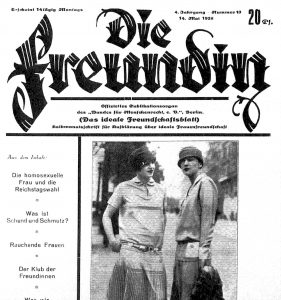 In March of 1932, Weimar-era gay publisher and activist Friedrich Radszuweit died of tuberculosis. Born in 1876, Radszuweit came to public gay life in 1923, when he founded the Bund für Menschenrecht (Federation for Human Rights, or BfM) in Berlin and began publishing dozens of gay, lesbian, and trans*-themed periodicals. The BfM grew to become the largest (indeed in some sense the only) mass-membership LGBT organization of its time. It claimed 100,000 members at a time when other Weimar gay organizations (like Magnus Hirschfeld’s scientific institute Institut für Sexualwissenschaft, the Wissenschaftlich-humanitäres Komitee he cofounded, and the masculinist Gemeinschaft der Eigenen) were vanguardist and tiny, circulating widely-distributed periodicals but lacking the ability or ambition to mobilize.
Radszuweit, on the other hand, had both. In the issue of Blätter für Menschenrecht (one of his firm’s flagship publications) that memorialized his death, his lover Martin remembered a survey Friedrich had conducted “in times of political peace.” He had sent 50,000 questionnaires about politics to his members, of which just over 37,000 were returned. The results:
1292 People’s Party,
8112 German National People’s Party,
1917 German People’s Party,
2903 Center Party,
709 German Democratic Party,
9207 Social Democratic Party,
7002 Communist Party,
16 German-Hanoverian,
6704 Independent/No Party.
This statistic has thus proved that homosexuals have spread to all parties, and that therefore only a neutral organization was the only possibility.¹
Of the approximately 31,000 members who stated their affiliation with a political party, just over half belonged to parties of the (at least nominally) Marxist left, with the rest approximately evenly divided between the center and the right. Nevertheless, for Radszuweit and his organization, they helped prove a larger point: that homosexuality was essentially apolitical, the movement “based solely on the grounds of law and human understanding.”² No alliances with parties were pursued, and while members of the organization were given information about which parties (the Social Democrats and the Communists) had supported the reform of sodomy laws, articles published under Radszuweit’s and other bylines across his firm’s publications sent conflicting political messages. Martin, whom he adopted as his son so that he could inherit the organization and firm, had been a Hitler Youth member who met Radszuweit while street brawling with Communists.
I’m in the archives of the Schwules* Museum Berlin — and many other university and private archives and libraries in Berlin — on the hunt for connections and comparisons between prewar Weimar queer identity formation and the intellectual development of the postwar California-based queer movements, mapping these onto the diaspora of refugee artists and intellectuals from the Nazi regime to Los Angeles. In the middle of competing and intertwining narratives of uniqueness and assimilation, of sociality and individuality, of collaboration with or separation from other social movements, up came a folder in which Schwules* Museum archivists have collected a series of pro-fascist and antisemitic articles written by Radszuweit in the early 1930s.
In January 1931, in his lesbian-oriented magazine Die Freundin, Radzuweit wrote, “We do not believe that even the National Socialists will proceed so rigorously against homosexuals as they announced before the September 1930 elections. Anyone who constantly reads the National Socialist newspapers, especially the ‘Völkischer Beobachter,’ will sometimes find some very reasonable articles on homosexuality. These newspapers generally do not condemn homosexuals as social pariahs, but on the whole only want to go after those Jews [das Judentum] (especially Dr. Magnus Hirschfeld) who wish to, in an ugly way…drag people’s sex lives into the public.”³ Radszuweit argued that even right-wing parties could be trusted to come around on the homosexual question:
We do not want to argue here and to justify what morality and so-called custom are, we only want to make the point that everything can be changed over the course of time. Moral concepts are different today than they were a hundred years ago. This is even acknowledged by right-wing circles…the vast majority of homosexual men of Germany do not intend to publicly display their relations, and would never have thought of creating a homosexual movement if the legislators were not so irrational…the homosexual men of Germany are of the opinion that one should not talk about these things at all, and that no one is concerned with the way in which two men, by their free will, and by mutual consent, have sexual intercourse in their secret chamber.⁴
Later that year, in an article in his Freundschaftsblatt newsletter so positive it inspired the mainstream centrist paper Die Welt to write it up under the headline “The Third Gender Welcomes the Third Reich,” Radszuweit claimed that the presence of homosexuals such as SA commander Ernst Röhm proved Nazi leaders were not personally homophobic, and that Hitler fit into a line of great manly leaders, many of whom were homosexual.⁵ The article, structured as an open letter, praised “Herr Hitler’s” focus on “political issues” rather than “sexual questions,” offering to “inform” him in a “non-partisan” way about “the prevalence of homosexuality.”⁶ It presented a list of “reasonable” requests, including equalizing the age of consent, allowing same-sex sexual contact in private between consenting adults, and strengthening laws against prostitution and intergenerational sex. In defenses of the article published in later issues of Die Freundin, Radszuweit acknowledged that the “Hitler camp” created anti-homosexual “propaganda,” but argued that the names of homosexuals in the Nazi Party should be kept secret and that their presence meant the Party would not seriously prosecute what we might now call ‘heteronormative’ homosexuals if in power.⁷
Radszuweit, as the publisher of widely circulated newsletters of a genuinely mass-movement organization, had the opportunity to mobilize his not-insignificant forces against the rise of fascism, and refused. Instead, he chose to collaborate with antisemitic rhetoric, denounce the most outrageous fascist statements in mild terms, and hope for accommodations and concessions once they took power.
We are too often today, in the face of a new and global and growing far-right that threatens economic, environmental, racial, and sexual justice, presented with new forms of this upper-class collaborationism. Twinks for Trump leader Lucian Wintrich claimed that the left is “just as if not more reactionary” than the radical right and compared himself to Robert Mapplethorpe after protests of his pro-Trump “Daddy Will Save Us” exhibition.⁸ Florian Philippot, Marine le Pen’s openly gay campaign manager, has masterminded a campaign strategy of turning French LGBT voters against immigrants.⁹ Twenty percent of French gays interviewed on the Hornet dating app, the same percentage who indicated their support for the hard-right proto-Nazi German National People’s Party in Radszuweit’s survey, say they will vote for le Pen in the first round of April’s elections.¹⁰ Gay magazines appealing to a broad readership publish glossy profiles of now-discredited fascist sympathizer and gay minstrel Milo Yiannopoulos.¹¹
Most extraordinary of all was the praise given President Trump by San Francisco Pride, after a New York Times article indicated that his daughter Ivanka and her husband Jared Kushner had persuaded him not to issue an executive order overturning many pro-LGBT Obama-era executive orders. Trump instead issued a press release insisting that the President “continues to be respectful and supportive of L.G.B.T.Q. rights, just as he was throughout the election.” Pride reposted the Times article on Facebook, commenting, “Very cautiously optimistic, with a nod of gratefulness.”
This was terrifying to read the same week as the pro-Hitler Radszuweit articles. To their credit, San Francisco activists forced Pride to rescind their optimistic statement and restate rote concern for the displaced, the targeted, the vulnerable. But the danger remains. It is entirely possible that in the United States and/or Europe, white middle- and upper-class gays and lesbians will choose to collaborate with the growing far right after being promised, however perfunctorily, that it does not seek to target them. These parties and figures (Trump, le Pen, Germany’s Alternative für Deutschland) are two-faced on gay issues, creating advertisements and messaging targeted at the racial insecurities and class privilege of newly-married older white gay and lesbian couples, while simultaneously promising religious and social conservatives the revocation of those rights and even, in the case of one state AfD politician in Saxony, a return to Nazi- and Weimar-era sodomy laws.
A bitter irony: the BfM’s cautious refusal to take a stand on the crucial issues of its day, its kind words about Hitler, its collaboration with poisonous anti-Semitism, bought it exactly no protection when the Nazi regime set its murderous sights on LGBT people and institutions. The final document in the organization’s file at the Schwules* Museum celebrates the organization’s dissolution, reading, “The liquidation has ended. Heil Hitler!”¹² Stormtroopers had raided and destroyed the publishing house. This document, like the Nazi bunker on my street and the tiny bronze memorials to murdered Jews set into the cobblestone sidewalks, is a reminder of the dangers of our time and their clear echoes in the past. Accommodation and collaboration are moral and political failures, even on their own terms. There is no sure path to safety except to win the fight for the kind of world we want.
- 1. Blätter für Menschenrecht, April/Mai 1932. Box 2, Folder 1. Sammlung Radszuweit — Schwules* Museum Berlin.
- 2. Ibid.
- 3. Die Freundin,
Jan. 11, 1931. Box 6. Sammlung Friedrich Radszuweit — Schwules* Museum Berlin - 4. Ibid.
- 5. Die Welt am Montag, Aug.17, 1931. Box 6. Sammlung Friedrich Radszuweit — Schwules* Museum Berlin
- 6. Herrn Adolf Hitler, München. Die Freundin, Aug. 12, 1931. Box 6. Sammlung Friedrich Radszuweit — Schwules* Museum Berlin
- 7. Die Freundin, February 1931. Box 6. Sammlung Friedrich Radszuweit — Schwules* Museum Berlin
- 8. http://www.breitbart.com/milo/2016/10/08/wintrich-trump-art-show-new-york/
- 9. https://www.buzzfeed.com/lesterfeder/frances-nationalist-party-is-winning-gay-support?utm_term=.mydAYV8Yz#.odKNv4LvV
- 10. https://www.pinknews.co.uk/2017/03/01/1-in-5-french-gays-are-voting-for-anti-gay-marriage-marine-le-pen/
- 11. http://www.out.com/out-exclusives/2016/9/21/send-clown-internet-supervillain-milo-doesnt-care-you-hate-him
- 12. Box 1: Vereinsakte. Sammlung Radszuweit — Schwules* Museum Berlin
Emerging LGBTQ Scholars Reflect on Dawn of Trump Presidency
BY Eric Gonzaba ON January 2, 2017
 I like to think of OutHistory as a sort of historical queer think tank, allowing scholars and the wider public alike to engage with LGBTQ studies and to ponder difficult questions about sexuality and gender. The OutHistory team graciously lets me muse about various topics from time to time, and America’s fractured political atmosphere seemed an obvious angle on which to write. However, with a Trump presidency just on the horizon, collaboration with various colleagues seemed more fitting a means of contemplation.
Below, I’ve invited a group of emerging LGBTQ scholars to reflect on the era of Trump, curious of what they think led to this man’s ascendency to the highest political office in the land, how they believe his administration will affect current LGBTQ movements, and in what way their own work in LGBTQ studies reflects the current political atmosphere. These individuals represent the future of LGBTQ scholarship. If their words indicate anything, it’s that the vigorous study of the queer past and present appears in good hands.
Best,
Eric Nolan Gonzaba
——————————————————————
Harrison Apple, Our Situation is White Supremacy and Mass Incarceration
Rachel Gelfand, Surveillance Constancy: Trump on the Threshold
Eric Nolan Gonzaba, The Queer Arc of Justice
Daniel Manuel, Complexity Can Give Us Hope
Sarah Montoya, We Stand On the Backs of Many
Chris Parkes, Reflecting From Across the Pond
Kristyn Scorsone, Oral Histories Speak Truth to Power
Terrance Wooten, Against the Romance of Futurity
 Our Situation is White Supremacy and Mass Incarceration
Harrison Apple
PhD Student, Gender & Women’s Studies, University of Arizona
Co-Director, Pittsburgh Queer History Project
In the summer of 2016, I was interviewing a woman as a part of my research on working class LGBT history in Pittsburgh, PA. Speaking about her feelings of contradiction she said, “for being gay, I have liberal policies on some things, but very conservative on others…” She then asked me, “Who do you like for President?” I had never been asked that question in an interview before, and I quickly began to ramble before settling on, “I just don’t know.” Mirroring her, I asked who she liked and she said, “I’m leaning towards Trump.”
I reflect on that conversation often, and the way she phrased it. “Who do you like?” sounded as much like a bet as a preference. Perhaps interpreting it as a bet was a form of disavowal. Rather than believe someone when they tell you that their imagined future is anchored in your own oppression, I pretended she was making due with her options, in the same ways he described her distaste for political correctness and our waning ability to take a joke.
Moments like these – of which there are plenty, believe me – demonstrate what I believe Teresa de Lauretis meant when she said, “the time for theory is always now.” Regardless of who is elected, in the next four years we are all going to be asked to make decisions that we will want to believe are unmotivated, objective, or neutral when they are not. We will be asked to preserve our own sense of security-futurity through the punishment-death of others.
This is by no means a new phenomenon. For many, the reality of a Trump presidency may mean little substantial shift in their everyday lives. The white supremacy that was eluded to by the woman I spoke with, saying that political correctness has hindered out ability to effectively enact racially profiling and support homeland security, is only one manifestation of anti-blackness that subtends LGBT U.S. history as a frequently deracialized field of study.
Rejecting the reality that a rights-based political platform is made possible with the same apparatus that has subtended white supremacy and cishetero-patriarchy (such as the prison industrial complex, overreaching surveillance, and dubious hate-crime legislation) is another form of disavowal. I’m reminded of Jonathan Ned Katz’s introduction to Gay American History in which he says, “all homosexuality is situational.” A political climate of white supremacy and mass incarceration is our situation. It is our responsibility to think through it.
——————————————————————

Surveillance Constancy: Trump on the Threshold
Rachel Gelfand
PhD Student, American Studies, University of North Carolina
Outhistory is a space, digitally housed, for historicizing queer movements. It holds what Ann Cvetkovich termed “archives of feeling,” an attention to the loves, losses, and liminalities of queer historical subjects. My research for the last few years has attended to questions of intergenerational history-making, the transmission of gay and lesbian activist strategies, and the passing along of experiences of surveillance. I am interested in how archives and oral history offer forms of time travel that transgress while simultaneously being institutionally bound, preserved by universities, libraries, government bureaus.
Living in North Carolina, I have focused on the Atlanta Lesbian/Feminist Alliance and traced how founding members “came out” of left movements. Many Atlanta feminists were on Cuba’s Second Venceremos Brigade, a part of Civil Rights activism, and key organizers working against the Vietnam War. For these actions, surveillance followed. While FBI agents struggled to find information about lesbian feminists, their presence was soon felt. In Atlanta, the FBI arrested an ALFA member in her lesbian collective house for antiwar activities. In Lexington Kentucky, a grand jury probed local lesbian connections to Susan Saxe, an underground lesbian activist.
With Donald Trump’s impending inauguration, my thoughts have been on his connections to this lineage of surveillance. I have been reading Simone Browne’s Dark Matters, in which she historicizes surveillance and its counterpart sousveillance, the people’s capacity to record state mechanisms. Surveillance systems grew out of histories of colonization and enslavement, a centuries-long process of biometrics. In my own research, I see cyclical fears of FBI presences. COINTELPRO and the anxiety it mustered echoed the McCarthy era of ALFA activists’ childhoods. Grand juries mirrored the House Un-American Activities Committee. Trump’s ideologies resound those of his mentor Roy Cohn, Joseph McCarthy’s star litigator (famously depicted in Angels in America). J. Edgar Hoover’s wiretap methods have played out on a digital scale in my lifetime and it seems the NSA’s role will only intensify. Reflecting on these connections, I think of my grandparents and great-grandparents living in Trump’s Brooklyn tenements. I think of my lesbian mother’s red-diaper-baby childhood and the fear she carries today.
Last Friday, I went to a protest here in Raleigh. Republican state legislators were in the process of passing bills to strip the incumbent Democrat governor of that post’s customary powers. Protests were loud and coalition-based, but Republicans did not bat an eye. With both press and police filming protestors, state legislators voted unviewed.
My time in North Carolina has made me acutely aware of legislative violence. Trump is one thing—something quite scary. His presidency emboldens patriarchy. The bullying culture he incites inherently hurts minoritarian communities, hurts queer people. But the racism of federal and state legislatures works on the level of the everyday. While Trump stokes white fears of a demographic shift toward black and brown political power, Paul Ryan and Mitch McConnell stall on passing an updated Voting Rights Act. The lack of preclearance, or federal oversight of voting law, is felt in quotidian life. The Supreme Court’s 2013 decision to gut the Voting Rights Act has led to violence that cuts across identity categories. In North Carolina, legislative gerrymandering has precipitated HB2, no Medicaid expansion, ransacked public education, voter suppression, and measures against police transparency. At Friday’s protest it was clear: the same politicians who are transphobic, are racist, sexist, anti-worker, xenophobic, islamophobic, and are swiftly moving on legislation in line with those ideologies. As a queer Jewish historian, I hope the Trump years increase solidarity and the fusion politics North Carolinians utilize. I hope, for example, Jewish communities will ally with Muslim communities.
Surveillance for my generation has been a constant. But for me it has been helpful to understand the racist historical underpinnings that produced the data-driven system we live within. My study of lesbian activism has been grounded in ALFA’s grassroots archives and FBI archival materials. I encourage historians thinking about this historical moment to look to both those archives for insight into creative resistance (radical softball teams, newsletters, bar life) and surveillance’s stumbling blocks. For historians of queer life, this work must continue to be framed by intergenerational dialogue. Outhistory can be a great resource toward these ends!
——————————————————————

The Queer Arc of Justice
Eric Nolan Gonzaba
PhD Candidate, History, George Mason University
Director, Wearing Gay History
Echoing the words of 19th century abolitionist clergyman, Dr. Martin Luther King, Jr. proclaimed many times throughout his life “the arc of the moral universe is long, but it bends toward justice.” Assuming King is right (and that’s a big assumption) after the recent election, it’s really hard to see that bend, especially if you’re a person with a disability, someone of Latino heritage, a Muslim seeking asylum in the “land of the free,” or anyone who understands that grabbing anyone by their private parts without consent constitutes sexual assault.
And yet, Donald Trump won a majority of votes in the Electoral College, and will become the 45th US President. President Obama’s departure from the White House seems so devastating to so many LGBTQ people because the Obama years felt like an era of change. Certainly there were big victories—marriage equality, the end of Don’t Ask Don’t Tell, the election of the first openly lesbian woman to the US Senate and the first openly bisexual person to become a governor. President Obama’s Attorney General Loretta Lynch even launched a suit against North Carolina and it’s anti-trans bathroom law. On behalf of the administration she served in, Lynch told trans communities that “we see you; we stand with you; and we will do everything we can to protect you going forward.”
There were also setbacks—the continuing attacks on trans people, especially trans women of color, persistent bullying in schools, the passage of so called “religious freedom bills” in GOP controlled statehouses, and the fact that LGBTQ people made up the vast majority of victims at the deadliest terrorist attack on U.S. soil since 9/11.
As historians, Trump’s victory is a call for us rethink how we teach history. The cliché answer students give me when I ask “why do we study history,” is some variation of the famous Santayana quote “Those who cannot remember the past are condemned to repeat it.” I mean . . . I guess? Though, I know lots of historians and we aren’t an army of modern Nostradamuses over here. Historians can certainly inform the present and give us tools to shape our futures, but I often respond to this answer by asking my students why they assume we’re living in some utopia compared to the past? Maybe those who cannot remember the past are condemned not to repeat it. Imagine for a moment future Attorney General Jefferson Beauregard Sessions ever telling transgender Americans that they have a friend in the Trump administration. While we all may be guilty—at times—of interpreting the past through rose colored glasses, it is clear that our future is no safe haven.
The Obama years were—by no means—Camelot, but the social progress during those eight years for some queer people was laid brick by brick by those who fought decades and centuries earlier. Our queer past isn’t something we study to pat ourselves on the back; rather, these requisite recounts of past tragedies and achievements give us necessary perspective to celebrate change and acceptance. More importantly, this history should embolden us all to fight injustices that some continue to overlook—and many continue to endure. The comfort of a supportive president is gone, and along with him should go our complacency to challenge and fight inequalities.
King may have been right; the arc may bend toward justice, but let’s not wait around to find out. We ought to bend it ourselves.
——————————————————————

Complexity Can Give Us Hope
Daniel Manuel
PhD Student, History, Rutgers University
I am a historian of the AIDS crisis in Louisiana in the 1980s and 1990s. I spent the first twenty-four years of my life in Louisiana, and my research is as much an effort to understand the world in which I came of age as it is an effort to historicize why Louisiana is at the forefront of the contemporary HIV epidemic.
Yet, my work also recognizes possibilities for resistance, even in hostile times and places. In recent days I have conceived of my work, and the work of historians, as arguing for the complexity of the past. Under an administration whose campaign suppressed narratives it found troublesome and rejected complexity in favor of simplistic mantras, historians are truly obligated to uphold complicated truths. In this disempowering post-election moment, a complicated past is a powerful past. I would like to explain by offering a few takeaways from the history of AIDS activism:
The Right is not monolithic. Historians, including Jennifer Brier in Infectious Ideas, have highlighted Republicans’ fault lines during the Reagan administration, as multiple issues divided the Right in the 1980s. Gary Bauer and other members of Reagan’s cabinet sharply conflicted with Reagan’s own Surgeon General, C. Everett Coop, over the administration’s approach to preventing HIV transmission. Similarly, we witnessed Trump’s difficult relations with the Republican establishment during the primaries, and, while many establishment figures have attempted to atone for earlier disagreements, the Right remains visibly fragmented. We should recognize that Trump’s administration comprises cabinet members and advisers with competing interests and outlooks. Despite the wishes and pronouncements of Trump and others, the Right is not unified, and its internal disagreements are potential sites of challenge and contest.
The Left lives on. Particularly when riven by internal conflict, the Right cannot quash all opposition. Populations and people marginalized by Trump’s victory are not powerless. Even in moments when conservative social and political messages predominate, they do not stymie the vital and ongoing work of the Left. Our organizing efforts endure, perhaps with renewed vigor and inspiration in the face of a hostile political administration and social climate. What we have to recognize is that the Left is alive in ways that are often ignored. In the 1980s everyday actions, like grocery shopping for a person with AIDS or writing a letter to a newspaper editor about living with HIV, were profoundly powerful. We can remember that in uncertain times, as the AIDS epidemic began to rage in the early 1980s, marginalized populations banded together to care for one another. These simple acts disrupted and displaced, even if temporarily, public rhetoric and attitudes that were heterosexist, racist, misogynistic, and classist. These simple acts asserted the value of lives deemed worthless by mainstream conservative attitudes. Many disregarded the social stigma attached to AIDS to care for friends, family members, lovers, and strangers. These practices were never perfect, and we should keep in mind the need for intersectional organizing, as we simultaneously reject limited conceptions of community. Nonetheless, the Left is alive and powerful.
Accordingly, we should recognize local and everyday politics as sites to challenge oppression. National elections and legislation are not the only measures of power. As HB2, the transphobic bathroom bill, in North Carolina and the recent rash of legislation restricting abortion access in Ohio and Texas have shown, we will be fighting for bodily autonomy and personal dignity at the state and local levels, too. Moreover, we have to remember that political power also lies beyond legislation. Local organizations provided the first care for people with AIDS, and I think often of what it meant to care for a person with AIDS before the advent of life-sustaining drugs. By refusing to let lives slip away and refusing to let people die in degrading circumstances, AIDS activists sent a political, life-affirming message. Caring for one another is a potent and meaningful political and human victory.
All this to say, historians are obligated to challenge narratives that claim the Right is all-powerful, that the Left is utterly lost, or that national electoral and legislative victories are all that matter. The present, like the past, is more complicated. That complexity can give us hope to carry on.
——————————————————————

We Stand On the Backs of Many
Sarah Montoya
PhD Student, Gender Studies, University of California, Los Angeles
In the days after the election, I found myself profoundly numb. The stillness was only periodically punctured by waves of fear and anger. As a victim and survivor of domestic violence and sexual assault, I wept. As a queer woman of color, I wept. For two weeks, I recoiled into myself and did not write. But I knew better than to ask the question, how could this happen?
The ideology and political, imperialist practices of this country are deeply invested in a white supremacist capitalist heteropatriarchy. The creation of this country was and remains contingent upon the dispossession of Native peoples and the systematic denial of their sovereignty. The American economy was built upon the backs of Black slave labor. It remains contingent upon the exploitation of people of color both here and abroad. This was never a place that offered recognition or protection to Black folks, Native folks, or queer folks of color. The promises of citizenship and legal recognition or protection have largely been illusory. Today, we see this legacy of violence at Standing Rock, in the state-sanctioned murders of men and women of color in our streets, in the brutality visited upon transwomen of color, and the rampant xenophobia aimed at Muslim communities and the undocumented.
For many of these communities, life will continue to be as precarious as it has always been. Perhaps we can begin the necessary work by holding ourselves accountable. I am a Ph.D. student at a Tier-One University on what was once Tongva territory. I value my work as an educator, but I am not naïve to its context. The university is, first and foremost, a business. The work I do is only valuable if it is accompanied by daily practice and I am willing to put my energy into the community outside the university grounds. We must continually ask ourselves, how can I be of service to the community? How is the work that I am doing helping to redistribute resources to those most vulnerable?
We cannot build radical communities or movements if we do not grapple with these realities. Many of us were not afforded the luxury and privilege of “shock” at this election’s outcome. We cannot afford to confuse progress towards social justice with neoliberal progressive politics. Here, we see the failure of single-issue politics and the need for intersectional analysis and political practice. Our political agendas should advocate for those continually and repeatedly rendered most vulnerable. To celebrate our existence is not enough, and our mobilization in the wake of a Trump regime means that coalition building is crucial.
In “The Transformation of Silence into Language and Action,” Audre Lorde writes, “For to survive in the mouth of this dragon we call america, we have had to learn this first and most vital lesson – that we were never meant to survive. Not as human beings. And neither were most of you here today, Black or not. And that visibility which makes us most vulnerable is that which also is the source of our greatest strength.” Lorde delivered this paper in 1977, and, nearly forty years later, the sentiment rings true. There is a long and storied history of survival and resilience around us – in the faces and stories of our elders and in the literature of women and queers of color. This is not the first time that we are struggling against domination and injustice. We are not doing this alone; we stand on the backs of so many.
——————————————————————

Reflecting From Across the Pond
Chris Parkes
Graduate Teaching Assistant, International History, London School of Economics and Political Science
More than once in the past month I have encountered historians here in the UK contemplate refusing to return to the United States because of the election of Donald Trump. There is something about the prospect of his presidency that fills some Americanists in this country with a palpable sense of revulsion. Much of it is distaste at the xenophobia, racism, sexism, homophobia, and a litany of other obloquies that can be rightly leveled at the candidate and his campaign. But there is something deeper, too. Perhaps it is the inevitability of having to see Mr. Trump’s incandescent mug displayed in the entryways to the National Archives and the Presidential Libraries in which we conduct much of our research. More likely it is a sense of anguish, despair, or even betrayal that the United States – a beacon of hope amid the gloominess of Britain’s Brexit winter – would succumb to the same populist backlash that has roiled this country. Best to turn our back, impose a personal embargo on the Yanks, and hope things turn around in four years time.
Those of us outside the US have the luxury of being able contemplate such remedies. But how much comfort does distance really provide given the enormity of recent events? For LGBT historians in particular the populist revolt of recent years portends a deeper crisis. The rise of the far right in France, the Netherlands, and other European countries, the clampdown on academic and press freedom in Turkey, the spike in hate crimes in the UK following the victory of the Leave campaign in the EU referendum, and, of course, Mr. Trump’s election represent not only a rejection of ‘elites’ but also a repudiation of the pluralist ethos that has underwritten the study of sexuality as a historical subject. For a (sub)discipline built on the recognition of the lives of the powerless, the nonconforming, and the despised, validation of casual bigotry and alt-right authoritarianism by the imprimatur of electoral success poses an existential threat.
If this sounds alarmist, it should. LGBT historians have a particular incentive to speak out in times of rising intolerance to dissent. Our subjects and their stories are salient because, more often than not, they concern those who occupied the margins of society. They were the first targets of oppression by the state, the mob, and civil society when demagogues fanned populist anger or induced people to look for scapegoats. Sexologists in Weimar Germany, gay and lesbian civil servants in the Federal Government during the Lavender Scare, and radical AIDS activists during the 1980s, to name but three examples, all endured official opprobrium in a political climate that deemed sexual diversity to be dangerous. Studying their successes and failures reminds us of how tenuous gains in civil rights can be and how intolerance of one minority group is rarely an isolated lapse in a society’s treatment of its most vulnerable citizens.
Bearing this in mind, LGBT historians in the coming years can reassure themselves that they have more resources, colleagues, and platforms to draw on than preceding generations did. The interconnectedness of contemporary scholarship – spanning continents and crossing disciplines – provides an armature to withstand the coming trials, provided we keep speaking out and do not stay home hoping it will all pass.
——————————————————————

Oral Histories Speak Truth to Power
Kristyn Scorsone
MA Student, History, Rutgers University – Newark
Team Member, Queer Newark Oral History Project
In the short time we have before the President-elect takes office, scientists are pushing to archive as much U.S. government data on climate change as possible. According to a recent article from the Washington Post, the scientific community is highly concerned about the new administration’s bent towards scientific suppression. Although the inauguration is still a few weeks away, there has already been an insidious request by Trump’s transition team for lists of Energy Department employees and contractors who have taken part in climate change talks. To date, the Energy Department is resisting and in Toronto, climate change data from the Environmental Protection Agency will be mass copied as part of a “guerrilla archiving” hackathon event.
As these storm clouds continue to gather over our political landscape and the word of the year is “post-truth,” the work of the Queer Newark Oral History Project feels more crucial than ever. Writer and activist Darnell Moore, who was also the first chair of the City of Newark’s Advisory Commission on LGBTQ Concerns, Rutgers-Newark history professor Beryl Satter, and Rutgers-Newark Department Administrator for History and African American and African Studies Christina Strasburger started the project in 2011 as a community-based and community-driven endeavor. Queer Newark’s focus is to document Newark’s urban communities of color in an effort to expand the dominant historical narrative, which largely ignores the contributions of queer people of color. In Trump’s Amerikkka, lies made up of 140 characters are eaten up by far too many people convinced a billionaire has their best interest at heart, while in depth political analysis and fact-finding by reputable journalists gets dismissed as “butthurt” rants. It is hard to say where the obfuscation of truth will extend its reach next. Therefore Queer Newark, and public history projects like it, are more than a repository of human experience, they become an important part of the defense against authoritarian influence.
While Tony Perkins, Trump ally and head of hate group, Family Research Council, calls for a “purge” of pro-LGBTQ employees from the State Department, Queer Newark provides a counter-narrative to the spread of hate speech and misinformation dangerously hostile to queer individuals and families. On our website, black lesbian narrators like Renata Hill and Venice Brown—two of four friends who were characterized by the news as a “Gang of Killer Lesbians” and sent to prison for defending themselves against a man who violently attacked them because of their sexuality—expose the intersections of racism and homophobia in our court system and media. You can also listen to Alicia Heath-Toby describe what it was like for her and her partner to be the only African American lesbian couple in the 2006 legal battle for marriage equality in New Jersey. Without the preservation of stories like these, the new administration’s vision for our nation gains another foothold.
Michel-Rolph Trouillot in his book, Silencing the Past: Power and Production in History, writes, “History is the fruit of power, but power itself is never so transparent that its analysis becomes superfluous. The ultimate mark of power may be its invisibility; the ultimate challenge, the exposition of its roots.” (xix) We must question what truths are lost from our historical records in order to dismantle dangerous ideologies of hegemonic forces. If you allow silences in the archive to persist, you allow power to exist unquestioned. The oral histories of Queer Newark speak truth to power. They disrupt the dominant paradigm and disseminate knowledge as a powerful act of resistance.
——————————————————————
Against the Romance of Futurity
Terrance Wooten
PhD Candidate, American Studies, University of Maryland
A little over a month ago I sat with a group of [predominantly liberal, white] coworkers processing various reactions to the outcome of the recent election. During our conversation, they almost uniformly expressed their genuine disappointment in the election results as well as their overall surprise at the increasing intensity with which acts of violence are happening against black and brown people—often queer and women of color—“in 2016.” Their surprise combined with the assumption that these issues should not be prevalent at this particular moment in our history suggests a progressive teleology wherein we should have arrived at a type of multicultural liberalism by now. We should be beyond sexism. And homophobia. And racism. The conversation sounded just like the ones I had with my [predominantly liberal, white] colleagues almost a decade ago during my undergraduate career while recounting childhood experiences growing up in a small rural town in central West Virginia.
My family moved from Sandusky, Ohio to West Virginia the summer before I started the seventh grade. At the time, the only cultural context through which I understood WV was the 1999 horror film The Blair Witch Project, which had just debuted. Needless to say, I was adamantly resistant to transplanting from a place where I had thriving friendships, familial relationships, and “a life” to one where an unidentifiable witch might lurk through the forest to claim my soul. On the first day of school, I found out how wrong I was; besides the fact that I had since dispelled all the myths presented to me in the film, I was confronted with the real threat lurking in the background.
It wasn’t witchcraft; it was racism. Interpersonal. Structural. Systemic. Racism. The stories are endless. Ask me.
That is to say, when I was just twelve-years-old I was forced to think deeply about how race, geography, and sexuality intersected. It was then that I started to realize the tapestry of American empire was sewn together through, against, and on the backs of black and brown folks, that there was no progress narrative to which I could cling, despite my colleagues’ desires, as the only progress I could ever measure was in my own change in height. And yet, every time I retell stories of my childhood, there is inevitably one—or four—person(s) who seems surprised, who is genuinely taken aback by how such racism could exist in 2000 (or 2005 or 2011 or 2016). What this tells me is people are profoundly committed to seeing this moment right now as one that is better than the moment preceding, as understanding the present as much better than the past and the future as always having the capacity to be even better than the now. And yet, there has been a cultural shift (at least amongst many liberals, perhaps exacerbated by Trump’s own campaign refrain to make American great “again,” which is to say to return to the past) since the election wherein the representations of the future have been fraught with a type of nihilistic, post-apocalyptic skepticism that suggests there is nothing forward to which we can look (presuming there ever was). While I want to otherwise resist this impulse, I think this is a productive place to sit for a while—a place of discomfort, a place that queer men and women of color often sit. Not to empathize. Not to know or consume the Other’s pain and trauma and trepidation. To strategize. To rethink time and the value of futurity. To reassess our relationship to the state and to think more critically and creatively about how to engage the state and state agents such that we account for the many people who cannot altogether afford to disavow it—people receiving housing subsidies, affordable healthcare, public assistance, and other forms of social welfare—while simultaneously not reinvesting in it as a site or recovery and retribution. It is a time to not only listen to but also center the voices and experiences of queer people of color. We have to work across and through difference, creating safety networks for when the state works—and it assuredly will—against us.
The day after the election, I did not mourn or cry or panic. Instead, I curled up and reread Wahneema Lubiano’s edited collection The House That Race Built. Not because I am better than or built differently from others but because being a black queer man in America has taught me that Trump is simply an embodiment of all of the intersecting modalities of oppression I—and many others before and with me—have encountered and been fighting against. I hope this moment encourages others to join. Right now. For now. Against the future.
In the Archives | The 1987 March on Washington Committee: The Chicago Chapter
BY John D'Emilio ON December 21, 2016
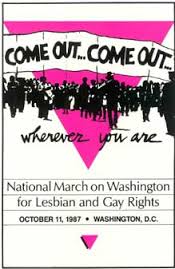 While the archival collections at Gerber/Hart are grounded in the history of Chicago, inevitably some of the papers reach beyond the city to illuminate national events. They reveal connections between the local and the national and the impact of each on the other. The papers of the Chicago chapter of the 1987 March on Washington Committee are a case in point.
The importance of the 1987 March on Washington cannot be overstated. It put the organized LGBT community on the national stage as never before. There had been a first lesbian and gay national march in 1979, but it drew fewer than 100,000 people to Washington. By the standards of the time, that marked it as decidedly unimpressive. By 1987, just eight years later, much had changed. The AIDS epidemic was raging across America, killing men who had sex with men in staggering numbers. The Reagan administration was disgracefully ignoring it. In 1986, in Bowers v. Hardwick, the Supreme Court added to the fury by upholding the constitutionality of state sodomy laws, with language that was gratuitously contemptuous of same-sex love and relationships. Put all this together, and the result was a march of 500,000 people in October 1987, perhaps the largest protest march to ever assemble in the nation’s capital.
But there was more. There was also mass civil disobedience and arrests in front of the Supreme Court, a mass wedding of same-sex couples to protest the absence of family recognition, and the powerful display, for the first time, of the Names Project Memorial Quilt on the Washington Mall. Key speakers at the rally were the Reverend Jesse Jackson, long-time African-American civil rights leader and a candidate in 1984 for the Democratic presidential nomination; Cesar Chavez, head of the United Farmworkers Union and perhaps the most visible Chicano leader in the U.S.; and Eleanor Smeal, president of the National Organization for Women, the largest feminist organization in the United States. Their participation was a dramatic sign that the LGBT movement had come of age and was recognized as a component of the broad struggle for social and economic justice in the United States.
Materials in the papers of the Chicago’s MOW Chapter provide a glimpse into just how wide and deep the organizing for the March was. The national steering committee had representatives from 18 states, and there were local committees in 43 states. For instance, three cities in Alabama, six in Georgia, and three in Maine had an organizing structure to get people to Washington. The Chicago chapter papers contain a list of endorsers of the March that filled several pages. It included labor unions, religious groups, and women’s organizations, as well as national, state, and local elected officials. It is worth remembering that every one of those endorsements came because an LGBT activist reached out to key figures in those groups, talked about the March and the issues, and persuaded them to lobby within their organization for an endorsement.
The papers also contain extensive materials about civil disobedience and the kind of training that was provided to individuals. A condition of joining in the civil disobedience outside the Supreme Court was that participants belong to a local affinity group. This meant that, in the summer and early fall of 1987, deep and trusting relationships were forming among groups of activists in cities across the country. As I looked through this material I could not help but wonder how much this contributed to the explosion of local direct action protests by ACT UP and other AIDS-activist groups in the months after the March on Washington, both in Chicago and around the country.
 Besides the window that this collection opens into the scope and reach of national preparation, it also naturally gives a close sense of what the organizing looked like and accomplished in Chicago. Julie Valloni and Victor Salvo were the co-chairs of the Committee. In the course of organizing Chicagoans to go to Washington, they and other committee members sought local endorsements, a process that undoubtedly built support for a city non-discrimination ordinance which still hadn’t passed in 1986-87. They also worked closely with media in Chicago; one result was front-page coverage of the March by the Chicago Sun-Times. Perhaps the most visible local achievement was the endorsement letter the Committee received from Mayor Harold Washington. “It is with enthusiasm that I endorse the National March on Washington for Lesbian and Gay Rights,” he wrote in his letter of September 17. “The breadth of the issues highlighted by the March – against racism and apartheid, as well as for civil rights – is consistent with the historic thrust of struggles for civil rights in this country.” Working hard to get a civil rights ordinance passed in Chicago, Mayor Washington also wrote: “The March will in turn support passage of a comprehensive Human Rights Ordinance here in Chicago.” Such a law was finally enacted a year after the March on Washington.
The last thing I’ll mention about this collection is a laugh that it elicited. In October 1986, the Vatican issued a major document on homosexuality that provoked a great deal of criticism and outrage, since it supported a theology that defined homosexual behavior as criminal. But one result was that, in Chicago, it led to the formation of a new group called “P.O.P.E.” The letters stood for “Pissed-Off Pansies Energized.” You’ve got to love our sense of humor!
What We’re Reading — On the Beach
BY Claire Potter ON June 14, 2015
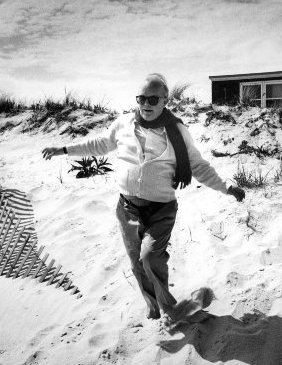
Truman Capote at the beachBarney Frank, (New York: Farrar, Strauss, Giroux, 2015). (June 4, 2014).
- Barney Frank, Frank: A Life in Politics (New York: Farrar, Strauss, Giroux, 2015). Read a review by Gary Wills in the New York Review of Books (June 4, 2014).
- Maggie Nelson, The Argonauts (Minnesota: Graywolf Press, 2015). Not exactly beach reading unless you are a historian, and then everything else is beach reading. A review in The Guardian is here.
- Nell Zink, Mislaid: A Novel (New York: HarperCollins, 2015). He’s gay, she’s a lesbian, and they’re married to each other in the 1960’s — what could go wrong?
- Mary Renault, The Bull from the Sea (New York: Vintage, 1962). An oldie, right? Totally camp, right? But I’m on the beach in Greece! If you are getting all misty about those teenage summer days spent making much of Renault’s not so hidden homophilia, you might also want to read Daniel Mendelsohn’s “The American Boy,” an account of his teenage correspondence with the author (The New Yorker, January 7, 2013.)
The Coming Gay Conservative Revolution
BY Eric Gonzaba ON March 23, 2015

Photo by Mario Piperni
I joke with some of my friends that soon, especially with what seems like the inevitable embrace nationwide of same-sex marriage, gay men will be flocking to the Republican Party, eager to distance themselves from gay activism or stereotypes as lefties, eager to act like their gay identity doesn’t tie themselves to a certain political ideology. I say joke, but I do think there’s something to be said that the end of the gay marriage debate might bring about an end to bringing national attention to LGBT issues, and with that, reassurance within our own queer communities that we have attained equality and are now living in a just society.
Gay marriage is a partisan issue and with that, LGBT people have largely united as a voting bloc against the conservative American political party. Self-identified LGBT Americans overwhelmingly voted for the reelection of Barack Obama (some 77% in support). That’s about 7% more than gay support to McCain, who, unlike Romney, did NOT support a federal amendment banning gay marriage. So why do I suspect there’ll be a conservative resurgence in our communities (but, most especially, among gay men)? Am I just some crazy skeptic, like Republicans who think global warming isn’t real because it snowed this winter?
No, I say this because advocating for marriage is, lest I sound like a “Mean Girl,” so0o0o0o0o conservative. Ask them yourselves—conservative gay columnists like Andrew Sullivan have argued as early as the 1980s that the Right should embrace gay marriage. They say, despite our communities’ transgressive roots, “a need to rebel has quietly ceded to a desire to belong. To be gay and to be bourgeois no longer seems such an absurd proposition.”
That, in fact, is part of the problem. Is our community really challenging “common assumptions and core institutions,” as John D’Emilio put it in a recent OutHistory post? This conflation of marriage equality as the main indication of LGBT progress has remade gay politics from being about class, gender, racial, and sexual liberation to one about money and societal comfort.
In Terrorist Assemblages: Homonationalism in Queer Times (Duke, 2007), Jasbir Puar discusses how the American gay community has sought integration and political rights through consumerism, exuding patriotism by doing what Americans do best—spending! Take, for instance, how the gay community is targeted by the tourism industry. After all, who better to target for travel to than the gay male, who, as the stereotypes tell us, is rich, educated, and without pesky children. In other words, they are prime consumers. As Alexandra Chasin suggests, gays and lesbians are bombarded by advertising that suggests their spending would eventually bring about their “full inclusion in the national community of Americans.”
This is nothing new for a social movement. In the past century, several disenfranchised groups, especially African Americans, sought progress not just by appealing to morality or political rights (the right to vote, hold office, etc.), but through consumption. They found a route to political success by appealing to economic freedom, the right to sit at a lunch counter or to buy a new washing machine at a segregated store. However, there is something extremely insidious about our embrace of a gay politics centered on spending and the conservative message that “we are just like everyone else.” If we are to believe the tourism industry, gay politics is all about being white and rich, which in turn means there is little demand to address the needs of racial minorities or those with lower socioeconomic status. It also produces an excuse for normative society to exclude sexual orientation as a suspect class in need of protection.
I’m not saying that you LGBT Americans can’t be conservatives. Everyone is allowed to believe what he or she wants (Senator Inhofe and his snowball on the Senate floor trying to debunk immense scientific consensus on climate change, is a great example that Americans really do have that freedom.) I also think you’re allowed to “care more about the economy and our nation’s security more than [you] do the government recognizing [your] relationship with someone,” as one young gay conservative told the Blaze last year.
While this divide is certainly problematic (I feel like Democrats probably care about national security too), LGBT communities certainly can turn Right if it aligns with their interests, though we should probably ask ourselves why so many don’t. Look at those enlightening (if not tangential) roundtables with black conservatives on Sean Hannity’s Fox show. While it’s great to give a forum to people with different viewpoints, one has to wonder why 90% of African Americans vote Democratic. It’s certainly not, as conservatives say, just that they’re pawns of the Democratic party; after all, Democrats have lost 3 of the last 4 midterm elections, certainly not indicative of a superb mind-control operation.
So yes: perhaps the emergence of a society okay with gay marriage will mean an end to an LGBT coalition. However, as a wider community, we ought to consider whether queer factions should want to leave such a political union. Even if we don’t want to be the radicals we once were (and we certainly should rethink that), we owe it to our progressive allies in any political party (Democrat, Republican, Green, Libertarian, or gasp!—Communist) to continue our aim at a more egalitarian society.
Defiance in Dixie
BY Eric Gonzaba ON March 9, 2015
 I wanted to spare readers yet another post on gay marriage, perhaps the most exhausted of topics written by and about LGBT communities. I figure we will all get our fill about the issue in the next few months as the U.S. Supreme Court is finally set to hear oral arguments on April 28th. I’m also fully aware about how problematic it is to focus on the issue of gay marriage (see Dan Royles excellent discussion about queer politics and Ferguson) That said, with all the mess same-sex marriage has caused in Alabama over the last few weeks, I couldn’t resist.
No, this won’t be a post where I try to convince you that gay marriage should be legalized. There are far too many eloquent writers who’ve already done that, and more importantly, far too many anti-gay marriage folk who’ve made it easier for those writers. (I’m looking at you, Dr. Ben Carson, who said this week that prison makes you gay.)
I wanted to focus on Alabama, which was ordered to begin granting marriage licenses to same-sex couples early last month following a ruling by a Federal District court judge. Unlike most states in similar situations that complied with federal rulings, Alabama’s deeply religious Chief Justice Roy Moore ordered probate judges to not grant marriage licenses. Probate judges split on the matter; some stood by their Chief Justice while others bowed to federal authority. All this became moot just a few days ago, however, after the Alabama Supreme Court (headed by Chief Justice Moore) halted all same-sex marriages in the state. Despite a tide of same-sex marriage acceptance nationwide, Moore and Alabama are prepared to take a stand.
It might be expected that same-sex marriage wasn’t going to go as smoothly in the state as it had in other parts of the country. After all, only 1 in 5 Alabamians approve of same-sex marriage (the state ranks 49th in the country. Your guess for #50 is probably correct). But the fight for marriage rights in Alabama was surprisingly civil. Despite some rare testy exchanges with protesters outside of county courthouses, news footage documented long waits for couples who waited to hear if their local probate judge would offer them a marriage application. Some were sustained, they said, by the kindness of strangers who brought them fast food during their day-long waits at the county offices, unwilling to miss being present in case any news trickled in. When Etowah County, far from the urban centers of Montgomery or Birmingham, opened their marriage windows, a lesbian couple remarked that the clerks were professional and courteous and “on their game.”
As of now, though, those windows remain closed to same-sex couples. The most frustrating thing about this whole fiasco is Chief Justice Moore himself. For over a generation now, the Deep South has been fighting the legacy of Jim Crow and segregation. Alabama and Mississippi (your guess as to #50) were the heart of white southern resistance during the black freedom struggle, and since then, outsiders have viewed them as the true racists of American society. Places like Alabama and Mississippi became what historian Joseph Crespino call “metaphor states,” sites the nation as a whole can point to as the genuine holders of racial and discriminatory animus, as if the rest of the nation is innocent of gross civil rights issues. For example, why does New York City, a beacon of gay tolerance we’re told, refuse to address rising LGBT homelessness. In terms of homophobia, the south is by no means exceptional.
To be sure, this doesn’t mean Alabama is off the hook. Alabama deserves our national anger. The legacy of lynching, voting disenfranchisement, peonage, slavery, and unethical medical experiments, to name just a few, is still very much real.
But Chief Justice Moore’s actions is so vividly reminiscent of Alabama Governor George Wallace’s famous stand in the schoolhouse door at the University of Alabama to protest desegregation in 1963. What’s mind boggling is that Moore is no dummy; he attended the U.S Military Academy and the prestigious, highly ranked law school at the University of Alabama. He’s fully aware of his home state’s tarnished racial legacy and yet still felt compelled to defy federal rulings on a monumental civil rights issue, which he opposed largely on religious grounds.
Now, I’m somewhat uncomfortable with the conflation of the black civil rights movement and the LGBT rights movement (the “new civil rights movement,” as some call themselves). Yet, Moore’s actions more easily merge the movements in the minds of the public. By doing so, it’s another anchor to pull down Alabama’s chances of ever really not being one of the focal points of national disgrace.
Maybe Alabama wasn’t going to be able to shed it’s racist label anytime soon, but Chief Justice Moore, a man overwhelming supported by his constituents, single handedly contributed to the state’s intolerant image. Like Wallace, I doubt history will be kind to him. Hopefully though, future historians will even care more about the clerks who opened their windows, the eager couples in line, and the vibrant queer communities of the South than they do about a cowardly Chief Justice.