


Call Me a “Kinsey-ite”
BY John D'Emilio ON December 31, 2014
This weekend marks the anniversary of Alfred Kinsey’s study, Sexual Behavior in the Human Male. Published on January 3, 1948, it and its companion study, Sexual Behavior in the Human Female (1953), may very well be the most influential books on sexuality published in the U.S. in the twentieth century. The male study is over 800 pages long, written in dry un-sensational prose, and without a single illustration. But that did not stop it from becoming a best-seller and provoking wave after wave of media attention and commentary from politicians, religious figures, scientists, and pundits. It isn’t hard to argue that Kinsey’s studies and the discussion they provoked closed the door on what remained of Victorian standards of reticence about discussing sexuality in the public sphere and that Kinsey, who became a household name for a decade or two, helped push American society in the direction of the massive cultural and social changes that, later, were labeled “the sexual revolution.”
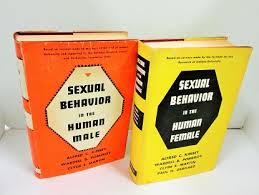
The response to the male study in particular focused on Kinsey’s findings on the incidence of male homosexual behavior: 50% of adult white males had experienced attraction to someone of the same biological sex; 37% had at least one post-adolescent sexual experience to orgasm with a male; 4% were exclusively homosexual in their behavior and desires; and one out of eight were predominantly homosexual for at least a three-year period. Nothing like these numbers had ever emerged before in scientific discussions of homosexuality.
Then and later, Kinsey was the target of much criticism, designed to discredit his findings. And there is much that can be criticized about the unscientific, non-representative nature of his “sampling.” Kinsey interviewed individuals wherever he could find willing subjects. He tended to use what today is called “snowball” sampling, in which one subject provides introductions to his friends and acquaintances. For a variety of reasons, it is doubtful whether, today, the “institutional review board” at Kinsey’s university would ever have approved his study.
Still, whatever the criticisms, Kinsey and his team had gathered more individual sexual histories than anyone before him. Regardless of whether his specific percentages around behavior – homosexual, pre-marital, masturbation, whatever – were accurate, he had a basis for what we might call “speculating” or theorizing about human sexuality. For instance, he created what he called his heterosexual/homosexual continuum – seven categories, from 0 to 6, ranging from completely heterosexual in behavior and desire to completely homosexual. But, with thousands and thousands of interviewees, he could just as easily have created a continuum with 14 or 28 or 70 categories differentiating behavior and desire.
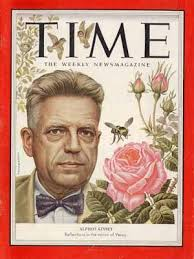
The point of the continuum for Kinsey was that human beings can’t be neatly categorized into heterosexual or homosexual. He refused to use the words as nouns that named a person and instead used them only as adjectives to describe a behavior or desire. The immense variety and range of human sexual desire led him to assert that human beings are born with a capacity for sexual arousal and response. That capacity is essentially without direction, or “object choice.” But, from the moment we are born, an array of experiences, emotions, cultural influences, and observation begins to shape and direct those desires.
Gay, lesbian, and bisexual activists made use of Kinsey’s findings over the next few decades to make the claim that there are lots of us, that it’s “normal,” and that the persecution of us therefore made no sense. Kinsey was a hallowed figure. But, beyond the statistical findings, his theory of human sexuality did not get picked up by activists, community members, and allies. It can too easily be bent to the service of those who say people “become gay” and that they become gay because of “bad” experiences that happen to them. It could play into sickness models of sexual identity.
But I find Kinsey’s perspective incredibly liberating. Kinsey basically argues that we are the sum of our experience, and our experience is infinitely various. We live in a world that seems to need categories, to need definitions. But wouldn’t it be wonderful to be able to accept whatever our own mix of sexual attractions was? I’m slipping into utopian fantasizing here, but still: I would like to live in such a world.
Read Kinsey! He still is thought-provoking, sixty-seven years after the first of his studies was published.
Ebola, HIV, and the Politics of Contagion
BY admin ON October 29, 2014

By Jim Downs
At a recent dinner party, a friend explained that she refused to travel to Paris because of the fear of Ebola. Another friend chimed in and said that he declined going to a social event because a friend of a friend had a relative who had just been to Africa. And the list goes on of people who, in some form or another, fear contracting Ebola.
Throughout American history, there are dozen of cases of hysteria surrounding the apparent outbreak of an epidemic, from recent fears over Asian bird flu to fears of cholera outbreaks in the 19th century. But the question of fear needs to be contextualized, not just in terms of alleviating Americans’ paranoia (as Shepherd Smith recently did on Fox News), but rather by thinking about how various populations within the nation have consistently lived under a threat of infection.
For gay Americans, the very act of sex — the most human act that leads to the creation of life — meant death for generations of gay people. The outbreak of HIV in the early 1980s has left gay people on high alert for the last 30+ years. Many gay men continue to live with the threat of contracting an epidemic every time they engage in sex, whether it is with a lifetime partner or a one-night stand. Sex could lead to death, be it because sometimes condoms break or because someone is unaware of his status.
The fear of Ebola, thus, tells us more about one’s social status and, dare I say, privilege, rather than about the disease itself. For many gay men, who have lived amid HIV “outbreak” for the last thirty years, the threat of Ebola perhaps has not rattled them as much as their heterosexual counterparts.
More to the point, when HIV broke out, the federal government did not react with the alacrity that it is today with Ebola — in fact, they denied it. When HIV began to spread, the media did not show images of medical professionals wearing space-age hazmat suits; rather, it continued to show images of emaciated victims dying of the disease. And when HIV broke out, gay people did not have the privilege of concocting far-fetched scenarios at dinner parties in which they could potentially imagine the threat of coming in contact with an epidemic; rather, HIV had already infiltrated their communities, came into their homes, and took away their family and friends — there was no “what if.”
The threat of Ebola provides a peek into the politics of contagion. For many gay Americans, going on a date often leads to a conversation about epidemic diseases. That Ebola now compels other Americans to consider the threat of a contagious virus suggests how fortunate they have been. Instead of sounding off an alarm of hysteria, they might just want to listen to how the other half lives.
Jim Downs is an Associate Professor of History and American Studies at Connecticut College. He is currently completing More Than Just Sex: The Forgotten History of Gay Liberation (Basic Books), and is the author of Sick from Freedom: African-American Illness and Suffering (Oxford U.P., 2012). Follow Jim Downs on Twitter.
Many thanks to the Huffington Post for allowing us to republish this essay.
Sexy Darwin
BY Claire Potter ON October 12, 2014
 I want to start this post, which is really about science and it’s various discontents, by saying: The Nation, a publication to which I am extremely loyal, does not publish enough in its regular edition, or even its blogs about LGBT people. Perhaps this has something to do with the fact that it is no longer fashionable on the left, especially among radical queers, to push publications like The Nation to take LGBT people’s politics,or their lives, seriously. Despite the fact that millions of queers are homeless, poor, racially and sexually discriminated against, there appears to be a general consensus that in the hierarchy of global and national suffering, we simply do not rank.
But you do have to credit The Nation with publishing more about sex in the last few years. JoAnn Wypijewski is doing a great job with the Carnal Knowledge feature, and no longer a backup to Katha Pollitt. Pollitt has been fighting the right (and the occasional fellow columnist, when they still let them do that at The Nation) on sex and gender for decades. Michelle Goldberg is a new utility infielder on the feminism beat. Richard Kim occasionally answers the call on queer issues but he’s been kicked upstairs to editorial. Despite these talented folks, we rarely see a feature or a cover story about LGBT people, or even the politics of sex, absent a compelling policy controversy (for example, Republican politicians pointing out a woman’s miraculous ability to not conceive if she just puts her mind on it.)
So when I stumbled upon an unread issue from earlier this fall that featured “Survival of the Sexiest: How Evolutionary Psychology Went Viral,” by Mal Ahern and Moira Weigal (September 9 2014) I had to wish queer people into it. Ahern and Weigal describe how evolutionary psychology (EP), a field with questionable methods and even more questionable conclusions has re-emerged as a respectable way of drawing conclusions about human sexual behavior. Heterosexual human behavior, that is.
In a nutshell, EP is a neo-Darwinian theory. It proposes that we are all hardwired to propagate the human species successfully: every sexual decision we make, and urge we feel, is linked to that. “We” are, of course, heterosexual in these studies. Our courting behaviors, attractions and sexual choices are all geared towards producing hardy offspring that carry our genetic material into infinity. Depending on our gender, we do this either by gaining access to young wombs or acquiring sperm from seemingly hardy, aggressive, successful males.
EPmakes me think of a middle school girls’ school joke in which, as a group, we would thrust our adolescent chests forward while chanting:
We must, we must,
We must increase the bust.
The bigger, the better,
The tighter the sweater, the more the boys depend on us.
To feed. The babies. We must….
(Etc. Repeat until falling down laughing or begged to stop.)
The popularity of EP as an explanation for otherwise inexplicable heterosexual behavior (for example, a guy having sex with a woman he meets at a bar who he then never calls again) is also a reminder that robustly funded and seemingly respectable scientific research continues to promote the idea that LGBT people are biologically broken or deviant. Because these are stupid overdetermined theories, EP’s explanations for human sexual behavior were dismissed as recently as the 1980s. But now they are back.
So what accounts for EP’s resurgence in science and popular culture in the 21st century? “In order to understand why there is such an insatiable appetite for this kind of explanation,” Ahern and Weigel argue,
why even the readers of center-left publications like The New York Times are willing to accept the idea that gender roles and relations are hardwired—we need to investigate how evolutionary psychology itself evolved. We propose that its popular success has nothing to do with how plausibly its proponents describe the struggle to survive on the plains of the Pleistocene Era. What it does reflect is the brutally competitive economic environment today. Evolutionary psychology may just provide an ideal theory of love for the precarious age in which we live.
Here’s the other thing about this field, which is hardwired into the larger field of sociobiology: like William Masters and Virginia Johnson, the researchers who have done the most prominent work in the field are all heterosexual couples themselves, many married, or ex-married, to each other. “Given the preponderance of couples at the forefront, and their desire to win attention (and thus funding),” Ahern and Weigel write, “it may have been inevitable that the new discipline would be sex-crazed. Sex and gender differences became evolutionary psychology’s most important topics.
Does EP apply to LGBT people at all as a method for figuring out why we are attracted to each other, aside from targeting a partner who seems to have the physical characteristics necessary for curating our Judy Garland LPs? Well, it appears that these theories are themselves “naturally” selective, and are only relevant to pairings that are most obviously reproductive in nature, even though men and women often do not naturally reproduce. About 10% of women who have sex with (possibly handsome but uncertainly fertile) men require medical interventions to conceive and carry a child to term (I’m going out on a limb to say: double that number for professional women.) Gay and lesbian people don’t qualify as sexual subjects who come together over the possibility of immediate, closed circuit reproduction, although bisexual and trans people might, I suppose. However, helped along by mass culture, EP has proven itself to be a fit survivor all on its own, and I think we can be confident that the proliferation of inseminating, sperm-donating, cross adopting, surrogate-employing queers will soon provide new opportunities for a field whose only consistent interest seems to be shilling sexist stereotypes.