


“Did You Really Mean to Say ‘Jimmy Baldwin Made You Gay?’?”
BY John D'Emilio ON December 24, 2014
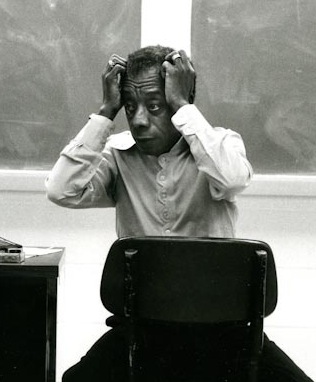
James Baldwin at Bowling Green State University, 1978
Sometimes it really hits home how little influence historians have on the way our community, or the larger culture in which we move, understands the world. A couple of friends/acquaintances (Don’t worry. You’ll remain nameless!) commented to me about my post last week, “Jimmy Baldwin Made Me Gay.” Each worried that the title would give the wrong impression, that it would suggest that I think we “become gay” instead of being “born gay.” Such an impression, one suggested, would only play into the hands of conservative Christians who argue that we “choose” to be gay.
Well, I don’t think that many of us “choose” to be gay or lesbian. But I would also be very surprised to discover that people are “born gay.” For decades now, some scientific researchers have been exploring that possibility, and periodically (though not recently) there will be a spate of news stories about the latest research project that seems to prove it. But, the truth of scientific theories depends on the ability of scientists to be able to replicate the findings of someone else, and so far none of the research studies claiming that some of us are born gay have been able to be reproduced by others.
By contrast, many historians and sociologists have been arguing for decades that “gay” is something socially and culturally constructed. Gay as an identity is something that has not always existed. There have been many times and places where same-sex love and attraction wasn’t recognized as something distinctive and where people were not categorized by their desires. Or, that desire was understood as a marker of gender so that what today we categorize as gay was instead seen as what we categorize today as transgender.
Some LGBT activists have interpreted this perspective as historians claiming that, because there was no word for it, then nobody felt that way or did those things. But that isn’t the claim at all. It is rather a recognition of the fact that the worlds we inhabit, with their institutions and structures and norms, shape our experiences, our possibilities, our ways of understanding and interpreting what we feel. And societies and cultures have varied tremendously in the most basic ways, including how sexuality was felt, experienced, and understood.
I have had many wonderful class discussions with students about these issues. Essays that I’ve written in the past – “Capitalism and Gay Identity” for one, and “Born Gay” for another – at least push people to reflect on why they think most of us are born one way or the other, even if they can’t quite absorb a convincing alternative. I mostly listen as the discussions unfold and questions get asked. “Born that way” seems like a safe liberal position to take. It allows individuals to be however and whoever they are, whether that is heterosexual, homosexual, or bisexual.
But sometimes one or more students would look at me and press the issue. “What do you think, Professor? You don’t think we choose how we are, do you?” And I will respond, “no, not exactly. I guess I would call myself a ‘Kinsey-ite.’” And that launches us into a whole other discussion about Alfred Kinsey, who he was, and what his studies might tell us about human sexuality. But, more on that next week, as we head toward the anniversary of the publication of Kinsey’s first major study, Sexual Behavior in the Human Male.
Comments