


History and Social Change
BY John D'Emilio ON January 14, 2015
 History has always been, for me, a story of change. Empires and kingdoms, political parties and corporations, come and go. Even when one can point to continuities, such as the persistence of structural inequality like racism and sexism, history allows us to analyze and come to grips with how the forms in which oppression expresses itself have shifted over time.
In terms of U.S. LGBT history, the last sixty years have been a story of tremendous change, and much of it deserves to be called progress. The end of sodomy laws, the passage by state and local governments of laws protecting people from discrimination based on sexual orientation or gender identity, the proliferation of organizations that allow LGBT people to come together openly, the visibility in popular culture: all of this is for the good. Who could have imagined sixty years ago, for instance, that a Golden Globes award ceremony would one day see a television series and an actor honored for a series about a transgender parent? Or that one of the most popular figures on network television would be a lesbian, who also hosted the Oscars? In many, many ways, the changes of the last two generations have improved the lives of many, many LGBT people.
But, ironically, there is at least one group of people for whom these changes may have made life worse: youth. The visibility, the organizations, the public discussion have all made it much easier for younger people to name the feelings and the sense of self that make them feel different. They have so many models for coming out. But, sadly, young people do not have the independence and autonomy that can let adults navigate the still complex matter of coming out publicly. Embracing their identity can put them squarely in the jaws of oppressive reactions that come at them from a variety of directions, but especially from peers in school. Despite the proliferation of Gay/Straight Alliances in thousands of schools, LGBT students are vulnerable to insult, to bullying, and to physical assault. The most recent school climate survey undertaken by GLSEN revealed horrifyingly high rates of homophobic and transphobic experiences among youth.
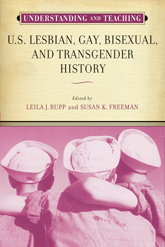
What are some of the ways to address this? I was brought face-to-face with this question at, believe it or not, this year’s annual convention of the American Historical Association. I participated in a session titled “Teaching Queer History,” along with Emily Hobson, Felicia Perez, Daniel Hurewitz, and Don Romesburg. The session was sparked by the recent publication of a book, Understanding and Teaching U.S. Lesbian, Gay, Bisexual, and Transgender History, edited by Leila Rupp and Susan Freeman.
The point of all of our presentations was that incorporating LGBT history into the school curriculum can make a significant difference. It opens the topic up for discussion. It “normalizes” the existence of LGBT people today by making same-sex love and gender-nonconformity important parts of the past. Less about finding “role models” in the past than about widening more generally the intellectual and cultural horizons of students, LGBT history can be a force for positive, progressive change, and especially in regard to a particularly vulnerable part of the LGBT population.
The book is a tremendous resource for teachers, both high school and college, looking for ways to include queer material into U.S. history courses. There are essays ranging from early America to the era of AIDS, essays exploring the resources available on the web and in the media, and essays in which teachers discuss their experience in the classroom. The book is especially timely because of the passage in California of the FAIR Act [Fair, Accurate, Inclusive, and Responsible Education Act] that mandates the inclusion of LGBT material in the curriculum. California’s leadership may encourage other states to follow suit, even as Understanding and Teaching U.S. Lesbian, Gay, Bisexual and Transgender History will help teachers across the country make the case that it can be done and then actually doing it.
History as a force for social change. I love the idea!
Comments