


Why People Who GayMarry Need Feminism
BY Claire Potter ON July 5, 2015
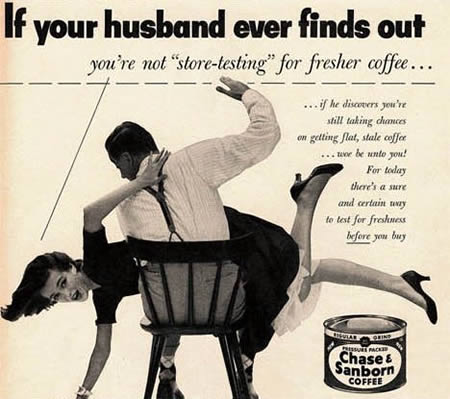
It was feminists, not queers, who first made the argument that marriage promoted inequality.
Several weeks ago, I was sitting in a coffee shop with M, a veteran of New York Radical Women, discussing the gay marriage case pending before the Supreme Court. We agreed that neither of us, as feminists, would have foreseen the emergence of marriage as a post-feminist civil rights issue. Our talk then turned to J, a prominent lesbian feminist who was rumored to have slept with nearly every radical feminist in the East back in the day.
M, a slim and bright-eyed married woman in her seventies, laughed. “J wanted me to leave my husband and run away with her,” she said with a smile that indicated she had been tempted. “I asked: `Are you ready to do equal child-care like he does?’ That ended that.”
My point is that the history of ideas about marriage is intertwined with a feminist intellectual past, but after the Supreme Court’s decision in Obergefell v. Hodges last Friday, it seemed that had been forgotten. The lingering, and often bitter, divisions among LGBT people about whether conventional forms of monogamy and marriage should convey special rights have their roots in this past. Like many radical feminists, anti-marriage queers reject marriage, and the increased state authority over private lives it represents, as oppressive. Conversely, like many liberal feminists, LGBT marriage advocates have viewed the right to wed as a sphere for conveying equality, as well as protection against multiple institutions — the state, schools, families of birth, financial institutions and hospitals — to name a few. Still other LGBT people wade between pro- and anti-marriage positions as most heterosexuals do, choosing marriage to advance their interests and please other people, while disregarding aspects of marriage ideology that they consider to be dated, ethically wrong or inconvenient.
The LGBT marriage wars have existed for at least two decades, but they erupted on queer academic social media after Obergefell. “Love wins!!” many crowed, as their queer Facebook friends rushed to the courthouse and posted marriage updates. For the anti-marriage crowd, “UGH!” was one of the more lighthearted responses: some critics were particularly angered by the tone of Justice Anthony Kennedy’s majority opinion, a document that idealized love, romance, coupledom and the importance of two-parent childrearing. Some in the queer anti-marriage camp reported being “sickened,” “despondent,” and “angry” after reading Kennedy’s words. Others, like Timothy Stewart-Winter, asked the organizations that achieved this milestone celebrate their victory by embracing the larger social justice agenda of an unfinished civil rights movement.

U-Haul tweeted its congratulations by riffing off the old joke about what lesbians do on the second date.
People who are not insiders to queer academia may be shocked by the animus marriage can provoke in LGBT circles. Both pro- and anti-marriage positions were activated in the 1980s, as newly radicalized queers confronted the limits of sexual liberation and identity politics. If AIDS, and the numerous vulnerabilities and inequalities it revealed, played a critical role in galvanizing the campaign on behalf of marriage, it impelled others to ask why citizenship rights were being withheld from those who refused to form “normal” monogamous families.
Michael Warner’s The Trouble with Normal (1999), the cover of which was decorated with little plastic grooms, argued that “homonormativity” not only undermined a queer social justice agenda, but presented a larger ethical problem for progressives by presenting marriage and other forms of normalization as a route to proper citizenship. One of many excellent books to come out of this intellectual moment was Elizabeth Freeman’s The Wedding Complex: Forms of Belonging in Modern American Culture (2002), which pointed to the numerous social longings and investments beyond the couple itself that marriage celebrations have satisfied over time. Yet too often academic critics of marriage have simply not spoken to the more progressive political and imaginative purposes that marriage has supported, particularly as a vehicle for supporting fragile citizenship. One feminist text that received very little attention by queer theorists, for example, was Ann DuCille’s The Coupling Convention: Sex, Text and Tradition in Black Women’s Fiction (1993). Here, duCille argued that marriage has not been a “a transhistorical ideal or a linear literary convention, but a sign of the times that shifts with the times, the place and the people.” (4)
Returning to my conversation with M in the coffee shop: although gay marriage, its proponents and its opponents, have dominated social media and the news, it is the intellectual history of feminism that may offer insights to LGBT people about how to enact this newly-won citizenship right. Calls for marriage rights, marriage reform, marriage resistance and women’s self-determination outside marriage were first articulated by public intellectuals like Angelina and Sarah Grimke, Harriet Jacobs, Ida B. Wells Barnett, Victoria Woodhull, Emma Goldman, and Margaret Sanger. As Leigh Ann Wheeler has pointed out in How Sex Became a Civil Liberty (2014), the ideas and practice of free love among American Civil Liberties Union founders, both women and men, laid the basis for embedding principles of free sexual expression, as well as sexual and gender liberation, into twentieth century civil rights law and social activism.
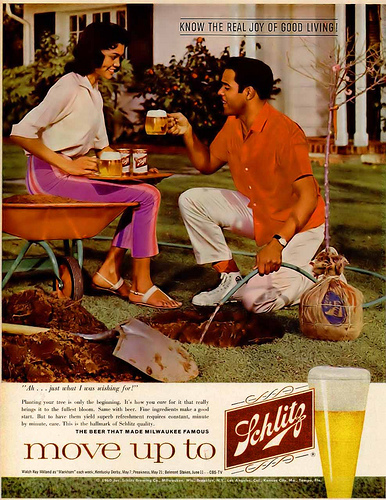
Af Betty Friedan noted, the ideal bourgeois marriage after World War II was full of well-chosen products, with wives as consumers-in-chief.
Second wave feminism targeted marriage for reform and revolution in its earliest days. Betty Friedan, who helped to found the National Organization for Women in 1966, is a classic example of a feminist marriage reformer who viewed sexism and gender roles within marriage, not the institution itself, as the central problem facing women in the United States. Although Friedan’s The Feminine Mystique (1963) critiqued marriage — its commercialism, its claims to romantic and sexual fulfillment that real women could never meet, and its function as an arena for unpaid labor — she saw these characteristics as reformable. In The Second Stage (1981), for example, Friedan argued that the nuclear family was “the new feminist frontier,” scrutinizing shifts of power that would make marriage and motherhood a realm for female fulfillment within heterosexuality. One might also look to early collections such as Toni Cade Bambara’s The Black Woman: An Anthology (1970), where numerous essays argue that it is sexism, not marriage, that prevented women from self-actualization in a loving relationship.
But many feminists, like many queers today, did not see marriage, heterosexuality or monogamy as reformable. For many, like Kate Millett, Charlotte Bunche, and Robin Morgan, leaving a marriage to become a lesbian became the ultimate feminist act. In Cheryl Clarke argued that lesbianism was “an act of resistance” to racism, capitalism and hetero-patriarchy. Many straight women in radical feminism, like Susan Brownmiller, Ti-Grace Atkinson, and Florence Kennedy, never married. Like political scientist and feminist theorist Jo Freeman, these second wave radical feminists saw marriage as an institution defined by unequal sex roles (something that is far from inconceivable in a same-sex marriage.)
For many radical feminists, to live outside of marriage and resist parenting was a fundamental step towards women’s liberation. Freeman’s “BITCH Manifesto,” written in the fall of 1968, declared that BITCH, a mythical organization was composed of “bitches” who “seek their identity strictly through themselves and what they do. They are subjects, not objects. They may have a relationship with a person or organization, but they never marry anyone or anything; man, mansion, or movement.” Like today’s radical queer critics, bitches embraced their role as “marginal beings in this society. They have no proper place and wouldn’t stay in it if they did.” Similarly, in Lesbian Nation: the Feminist Solution (1974), journalist Jill Johnston renounced her marriage and custody of her children as diametrically opposed to female self-actualization.
This sampling of ideas about marriage makes a larger point: that feminism was the starting point for queer critiques of marriage, and we might want to return to feminist theory as well as queer theory if LGBT people imagine that they will inhabit the institution differently and with better outcomes for adults and children. Obergefell offers a significant step forward for civil rights without being the endpoint of any history of women’s rights, gender equality or social justice agenda that is necessarily progressive or without contradiction. So now that the dust has settled, let’s celebrate equal rights without celebrating marriage as establishing gender or sexual equality; and without framing the LGBT pro-marriage coalition as particularly culpable for the promotion of social inequality. At this moment when marriage, and the legal right to parent, is expanding exponentially, we may or may not need more queer theory — but we need feminism more than ever.
This post appeared on July 2 at the S-USIH Blog.
Comments